Insights · Report · Industry · May 2026
CRM hygiene, fundraising ethics, beneficiary privacy, and funder reporting chains that keep mission impact visible without oversharing personal stories or breaking trust.

Nonprofits operate in a trust economy. Donors, grantmakers, volunteers, and program participants each share personal information under different expectations, yet that information frequently converges inside a single CRM instance with no structural separation. When a development officer pulls a list for a funder report, the export may include newsletter opt-in fields, case management notes, and volunteer availability flags that no one intended to share with that audience. The consequences range from regulatory fines to reputational damage that erodes the donor base over years.
This report presents a practical framework for classifying nonprofit data by purpose of collection, consent scope, and permissible use. It addresses the full lifecycle from intake to retention and deletion, covering donor files, grant deliverables, beneficiary records, and volunteer rosters. The recommendations draw on fieldwork with community development organizations, international relief agencies, and arts and education nonprofits navigating overlapping compliance regimes in 2026.
Data categorization is the foundational discipline. Every record entering the CRM should carry a purpose tag that maps to one of four domains: fundraising and stewardship, program delivery, grant reporting, and internal operations. Fields that serve multiple purposes require explicit dual-consent capture at the point of collection. Without this schema-level separation, teams resort to informal tribal knowledge about which columns are safe to include in which export, a practice that fails the moment a staff member leaves or a new intern joins the annual giving campaign.
Consent management for nonprofits lags behind the commercial sector despite comparable regulatory exposure. Organizations collecting stories, photographs, and health-adjacent data from vulnerable populations face obligations under GDPR, state biometric statutes, and sector-specific codes of conduct issued by bodies like the Fundraising Regulator and the Council on Foundations. A consent registry that timestamps each permission, links it to a specific communication channel and data use, and supports granular revocation is no longer optional for organizations processing records at any meaningful scale.
We can present findings in a working session, map recommendations to your portfolio and risk register, and help you prioritize next steps with clear owners and timelines.
Grant compliance demands precision that many organizations underestimate. Funders increasingly require metric attestations that trace from raw source tables through transformation logic to published outcomes. A report claiming 1,200 individuals received job training services must link to enrollment records, attendance logs, and completion certificates in a defensible chain. Building this lineage proactively, rather than reconstructing it at audit time, reduces staff hours and protects the organization from clawback risk when numbers come under scrutiny.
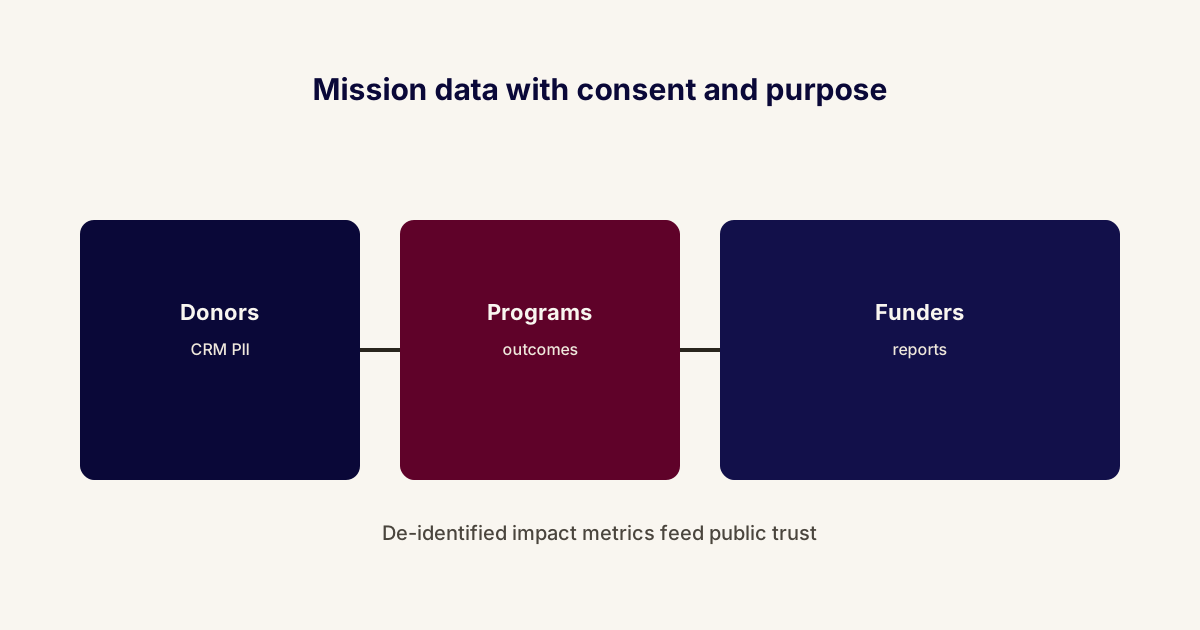
Outcome measurement frameworks like logic models and theories of change produce reporting hierarchies that intersect with data governance. Outputs feed into outcomes, which roll up into impact narratives shared with boards and the public. At each aggregation step, personally identifiable information should be stripped or pseudonymized. The reporting pipeline must enforce de-identification rules automatically rather than relying on manual redaction, which introduces both error and delay into the grant closeout process.
International programs introduce cross-border data transfer obligations that many nonprofits discover too late. A community health program in sub-Saharan Africa that stores beneficiary records in a U.S.-hosted SaaS platform triggers transfer mechanism requirements under both the originating jurisdiction and the hosting jurisdiction. Organizations must map lawful bases, processor locations, sub-processor chains, and breach notification timelines before selecting technology. Defaulting to a vendor's standard data processing agreement without reviewing jurisdictional adequacy decisions is a compliance gap that auditors are beginning to flag with regularity.
Fundraising analytics present a distinct privacy challenge. Wealth screening services, social media enrichment tools, and predictive giving models ingest data from sources that donors may not realize are being combined with their gift history. Prospect research teams should operate under a documented ethical framework that defines acceptable enrichment sources, prohibits covert profiling of vulnerable individuals, and establishes review thresholds for high-value cultivation strategies. Transparency about data practices builds long-term donor confidence even if it slows short-term prospect identification.
Access control within nonprofit CRMs deserves the same rigor applied in commercial environments. Role-based access should reflect functional responsibilities: program staff see case records, development staff see giving history, and finance staff see transaction reconciliation data. Seasonal adjustments matter because many nonprofits rely on temporary staff during campaigns and events. Provisioning and deprovisioning workflows tied to engagement start and end dates prevent credential sprawl that otherwise persists unnoticed for months.
Major gift officers represent a concentrated insider risk. Their effectiveness depends on deep relationship context, including family connections, philanthropic interests, health considerations, and estate planning intentions. This information carries significant sensitivity, and its misuse or leakage can cause irreparable harm to both the donor relationship and the organization's reputation. Logging access to high-value donor profiles, enforcing device management policies on mobile CRM applications, and executing thorough exit procedures when gift officers depart are controls that mirror best practices in commercial wealth management.
Vendor concentration in donation processing creates operational and compliance risk that boards must understand. Many nonprofits depend on a single payment processor for online giving, event ticketing, and recurring gift management. If that processor experiences a prolonged outage during a year-end campaign or a data breach that exposes donor payment credentials, the financial and reputational impact can be severe. Organizations should evaluate backup processing relationships, understand PCI DSS scope for their specific configuration, and confirm that their processor's incident response plan aligns with the nonprofit's own notification obligations.

Board reporting on data governance should move beyond anecdotal reassurance. Directors increasingly expect concise dashboards covering multi-factor authentication adoption rates, backup restoration test results, open vulnerability counts, and third-party risk assessment summaries. Presenting these metrics alongside program outcome data reinforces the message that operational resilience protects mission delivery. Boards that receive structured cyber reporting are better positioned to approve proportionate investments in security tooling and staff training.
Data retention policies in the nonprofit sector suffer from a hoarding instinct driven by legitimate concerns about longitudinal impact measurement. Organizations want to demonstrate ten-year outcomes, which conflicts with minimization principles embedded in modern privacy regulations. The resolution lies in tiered retention: keep aggregated, de-identified outcome data indefinitely for longitudinal analysis while purging identifiable records according to schedules aligned with funder requirements and applicable statute of limitations periods. Retention schedules should be encoded in system automation, not left as policy documents that no one enforces.
Incident response planning requires sector-specific considerations. A breach affecting beneficiary records, particularly in sensitive service areas like domestic violence support, refugee resettlement, or addiction recovery, carries physical safety implications that commercial breach playbooks do not address. Notification decisions must weigh regulatory timelines against the risk that notifying certain individuals at known addresses could expose them to harm. Nonprofit incident response plans should include consultation protocols with legal counsel experienced in both privacy law and the specific vulnerability of the affected population.
Emerging regulatory trends point toward increased scrutiny of nonprofit data practices. State attorneys general are expanding enforcement of charitable solicitation statutes to include data handling requirements. The IRS has signaled interest in whether organizations claiming tax-exempt status maintain governance controls proportionate to the sensitivity of the data they hold. Sector self-regulation through accreditation bodies and donor bill-of-rights frameworks provides a proactive path, but only if organizations treat those standards as operational mandates rather than aspirational statements.
Technology selection should prioritize platforms that support field-level permissions, audit logging, and automated de-identification pipelines. Many nonprofit CRMs now offer configurable consent tracking modules, though implementation quality varies. Organizations evaluating new systems should test whether consent records propagate correctly to downstream integrations, whether access logs capture query-level detail, and whether the de-identification function handles edge cases like small cohort sizes that allow re-identification through inference. A proof-of-concept focused on these three capabilities provides more procurement confidence than feature comparison spreadsheets.
Appendices to this report include sample consent language variants for newsletter subscriptions versus research participation, a lightweight data protection impact assessment template sized for small development shops, a role-based access matrix template for CRM configuration, and a board reporting dashboard specification. These artifacts are designed to be adopted incrementally, starting with consent capture and data categorization before layering on automated lineage and advanced analytics governance. Organizations that begin with classification discipline find that every subsequent control deploys faster and with greater staff adoption.