Insights · Report · Data & AI · Apr 2026
Validation depth, independent review, drift monitoring, and retirement evidence that align ML operations with supervisory expectations without freezing iteration.

Model risk management frameworks in banking and insurance were designed for an era of logistic regressions and manually calibrated scorecards. Machine learning models introduce nonlinearity, feature interaction complexity, and training data dependencies that traditional validation playbooks were not built to assess. Regulators have not retreated from existing expectations. SR 11-7, SS1/23, and comparable supervisory letters apply to ML-based decisions with equal force, even as the underlying techniques evolve rapidly across the financial services sector.
The central tension for model risk teams is straightforward but difficult to resolve in practice. ML models improve prediction accuracy, enable faster decisioning, and unlock new product segments, yet the same properties that make them powerful also make them harder to explain, validate, and monitor over time. Institutions that freeze their model inventory to avoid this complexity lose competitive ground, while those that deploy without proper controls invite supervisory scrutiny and potential consumer harm.
Effective model risk management for machine learning starts well before the first line of training code. Every model should originate with a decision-use statement that specifies the business process it serves, the population it scores, the actions triggered by its output, and the consequences of an incorrect prediction. This statement anchors all downstream validation, monitoring, and retirement criteria, ensuring that technical decisions remain firmly connected to business risk appetite throughout the model lifecycle.
Data governance is inseparable from model governance in modern ML operations. Feature engineering pipelines draw from data warehouses, streaming sources, third-party enrichment feeds, and increasingly from unstructured text or image repositories. Each source introduces lineage risk, quality risk, and legal risk related to consent, permissible purpose, and cross-border transfer restrictions. MRM programs must require a signed-off data dictionary for every model that documents source provenance, refresh cadence, missing-value treatment, and any proxies that could introduce fair lending or discrimination exposure.
Validation depth should scale with materiality. A fraud detection model influencing millions of daily transactions warrants deeper scrutiny than an internal workflow routing classifier. Tiering models by financial exposure, customer impact, and regulatory sensitivity allows validation teams to allocate effort proportionally. For high-tier ML models, validation should include replication of training pipelines, independent holdout testing, sensitivity analysis on key features, and benchmarking against interpretable alternatives to quantify the accuracy gains that justify the added complexity.
We can present findings in a working session, map recommendations to your portfolio and risk register, and help you prioritize next steps with clear owners and timelines.
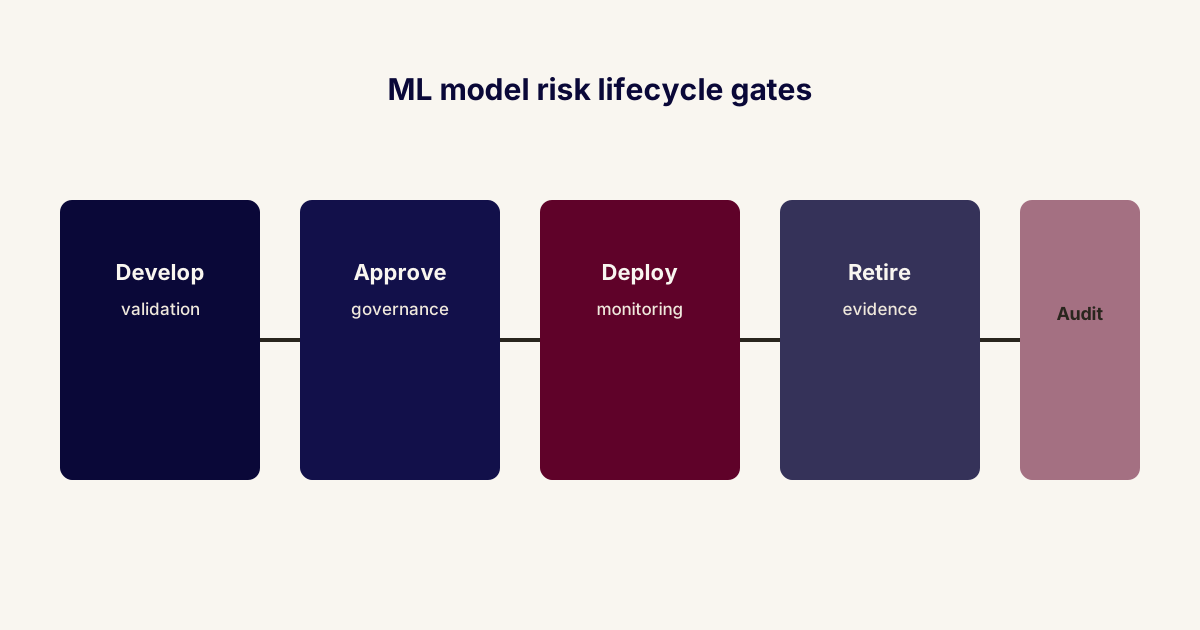
Independent review does not require adversarial dynamics between model development and validation teams. The most effective programs embed reviewers early in the development cycle, granting access to experiment tracking logs, feature importance analyses, and evaluation harnesses. This collaborative posture accelerates the review timeline without compromising independence, because formal findings and escalation authorities remain clearly separated from advisory participation. Timeboxing review cycles prevents models from languishing in validation queues while business opportunities expire.
Explainability requirements vary by use case and jurisdiction. Consumer-facing credit decisions in the United States require adverse action notices that cite specific reasons, making post-hoc explanation tools like SHAP and LIME operationally essential rather than academic exercises. Internal capital models may face lighter explainability mandates but still require documentation sufficient for supervisory challenge. Teams should select explanation methods during model design, not retrofit them after deployment, to ensure that explanations remain faithful to the model's actual decision logic.
Fairness testing belongs in the development stage, not as a compliance afterthought. Disparate impact analysis across protected classes, intersectional subgroup evaluation, and bias mitigation techniques such as reweighting or threshold adjustment should be incorporated into the model selection process. Documenting fairness metrics alongside accuracy metrics provides supervisors and internal audit with evidence that the institution considered equity outcomes before deployment, rather than discovering disparities through complaint-driven reviews months after launch.
Deployment governance connects model risk management to production reliability engineering. Version pinning ensures that the exact model artifact reviewed by validation is the artifact running in production. Canary releases allow new model versions to serve a small traffic fraction while monitoring key performance indicators before full rollout. Automated rollback triggers, tied to predefined accuracy or stability thresholds, provide a safety net that satisfies both operational resilience requirements and regulatory traceability expectations.
Change management discipline distinguishes mature MRM programs from reactive ones. Every model change, whether a full retrain, a feature addition, a hyperparameter adjustment, or an infrastructure migration, should be classified by its risk impact and routed through an appropriate approval pathway. Minor recalibrations may proceed with model owner sign-off alone, while material changes require validation team review and committee notification. This tiered approach prevents bottlenecks without sacrificing oversight on consequential modifications.
Monitoring is where most ML model risk programs have the widest gap between intention and execution. Statistical drift detection, comparing live scoring distributions against training or validation baselines, forms the foundation. Population stability indices, Kolmogorov-Smirnov tests, and divergence metrics applied to both input features and output scores can surface distributional shifts before they degrade model performance. Alert thresholds should be calibrated empirically against historical drift episodes to minimize false alarms that erode trust in monitoring systems.
Data quality drift and operational drift deserve equal attention alongside statistical monitoring. Upstream schema changes, API latency spikes, third-party feed outages, and encoding inconsistencies can alter feature distributions in ways that standard statistical tests may not immediately flag. Monitoring frameworks should track data completeness, timeliness, and schema conformance as first-class signals. Alerts must route to model owners with actionable runbooks rather than generic operations queues, so that the team with context can diagnose and remediate issues efficiently.

Third-party and vendor-hosted models demand explicit accountability structures within the MRM framework. Many institutions now consume credit bureau scores, fraud consortium signals, and cloud-based ML services where the model logic is opaque and retraining schedules fall outside institutional control. Contracts should specify retraining notification obligations, performance reporting frequency, incident disclosure timelines, and the right to export model artifacts or scoring logs for independent analysis. When a vendor sunsets a model or changes pricing, the institution must have a documented fallback strategy.
Open-source foundation models and pretrained embeddings introduce a distinct risk profile that MRM teams cannot ignore. Licensing terms, training data provenance, and version stability vary widely across repositories. Programs should maintain an approved model registry that catalogs permissible open-source components, tracks version updates, and flags models trained on datasets with known bias or intellectual property concerns. Treating open-source components with the same rigor as vendor-supplied artifacts prevents a governance blind spot that regulators are increasingly scrutinizing.
Model retirement is a formal lifecycle stage that many programs underinvest in. When a model is decommissioned, production artifacts, training data snapshots, validation reports, and monitoring history must be archived for the supervisory retention window applicable in the institution's jurisdiction. Customer impact analysis should document whether decisions previously informed by the model will revert to manual processes, alternative models, or updated automated systems. A clean retirement record protects the institution during retrospective supervisory examinations and audit cycles.
Governance committee structure should reflect the institution's model inventory complexity. Smaller institutions with fewer than fifty models may operate with a single model risk committee that reviews all tiers. Larger organizations benefit from a delegated authority structure where a senior committee sets policy and risk appetite while tier-specific subcommittees handle routine approvals and issue tracking. Agendas should allocate dedicated time for portfolio-level risk reporting, not only individual model reviews, to surface concentration risk and correlated failure scenarios.
Mapping MRM responsibilities to agile delivery teams requires a purpose-built RACI matrix. Traditional organizational charts that assign accountability to a single model owner break down when cross-functional squads share development, deployment, and monitoring duties. A modern RACI should identify accountable individuals for each lifecycle stage, clarify escalation paths for material findings, and specify which team member signs off on regulatory documentation. Aligning this matrix with sprint ceremonies ensures that risk activities integrate naturally into delivery cadence.
Supervisory expectations will continue to evolve as ML adoption accelerates across credit underwriting, claims adjudication, anti-money laundering, and customer engagement. Institutions that embed model risk management into the engineering workflow, rather than layering it on as periodic audit exercises, will move faster with less regulatory friction. This report provides a lifecycle framework, validation tiering criteria, monitoring architecture, and governance templates that enable responsible ML deployment without freezing the innovation that competitive markets demand.