Insights · Report · Security · May 2026
Fleet management networks, pit connectivity, vendor remote access, and safety interlocks when autonomous trucks share roads with human operators and loaders.

Autonomous haulage systems represent one of the largest concentrations of operational technology risk in modern mining. These fleets depend on GPS positioning, radar perception, wireless communications, and centralized dispatch software to move hundreds of tonnes of material per cycle. When cybersecurity controls fail, the consequences extend beyond data loss into physical safety incidents, production halts, and environmental exposure. This report examines the threat vectors, architectural controls, and governance frameworks that mining operators should prioritize in 2026.
The attack surface of an autonomous haulage operation spans multiple technology layers. At the vehicle level, perception sensors, positioning receivers, and onboard compute platforms each present distinct compromise vectors. At the network level, pit-wide mesh radios, backhaul links, and satellite fallback channels create lateral movement opportunities for adversaries. At the enterprise level, connections between fleet management systems and mine planning, dispatch, and ERP platforms extend the blast radius of any successful intrusion into production scheduling and financial reporting.
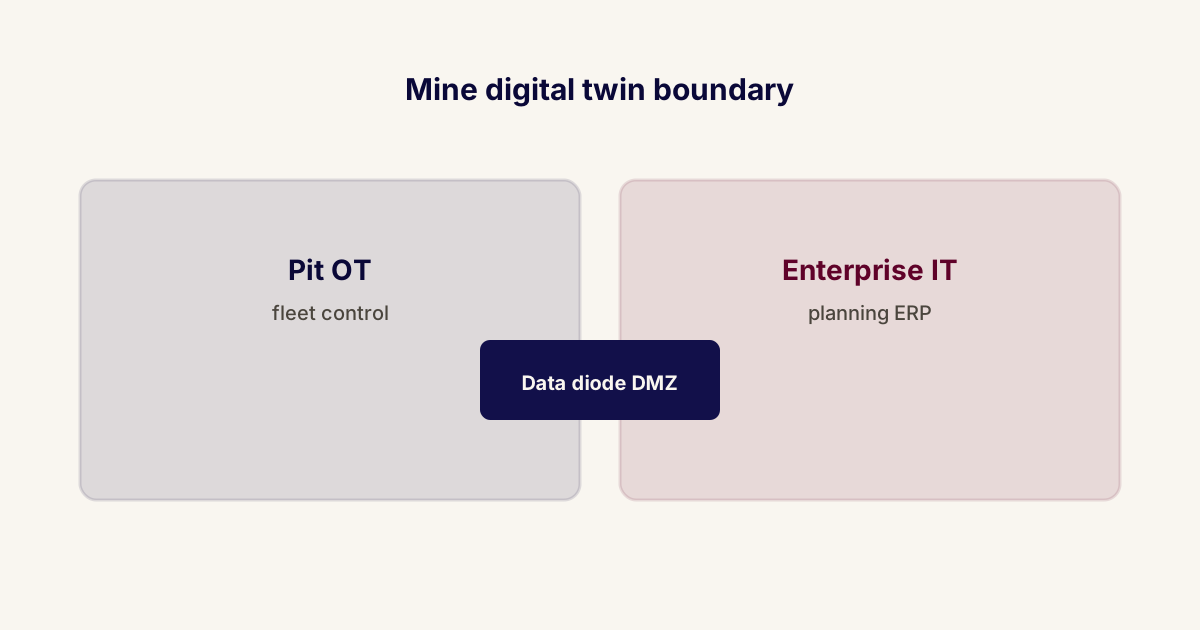
Fleet management networks form the central nervous system of autonomous haulage. These networks carry real-time telemetry from every truck, load position assignments from dispatch, collision avoidance coordination messages, and health diagnostics for predictive maintenance. A flat network architecture that places all of these functions on a single broadcast domain creates unacceptable risk. Segmentation into distinct zones for safety-critical messaging, operational telemetry, and enterprise data exchange is the foundational control upon which every subsequent security measure depends.
Pit connectivity presents unique challenges that surface-level industrial environments rarely encounter. Mine pits are dynamic, with haul roads, ramps, and dump locations shifting as extraction progresses. Wireless coverage must follow the evolving geometry of the pit, requiring frequent radio repositioning and signal surveys. Mesh networking topologies offer resilience against single-point failures, but they also create complex routing paths that complicate traffic inspection. Operators should deploy dedicated monitoring probes at mesh gateway nodes to detect anomalous traffic patterns without adding latency to safety-critical message paths.
We can present findings in a working session, map recommendations to your portfolio and risk register, and help you prioritize next steps with clear owners and timelines.
Vendor remote access represents one of the most exploited entry points in industrial cybersecurity, and autonomous haulage is no exception. OEM engineers routinely require connectivity to onboard vehicle systems, dispatch servers, and perception algorithm tuning interfaces. Without controls, these sessions grant broad access to safety-critical infrastructure from locations outside the mine operator's security perimeter. Just-in-time credential provisioning, mandatory session recording, and explicit approval workflows tied to maintenance windows reduce this exposure to a manageable level.
Zero trust principles should govern every remote connection into the autonomous haulage environment. Rather than granting network-level access through VPN tunnels that expose entire segments, operators should deploy application-level gateways that authenticate each session, authorize specific actions, and terminate access automatically when the maintenance window closes. Multi-factor authentication, device posture checks, and geolocation validation add defense layers that compensate for the inherent risk of connecting external parties to safety-critical systems.
Over-the-air firmware and software updates for autonomy stacks introduce a critical dependency on supply chain integrity. A compromised update package delivered to an entire fleet can disable collision avoidance, corrupt positioning algorithms, or introduce subtle behavioral drift that degrades haulage efficiency before triggering safety alarms. Signed firmware images, verified against a hardware root of trust on each vehicle, prevent tampering during distribution. Staged rollout policies that update a small subset of the fleet first, with automated rollback triggers tied to telemetry deviation thresholds, contain the blast radius of any defective or malicious update.
Safety interlock systems occupy a privileged position in the autonomous haulage architecture. These controllers enforce geofencing boundaries, speed limits on grades, proximity exclusion zones around human-operated equipment, and emergency stop commands. Because interlocks serve as the last line of defense against physical harm, they must operate on isolated networks with independent power supplies and hardened communication channels. Any architecture that routes interlock signals through shared infrastructure with non-safety traffic violates the fundamental principle of safety-critical independence.
Mixed fleet operations, where autonomous trucks share haul roads with human-operated loaders, dozers, and water carts, compound the cybersecurity challenge. Collision avoidance systems must exchange position and intent messages between autonomous and manually driven equipment in real time. The integrity of these messages is paramount. Spoofed or delayed position reports could place personnel in the path of a 400-tonne autonomous truck. Message authentication codes, sequence numbering, and freshness timestamps provide cryptographic assurance that collision avoidance data has not been altered or replayed.
Threat modeling for autonomous haulage should follow a structured methodology adapted from both IT and industrial control system frameworks. The MITRE ATT&CK for ICS matrix provides a useful starting taxonomy, mapping adversary tactics from initial access through lateral movement to impact. Mining operators should extend this baseline with domain-specific scenarios including GPS spoofing, radio jamming, dispatch manipulation, and safety interlock bypass. Tabletop exercises that walk through these scenarios with operations, maintenance, IT, and safety teams reveal control gaps that technical assessments alone cannot surface.

Regulatory expectations for cybersecurity in autonomous mining are maturing rapidly across major jurisdictions. Western Australia, Queensland, and parts of Canada now require operators to demonstrate cyber risk management as a component of safety case submissions. Insurers underwriting autonomous operations increasingly request evidence of network segmentation, access controls, and incident response capabilities before issuing or renewing policies. Operators who treat cybersecurity solely as a compliance exercise will find their programs perpetually reactive, addressing audit findings instead of preventing incidents.
Insurance and regulator relationships improve measurably when operators present documented cyber programs alongside traditional geotechnical and mechanical risk registers. Combining cyber risk into the broader operational risk framework signals organizational maturity and provides actuarial data that supports favorable premium negotiations. Operators should maintain evidence packages that include network architecture diagrams, access control policies, vulnerability scan results, incident response playbooks, and records of tabletop exercises conducted within the prior twelve months.
Workforce culture is a force multiplier for cybersecurity controls. Operators and maintenance personnel who interact with autonomous haulage systems daily are often the first to notice anomalies, from unexpected truck behavior to unfamiliar devices connected in the pit. A reporting culture that encourages these observations without blame accelerates threat detection beyond what automated monitoring can achieve alone. Blameless incident reviews, modeled on practices from aviation and high-reliability organizations, transform near-miss reports into actionable intelligence that strengthens preventive controls.
Training programs should address the specific intersection of cybersecurity and autonomous operations. General cybersecurity awareness modules designed for office environments fail to resonate with mine site personnel. Scenario-based training that walks operators through the indicators and consequences of a compromised dispatch system, a spoofed GPS signal, or a failed safety interlock update builds practical recognition skills. Refresher exercises conducted quarterly maintain vigilance across shift rotations and seasonal workforce changes common in remote mining regions.
Incident response planning for autonomous haulage must account for the physical consequences of cyber events. Playbooks should define clear escalation criteria for transitioning from a cybersecurity investigation to a full safety stand-down. Pre-staged manual override procedures, backup communication channels independent of the primary network, and designated assembly points for personnel working near autonomous equipment ensure that human safety remains the overriding priority during any cyber incident. Response teams should rehearse these transitions under realistic conditions at least twice annually.
Appendices to this report include sample vendor security questionnaires tailored for autonomy providers, covering firmware signing practices, vulnerability disclosure timelines, and incident notification obligations. Additional materials provide tabletop exercise outlines for loss-of-supervisory-link scenarios, GPS denial events, and coordinated ransomware attacks targeting both IT and OT environments simultaneously. These templates offer a practical starting point for operators building or maturing cybersecurity programs around autonomous haulage operations in any jurisdiction.