Insights · Report · Industry · Apr 2026
DRM license flows, CDN geo policy, watermarking telemetry, and partner syndication controls for studios and platforms competing with credential sharing and restreaming abuse.

Streaming economics hinge on a delicate balance between content availability, territory licensing, and subscriber monetization. As global platforms expand into new markets, windowing strategies and device limits become primary levers for revenue optimization. Piracy exploits every gap in this chain, from credential sharing and unauthorized restreaming to UHD content ripping. Each vector demands a distinct detection mechanism and legal response framework. This brief provides a technical and operational map of the anti-piracy infrastructure studios and platforms must deploy to protect streaming revenue in 2026.
The threat landscape has shifted dramatically over the past three years. Casual password sharing, once tolerated as a growth strategy, now represents measurable revenue leakage as platforms mature and subscriber acquisition costs rise. Meanwhile, organized piracy operations run sophisticated restreaming panels that aggregate stolen credentials, relay live sports and premium content, and monetize through advertising or subscription fraud. UHD ripping syndicates leverage HDCP stripping hardware and screen capture exploits to distribute near-original-quality copies within hours of release.
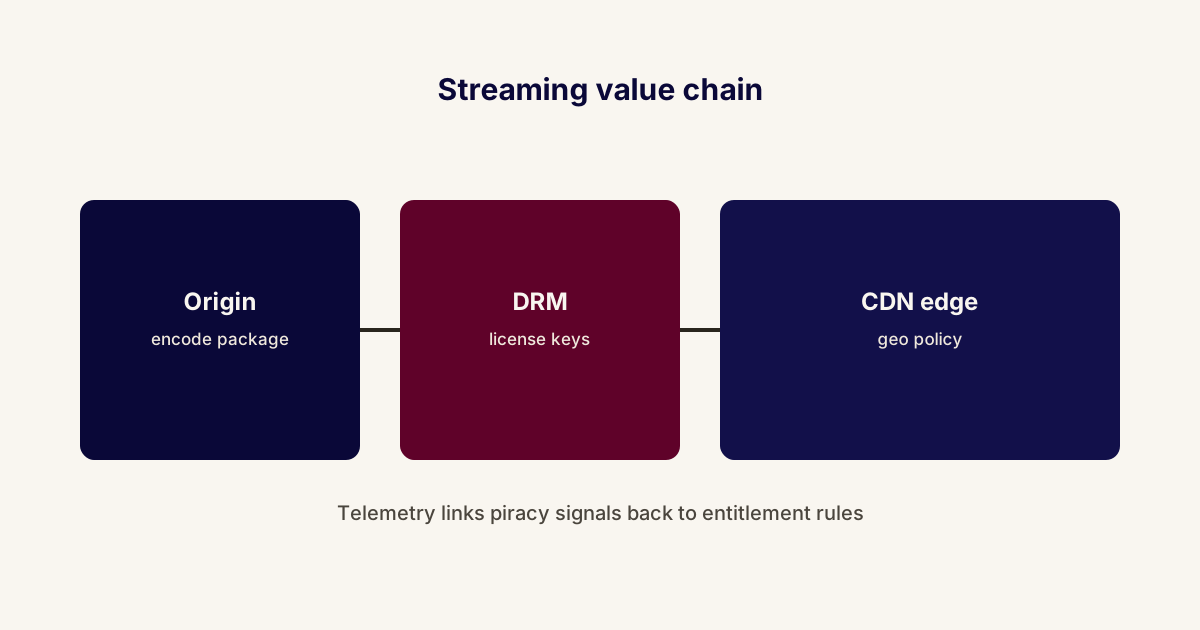
Content protection begins at the ingest and encoding stage. Adaptive bitrate packaging with Common Encryption ensures that a single encrypted asset can serve multiple DRM systems without redundant storage. Studios should mandate AES-128 CTR or CBCS mode encryption at all quality tiers, including lower resolution renditions that pirates often target as easier extraction points. Packaging pipelines must integrate directly with key management services to eliminate any window where unencrypted mezzanine files remain accessible to unauthorized processes.
Multi-DRM orchestration through Widevine, FairPlay, and PlayReady remains the industry standard for cross-device coverage. License servers must enforce business rules including concurrent stream limits, device registration caps, offline download expiry, and territory restrictions at the point of license issuance. Latency in license acquisition directly impacts playback start time, so caching strategies for license tokens require careful design. Security teams should rotate content encryption keys on a per-title or per-window basis rather than relying on static keys across the entire catalog.
CDN edge policy enforcement translates contractual territory rights into real-time access decisions. IP geolocation databases must be updated at least daily to account for VPN exit node churn and IP block reassignments. Edge logic should combine IP geolocation with device locale signals, billing country, and GPS data where available to build a multi-signal territory confidence score. Single-signal geo-blocking is trivially bypassed by consumer VPN services and should not be treated as sufficient for rights compliance.
We can present findings in a working session, map recommendations to your portfolio and risk register, and help you prioritize next steps with clear owners and timelines.
Forensic watermarking embeds an imperceptible, unique identifier into each playback session's video and audio streams. When pirated content surfaces online, extraction of the embedded watermark reveals the specific subscriber account and device responsible for the leak. A/B variant watermarking, which alternates slightly different encoded segments across sessions, provides a detection mechanism that survives transcoding, cropping, and resolution downscaling. Studios increasingly require platform partners to implement forensic watermarking as a contractual prerequisite for premium content licensing.
Session fingerprinting extends watermarking by correlating playback metadata with behavioral signals. Device attestation APIs from operating system vendors verify that the client environment has not been tampered with, while concurrent session monitoring detects credential sharing in near real time. Token binding ties each playback session to a specific device and network context, making stolen tokens unusable on unauthorized hardware. These layered signals feed into risk scoring engines that trigger stepped enforcement responses based on confidence thresholds.
Anti-piracy telemetry inherently collects data that can identify households and viewing habits. Privacy engineering teams must participate in the design of every detection pipeline to ensure compliance with GDPR, CCPA, and emerging regulations across Latin America and Southeast Asia. Data minimization principles should govern retention policies, pseudonymization should be applied at the point of collection, and purpose limitation controls should prevent anti-piracy signals from being repurposed for advertising targeting or content recommendation without explicit consent.
Credential sharing detection has evolved from simple concurrent stream counting to sophisticated household modeling. Machine learning classifiers analyze login location patterns, device rotation frequency, network diversity, and viewing behavior consistency to distinguish legitimate multi-device usage from systematic sharing. Platforms that have deployed household verification programs report conversion rates between eight and fifteen percent among flagged accounts, representing significant incremental revenue. Graduated enforcement, beginning with gentle prompts and escalating to session termination, balances revenue recovery with subscriber retention.
Free ad-supported streaming television channels and syndication partnerships multiply the surface area for content leakage. Each partner integration introduces a new trust boundary where content, metadata, and entitlement decisions cross organizational lines. Content owners must enforce scoped API credentials with fine-grained permission models that restrict partners to specific titles, territories, and time windows. Audit logging of every content access and delivery event provides the forensic trail necessary when disputes or breach investigations arise.
Partner security assessments should follow a structured framework covering authentication mechanisms, transport encryption, content storage policies, and incident response capabilities. Contractual takedown service level agreements must specify maximum response times for removing unauthorized content once notification is provided. Partners operating in jurisdictions with weaker intellectual property enforcement require additional technical controls including short-lived access tokens, server-side ad insertion to prevent content extraction, and real-time consumption reporting that flags anomalous distribution patterns.

Effective anti-piracy programs operate as cross-functional fusion cells linking trust and safety, legal, engineering, and business intelligence teams. This operational model enables rapid triage of detected incidents with coordinated technical, legal, and public relations responses. Automated monitoring scans social media platforms, messaging applications, and known piracy forums for unauthorized redistribution. When infringing content is identified, automated DMCA takedown workflows reduce the interval between detection and removal, limiting the audience reached by unauthorized copies.
Takedown operations scale through integration with rights enforcement platforms that maintain relationships with major hosting providers, social media networks, and search engines. Batch takedown APIs enable the removal of thousands of infringing URLs within hours rather than days. Search engine delisting requests complement hosting takedowns by reducing discoverability of pirated content. Repeat infringer tracking across platforms and jurisdictions supports escalated legal action including injunctions and damages claims against the most persistent and commercially motivated piracy operations.
Anti-piracy program effectiveness requires a structured measurement framework. Key performance indicators should include mean takedown latency from detection to removal, repeat infringer recurrence rate, estimated audience reached before takedown, and where measurable, incremental revenue attributed to enforcement actions. Executive dashboards should present trend data at monthly and quarterly intervals, enabling rights holders to assess return on investment during quarterly business reviews and to adjust enforcement resource allocation based on demonstrated impact.
Customer experience friction introduced by anti-piracy measures deserves explicit governance at the product leadership level. Aggressive device verification, frequent re-authentication, and restrictive concurrent stream policies reduce piracy but increase subscriber churn and support ticket volume. A/B testing frameworks should measure satisfaction scores, complaint rates, and net promoter impact alongside fraud reduction metrics. Products that optimize solely for security without weighing user experience risk pushing legitimate subscribers toward pirated alternatives that impose fewer barriers to access.
Cloud egress and peering costs represent a significant share of streaming infrastructure spend, and anti-piracy controls must account for their economic impact. Cache efficiency strategies that serve long-lived segments without validating entitlements at the edge create openings for unauthorized access. Token-authenticated segment delivery, where each CDN request carries a short-lived, geo-scoped authorization token, closes this gap while preserving cache hit ratios. Origin shield architectures further reduce egress costs without compromising per-request entitlement verification.
Looking ahead, studios and platforms should prioritize three strategic investments. First, adopt multi-signal territory verification that moves beyond IP-only geolocation to combine device, billing, and behavioral indicators. Second, deploy forensic watermarking as a baseline requirement across all premium content tiers. Third, establish cross-functional anti-piracy fusion cells with clearly defined escalation paths and measurable performance targets. Appendices to this brief include RFP evaluation criteria for DRM and watermarking vendors, CDN geo-policy rule templates, and sample executive dashboards suitable for rights holder quarterly business reviews.