Insights · Report · Security · Mar 2026
How enterprises are packaging SD-WAN, SSE, and identity into managed services, and what procurement should verify before signature.

Secure Access Service Edge, commonly abbreviated SASE, has evolved from a Gartner-coined marketing category into an operational imperative for enterprises managing hybrid workforces. The original vision of a single-vendor convergence of networking and security delivered from the cloud rarely survives contact with regulated environments, multi-cloud architectures, and brownfield network estates. This report examines how organizations are packaging SD-WAN, Security Service Edge, and identity governance into managed service engagements, and identifies the procurement, architectural, and operational considerations that separate successful deployments from costly rework.
The strongest SASE programs begin by acknowledging a foundational truth: no single provider excels at every layer. Carriers bring global network reach and last-mile diversity. Cloud security vendors deliver inspection depth, threat intelligence freshness, and policy granularity. Internal network operations centers retain institutional knowledge of application dependencies, change windows, and escalation paths. Effective managed SASE contracts establish an explicit RACI matrix across these three parties, assigning unambiguous ownership for provisioning, incident response, policy changes, and capacity planning.
Control plane ownership is the single most consequential architectural decision in a managed SASE deployment. The control plane governs policy distribution, certificate lifecycle management, tunnel orchestration, and configuration versioning. When enterprises delegate control plane operations entirely to the managed service provider without retaining read access to policy state and change audit logs, they sacrifice the ability to validate security posture independently. The most resilient contracts require providers to expose a read-only API to the current policy configuration and every change event.
Data plane service level agreements require equal specificity but address different concerns. Latency, jitter, packet loss, and availability targets must be defined per traffic class and per geographic corridor, not as global averages. A managed SASE provider guaranteeing 99.95 percent availability across all points of presence may still deliver unacceptable performance on a critical corridor between a regional headquarters and a specific cloud region. Procurement teams should insist on corridor-level SLA appendices tied to financial penalties.
We can present findings in a working session, map recommendations to your portfolio and risk register, and help you prioritize next steps with clear owners and timelines.
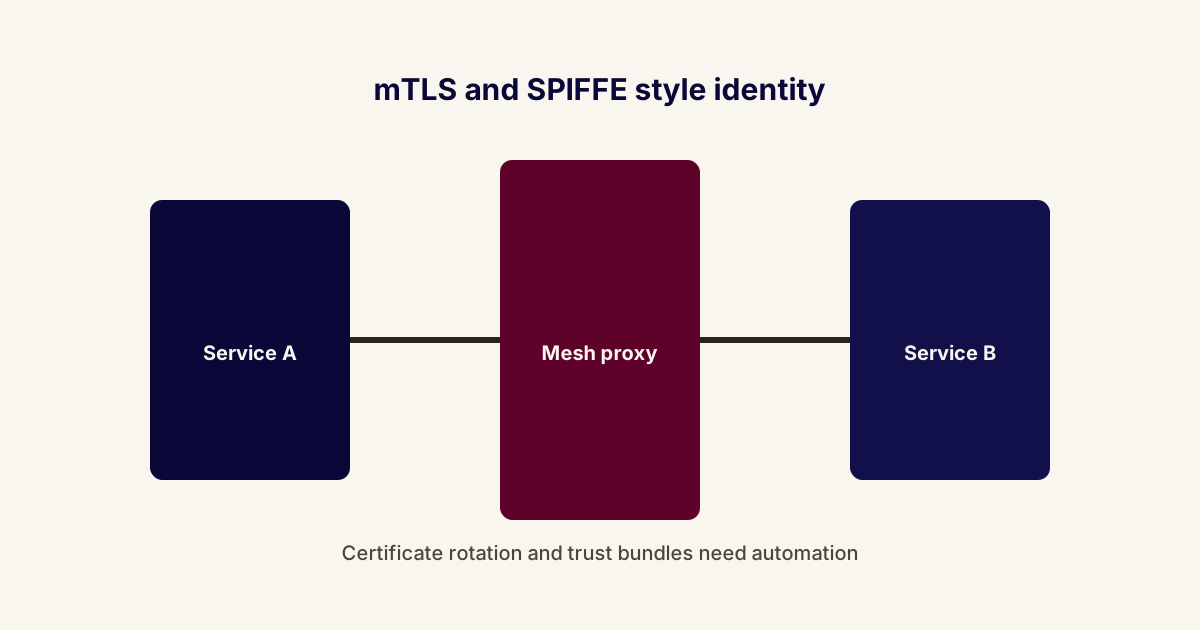
SD-WAN serves as the network foundation of any SASE deployment. Application-aware routing, dynamic path selection across MPLS, broadband, and cellular links, and centralized orchestration reduce the operational burden of managing distributed branch connectivity. Managed SD-WAN offerings vary significantly in their support for custom application signatures, bandwidth allocation policies, and integration hooks for third-party security inspection. Organizations should evaluate orchestration API maturity alongside headline throughput claims when shortlisting providers.
Security Service Edge consolidates secure web gateway, cloud access security broker, and zero trust network access capabilities into a unified, cloud-delivered security stack. SSE evaluation demands testing against real production traffic patterns rather than reliance on vendor feature matrices. Decryption throughput under mixed TLS 1.2 and 1.3 traffic, false positive rates for data loss prevention policies, and latency overhead introduced by inline inspection at regional points of presence are metrics that only proof-of-concept deployments can reliably quantify.
Zero trust network access for partner and contractor populations represents one of the highest-value early wins in a SASE program. Legacy VPN concentrators grant broad network-level access once authentication succeeds, exposing lateral movement paths that advanced threat actors routinely exploit. ZTNA replaces this model with identity-aware, application-specific micro-tunnels that enforce least-privilege access continuously. For third-party users who access only two or three applications, ZTNA eliminates unnecessary network exposure while simplifying onboarding and offboarding workflows.
Coexistence with legacy VPN infrastructure is a brownfield reality that most SASE roadmaps underestimate. Migration from traditional VPN to ZTNA cannot follow a big-bang approach without introducing unacceptable business risk. The recommended pattern involves parallel operation, where ZTNA handles new application onboarding and low-risk user segments while the VPN continues to serve legacy thick-client applications and populations with complex split-tunnel requirements. Traffic steering rules at the endpoint agent determine which path each session follows during the transition period.
Operational technology adjacent sites introduce constraints that challenge standard SASE assumptions. Manufacturing floors, energy grid substations, healthcare facilities with connected medical devices, and logistics warehouses with real-time inventory scanners all require deterministic network behavior. Always-on encrypted tunnels that introduce variable latency are not acceptable in environments where millisecond jitter can disrupt programmable logic controller timing or patient monitoring telemetry. SASE architectures must accommodate local breakout with compensating security controls for these sites.
Identity maturity is the prerequisite that most organizations underinvest in before launching a SASE program. SASE policy decisions depend on reliable signals about who the user is, what device they are using, where they are connecting from, and what application they are requesting. If the identity provider cannot furnish device posture attributes, group membership claims refresh with unacceptable lag, or conditional access policies remain rudimentary, the SASE enforcement layer lacks the context needed to make nuanced access decisions. Identity readiness assessments should precede any SASE procurement.
Managed service engagement models fall along a spectrum from co-managed to fully managed. In a co-managed arrangement, the enterprise retains policy authoring authority while the provider handles infrastructure provisioning, monitoring, and incident first response. Fully managed models delegate both policy and infrastructure operations, which suits organizations with limited internal security engineering capacity but demands rigorous governance frameworks. The choice should reflect internal team maturity, regulatory requirements for control retention, and the organization's appetite for operational dependency.

The SASE maturity ladder presented in this outlook provides a four-phase sequencing model. Phase one focuses on SD-WAN consolidation, rationalizing branch connectivity and establishing centralized orchestration. Phase two introduces SSE pilot deployments for a defined user population and application set. Phase three extends ZTNA to partner and contractor segments while decommissioning legacy VPN capacity. Phase four unifies the policy plane, enabling cross-domain policies that reference network context, user identity, and device posture in a single rule evaluation.
Digital experience monitoring and security event correlation form the observability foundation for managed SASE operations. Endpoint-to-application synthetic testing reveals latency degradation before users report productivity impact. Network flow telemetry correlated with security inspection logs enables rapid root cause isolation when connectivity or access failures occur. A single pane of glass across SD-WAN performance, SSE inspection verdicts, and ZTNA session state remains aspirational for most deployments, but consolidating telemetry into a common data lake with shared correlation identifiers is an achievable intermediate step.
Total cost of ownership modeling for managed SASE must account for several categories that procurement teams frequently overlook. Egress charges at cloud security inspection points, premium support tiers required to meet response time SLAs, custom policy development fees for non-standard application signatures, and per-user licensing tiers that escalate with feature enablement all contribute to costs that exceed headline per-site or per-user pricing. A three-year TCO model that includes migration costs, parallel running expenses, and projected user growth provides a more honest comparison against the incumbent architecture.
Vendor lock-in risk in managed SASE engagements is substantial and often underappreciated. Proprietary endpoint agents, policy languages without export capabilities, vendor-specific telemetry formats, and tunnel orchestration protocols that preclude multi-vendor failover all increase switching costs over time. Mitigation strategies include contractual requirements for policy export in open formats, retention of raw telemetry data in customer-owned storage, and periodic validation that critical security policies can be reconstituted on an alternative platform within a defined recovery window.
Data sovereignty and inspection jurisdiction deserve explicit contractual treatment. When user traffic routes through cloud security inspection points located in foreign jurisdictions, regulatory exposure may arise under data protection frameworks such as GDPR, CCPA, or sector-specific regulations. Managed SASE contracts should specify the geographic boundaries of inspection nodes, guarantee that traffic from defined user populations never egresses through restricted jurisdictions, and provide audit evidence of routing compliance on a recurring basis.
Looking ahead, the managed SASE market will continue to consolidate as networking and security vendors pursue platform completeness through acquisition and organic development. Organizations that thrive in this environment will be those that invest in identity maturity before launching SASE procurement, select managed providers based on integration depth and operational transparency rather than feature breadth, and sequence rollout by user population risk profile. The maturity ladder in this outlook offers a pragmatic framework for aligning security and network teams on a shared roadmap without re-litigating architectural decisions each quarter.