Insights · Report · Industry · May 2026
Fluidless risk models, prescription history, optional genetic tests, and regulatory boundaries when carriers compete on instant decisions without eroding anti-discrimination norms.

Accelerated underwriting has moved from a niche pilot program to the dominant application pathway at nearly every major North American life insurer. By eliminating blood draws, urine samples, and lengthy paramedical exams for a growing share of applicants, carriers can issue policies in days rather than weeks. The competitive pressure is immense: applicants who encounter a six-week traditional process frequently abandon their applications entirely, costing insurers both premium revenue and distribution partner confidence.
The core proposition is straightforward. External data feeds, electronic health records, prescription histories, and predictive algorithms can collectively approximate the mortality risk that a full medical exam would reveal, at least for a definable subset of applicants. The challenge lies in determining where that boundary sits, how to handle cases near the margin, and what ethical constraints apply when algorithms consume health-adjacent data that applicants may not realize is being evaluated.
Consumer expectations set the pace for this transformation. Digital insurance distributors now promise preliminary quotes in minutes and binding coverage within forty-eight hours. Traditional carriers that cannot match these timelines risk losing younger, healthier applicants to competitors whose streamlined journeys feel indistinguishable from purchasing any other digital product. This demographic shift makes accelerated underwriting an existential priority, not merely an operational improvement.
Several core data sources power fluidless risk decisions. The Medical Information Bureau provides prior application history and coded impairment signals across participating carriers. Prescription drug history from pharmacy benefit managers reveals chronic conditions, medication adherence patterns, and therapeutic trajectories. Motor vehicle records surface behavioral risk indicators. Credit-based insurance scores, where permitted by state regulation, contribute actuarial lift. Each source carries distinct accuracy profiles, latency characteristics, and regulatory restrictions that underwriting engines must accommodate.
Prescription history has emerged as the single most predictive non-exam data element for mortality risk stratification. Carriers analyze not only which medications an applicant fills but also refill consistency, dosage escalation patterns, and therapeutic drug class combinations that suggest comorbidities. However, prescription data quality varies significantly by pharmacy benefit manager coverage, geographic region, and whether the applicant uses cash-pay pharmacies that do not report to centralized clearinghouses.
We can present findings in a working session, map recommendations to your portfolio and risk register, and help you prioritize next steps with clear owners and timelines.
Predictive model architectures in accelerated underwriting typically follow a triage design. A first-pass algorithm scores the applicant against a risk threshold calibrated to the carrier's appetite. Applicants who score below the threshold proceed to instant or near-instant issue. Those who score above it are routed to a traditional underwriting queue. A growing number of carriers insert a middle tier where additional targeted data requests, such as attending physician statements for a single flagged condition, can resolve borderline cases without requiring the full paramedical exam.
Genomics vendors have entered this landscape with direct-to-consumer genetic testing platforms that offer optional integration into the insurance application process. The marketing pitch is compelling: applicants with favorable genetic risk profiles could receive lower premiums, while carriers could refine mortality predictions beyond what prescription and claims data alone reveal. The ethical and legal complications, however, are substantial and vary dramatically across jurisdictions.
In the United States, the Genetic Information Nondiscrimination Act prohibits the use of genetic information in health insurance underwriting but notably does not extend to life, disability, or long-term care insurance. Several states have enacted their own protections, creating a fragmented regulatory patchwork. Canada passed the Genetic Non-Discrimination Act in 2017 with broader scope. The United Kingdom operates under a voluntary moratorium administered by the Association of British Insurers. Each jurisdiction demands a distinct compliance posture.
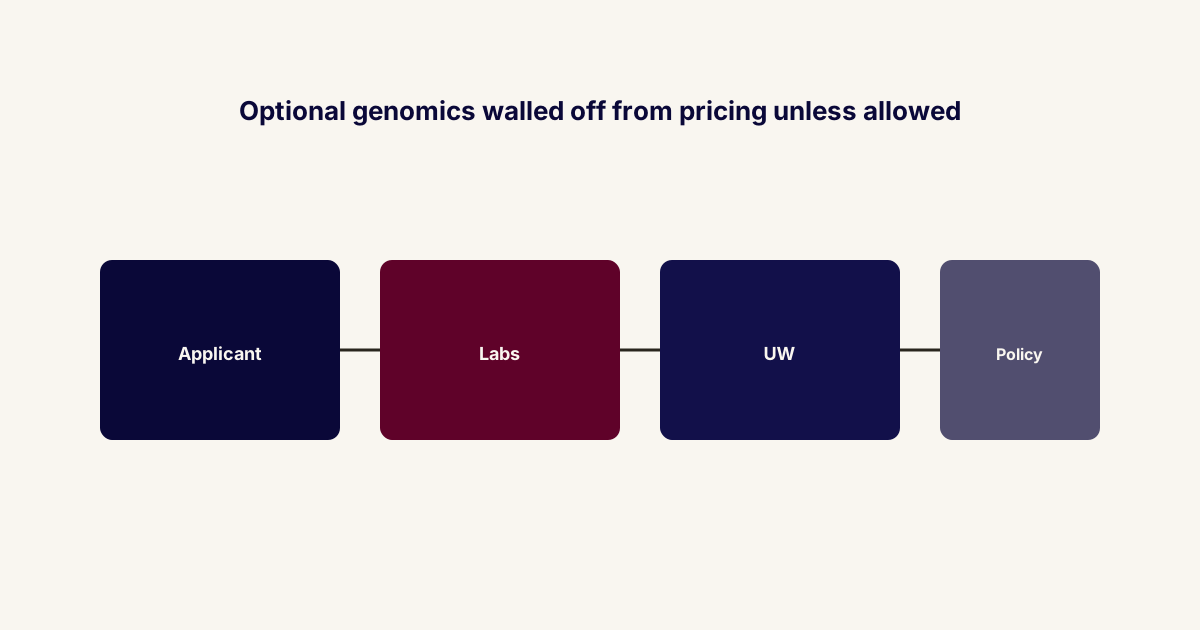
Separating genomics from core underwriting requires more than a policy statement in an employee handbook. Technical firewalls must prevent genetic signals from flowing into pricing models, even indirectly through correlated features. Contractual provisions with genomics vendors should specify data destruction timelines, audit rights, and prohibitions on secondary use. Internal access controls must ensure that underwriters reviewing flagged cases cannot see genetic results unless the applicant has provided explicit, informed, and revocable consent.
Third-party data quality presents an underappreciated operational risk. Prescription databases occasionally contain erroneous fills, duplicate records from pharmacy transfers, or missing entries for medications dispensed through specialty channels. MIB codes may reflect conditions that were investigated but never confirmed. Motor vehicle records can lag by months in certain states. Carriers that issue accelerated decisions based on flawed inputs expose themselves to regulatory scrutiny, litigation risk, and reputational damage when adverse actions are challenged.
Adverse action notices in accelerated underwriting must meet a higher clarity standard than traditional declines. When an algorithm drives the decision, the applicant deserves an explanation tied to verifiable, specific data elements rather than an opaque reference to overall risk scoring. Several state insurance departments have issued guidance requiring carriers to identify the particular data source and the nature of the adverse information. This transparency obligation creates a direct dependency on data provenance tracking within the underwriting technology stack.
Model governance should encompass regular adverse impact testing across protected classes. Where jurisdictions mandate fairness review, carriers must demonstrate that accelerated pathways do not systematically disadvantage applicants on the basis of race, ethnicity, gender, or socioeconomic status. This testing requires access to demographic data that carriers may not directly collect, necessitating proxy analysis methodologies. Documented override rates and human review escalation metrics provide additional evidence of governance rigor during regulatory examinations.
Algorithmic explainability is rapidly becoming a regulatory expectation rather than a voluntary best practice. Carriers deploying gradient-boosted trees, neural networks, or ensemble methods must be prepared to decompose individual underwriting decisions into feature-level contributions. Techniques such as SHAP values and LIME approximations offer post-hoc interpretability, but regulators increasingly want to understand the model development lifecycle itself, including training data composition, feature selection rationale, and validation against out-of-sample mortality experience.

Reinsurance treaties introduce an additional constraint layer that carriers sometimes overlook during accelerated underwriting rollouts. Many existing treaties were written with the assumption that full medical evidence would be available for claims adjudication. Automated decisions issued without that evidence may fall outside treaty terms, leaving the ceding carrier exposed to unexpected retained risk. Aligning treaty language with the specific data elements and decision thresholds used by the underwriting engine is essential before scaling instant-issue volumes.
Customer experience design must communicate clearly what the accelerated path means for the applicant's privacy. Disclosure language should specify which data sources the carrier will access, how long that data will be retained, and under what circumstances a claim investigation might revisit the original underwriting evidence. Vague consent forms that bundle dozens of data permissions into a single checkbox erode consumer trust and invite regulatory challenge, particularly as state privacy frameworks continue to expand.
Post-issue contestability introduces a tension that accelerated underwriting amplifies. Carriers that skip the paramedical exam at point of sale may rely more heavily on the contestability period to investigate claims filed within the first two years. If the accelerated model approved an applicant who would have been declined or rated under full underwriting, the insurer faces a difficult choice between honoring the algorithmic decision and contesting the claim based on information that was theoretically available but not retrieved at application.
Security requirements for health-adjacent data exceed the baseline protections that generic SaaS contracts provide. Encryption must cover data at rest and in transit with key management practices that prevent vendor access to plaintext records. Access logging should capture every query against applicant health data with immutable audit trails. Vendor breach notification timelines must be measured in hours, not the thirty-day windows common in standard service agreements. Carriers should conduct annual penetration testing against underwriting data stores and require vendors to do the same.
Cross-border applicant scenarios add further complexity. A Canadian resident applying for coverage with a U.S. carrier may trigger obligations under both Canadian genetic nondiscrimination law and the specific state insurance regulations where the policy is issued. Carriers operating in multiple jurisdictions need rules engines that dynamically adjust data ingestion permissions, consent requirements, and adverse action procedures based on the applicant's residency, the policy's situs, and the governing regulatory framework.
Looking ahead, the convergence of wearable health data, continuous glucose monitors, and real-time biometric feeds will further blur the line between underwriting and ongoing risk monitoring. Carriers experimenting with wellness program integrations must ensure that optional health-sharing features do not become de facto underwriting back doors. Consent architecture should clearly separate engagement incentives from coverage determination, with robust audit mechanisms verifying that the separation holds in practice as data pipelines evolve.
Appendices to this report include a jurisdiction-by-jurisdiction legal primer covering genetic data protections in seventeen markets, sample consent language for optional wellness integrations that preserves regulatory compliance, model governance checklist templates aligned with NAIC guidelines, and reinsurance treaty amendment recommendations for carriers transitioning from traditional to accelerated underwriting programs. These resources provide a practical foundation for carriers seeking to compete on speed without compromising ethical commitments or regulatory standing.