Insights · Report · Industry · Apr 2026
Preservation in place, forensic collection, hashing, review platform portability, and defensible workflows when evidence spans SaaS, mobile, and collaboration tools.

Litigation, regulatory investigations, and internal compliance inquiries now routinely implicate data stored across cloud mail, team collaboration platforms, versioned document repositories, and ephemeral messaging channels. The volume and variety of electronically stored information have grown faster than the procedural frameworks designed to govern its collection and review. Organizations that rely on legacy forensic workflows, built for on-premises file servers and local hard drives, face mounting defensibility challenges when evidence resides in multi-tenant SaaS environments where infrastructure rotates invisibly beneath the custodian layer.
Chain of custody, the documented trail proving that evidence has not been altered from collection through production, becomes exponentially more difficult to maintain when no physical media changes hands. Cloud-native collection depends on API calls, vendor-supplied audit logs, and cryptographic hashing at ingestion. Each link in the chain must be logged with timestamps, operator identities, and hash values that withstand adversarial scrutiny. This report provides a comprehensive framework for building defensible e-discovery workflows in cloud-first enterprises.
Legal hold notification marks the beginning of every defensible e-discovery process. When litigation or an investigation is reasonably anticipated, custodians must receive clear, documented instructions to preserve relevant materials. In cloud environments, notification alone is insufficient because users can delete, modify, or lose access to data through routine platform operations. Automated preservation policies that apply litigation holds at the platform level, suspending retention schedule deletions and preventing custodian modifications, are essential complements to written notice.
Preservation in place has become the preferred strategy for cloud-hosted data, replacing the older model of copying data to isolated storage immediately upon hold. Microsoft 365 litigation hold, Google Vault retention policies, and Slack enterprise retention controls allow organizations to freeze data within the source platform while business operations continue uninterrupted. This approach reduces storage costs and limits the chain of custody surface area, but it introduces dependency on vendor implementation details that must be validated through testing rather than assumed from marketing documentation.
We can present findings in a working session, map recommendations to your portfolio and risk register, and help you prioritize next steps with clear owners and timelines.
Targeted collection through platform APIs represents a significant improvement over full-image forensic acquisition for cloud data. Microsoft Graph, Google Workspace APIs, and Slack export endpoints enable collectors to retrieve specific mailboxes, channels, or date ranges without pulling entire tenants. This precision reduces the volume of irrelevant data entering the review pipeline and limits exposure of privileged or sensitive material that falls outside the scope of the matter. API-based collection also produces structured metadata that simplifies downstream processing and threading.
Credential governance for collection operations demands the same rigor applied to production system access. Service accounts used for e-discovery pulls should operate under dedicated credentials with narrowly scoped permissions, time-limited access windows, and comprehensive audit logging. Organizations that repurpose administrator accounts for forensic collection risk both over-collection, which inflates review costs and privacy exposure, and audit trail contamination that opposing counsel can exploit during motions to compel or sanctions hearings.
Processing transforms raw collected data into reviewable document sets. Deduplication, email threading, near-duplicate identification, and metadata extraction each affect the proportionality calculus that courts evaluate when assessing discovery burden. Global deduplication across custodians reduces document counts substantially but may obscure which custodians possessed specific documents, a fact pattern that matters in knowledge attribution disputes. Custodian-level deduplication preserves this information at the cost of higher review volumes, and the choice between strategies should be documented and defensible.
Near-duplicate detection thresholds require careful calibration. Setting similarity thresholds too low produces clusters so large that reviewers cannot meaningfully assess them, while thresholds set too high miss substantively similar documents that should be reviewed together. Industry practice centers on similarity thresholds between 85 and 95 percent for textual content, but optimal settings vary by document population characteristics. Processing teams should conduct pilot runs on representative samples and document their threshold selections with supporting rationale for any court submissions.
Technology-assisted review has matured from a contested methodology into a court-accepted standard for large-scale document review. Continuous active learning models train iteratively on reviewer decisions, prioritizing the most informative documents for human judgment and relegating clearly non-responsive material to lower review priority. Courts in multiple jurisdictions have affirmed that TAR workflows, when properly validated, satisfy proportionality and reasonableness requirements. The introduction of generative AI summarization tools adds new capability but also invites heightened scrutiny of the review process.
Validation protocols for technology-assisted review must satisfy both statistical rigor and judicial expectations. Recall and precision measurements, drawn from statistically valid random samples of the document population, provide the quantitative foundation for defensibility. Control sets should be established early in the review and refreshed as the model stabilizes. Organizations deploying generative summarization alongside TAR must maintain audit trails showing which summaries were generated, which reviewers relied on them, and what quality control sampling rates were applied to verify accuracy.
Cross-border e-discovery introduces data sovereignty constraints that can override otherwise sound collection strategies. The European Union General Data Protection Regulation, China's Personal Information Protection Law, and similar frameworks in Brazil, India, and other jurisdictions impose transfer restrictions that affect where collected data may be processed and reviewed. Organizations must maintain current data maps that identify where custodian data physically resides before initiating collection, because remedial transfers after collection has begun invite both regulatory penalties and judicial skepticism.
Model contractual clauses and vendor subprocessor inventories should be treated as standing discovery readiness artifacts rather than documents assembled under litigation pressure. Review platform vendors that process data in multiple regions must provide clear documentation of data residency controls, encryption at rest and in transit, and subprocessor notification obligations. Legal teams that discover transfer mechanism gaps only after collection has begun face costly re-collection or motion practice that delays case timelines and increases overall spend.

Mobile device data presents unique chain of custody challenges. Bring-your-own-device policies, encrypted messaging applications, and device-level security controls complicate both preservation and collection. Mobile device management platforms can enforce litigation hold policies on enrolled devices, but personal devices outside MDM control require custodian cooperation backed by clear organizational policies. Forensic imaging of mobile devices remains necessary for some matters, but selective extraction tools offer a less intrusive alternative when the scope of relevant data is well defined.
Collaboration tools such as Slack, Microsoft Teams, and similar platforms generate data structures that defy traditional document review paradigms. Conversations span channels with branching threads, emoji reactions carry contextual meaning, and file attachments may exist in multiple versions across linked storage services. Review platforms must render these conversations in context rather than as isolated message fragments, because decontextualized messages are both harder for reviewers to assess and easier for opposing counsel to mischaracterize during depositions or trial.
Review platform portability should be evaluated during vendor selection, not discovered during a forced migration. Portable load file formats, comprehensive metadata field dictionaries, and documented export procedures ensure that work product, including coding decisions, privilege designations, and reviewer notes, survives a platform transition. Organizations should require vendors to demonstrate full round-trip export and import capability during evaluation, testing that production sets, redaction coordinates, and annotation layers transfer without data loss or formatting degradation.
Exit planning extends beyond technical portability to commercial and operational considerations. Contracts should specify data retention periods after matter completion, export assistance obligations, and pricing for bulk data egress. Review platforms that impose prohibitive export fees or proprietary format requirements create lock-in that compromises both cost control and litigation agility. Negotiating clear exit terms before engagement begins protects against leverage imbalances that surface when a matter is active and migration risk feels unacceptable to the legal team.
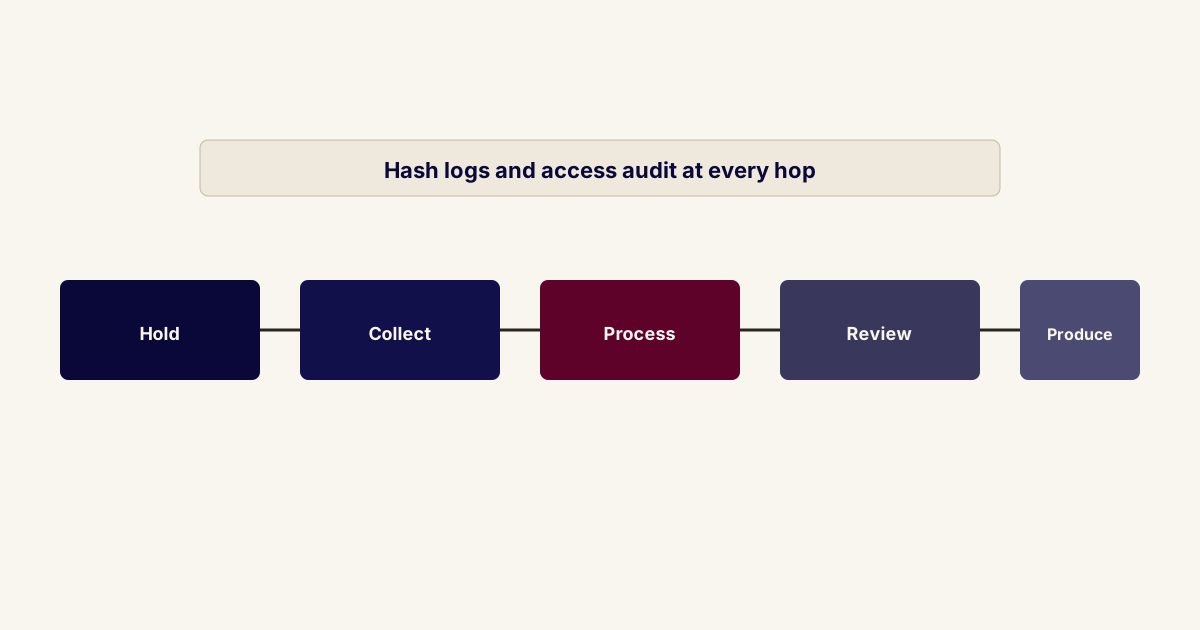
Hash verification should occur at every transition point in the e-discovery workflow, not only at final production. Collecting from cloud APIs, transferring to processing environments, loading into review platforms, and exporting for production each represent opportunities for undetected data alteration. MD5 and SHA-256 hash comparisons at each stage create a layered verification record that withstands challenge. Organizations should automate hash validation as part of their workflow tooling rather than relying on manual spot checks that scale poorly and introduce human error.
Building a defensible e-discovery program requires coordination between legal, information technology, information security, and compliance functions. Joint runbooks that define roles, escalation paths, and decision authorities for each phase of the e-discovery lifecycle prevent the ad hoc improvisation that creates defensibility gaps. Tabletop exercises simulating spoliation accusations, cross-border collection disputes, and vendor platform outages build organizational muscle memory that reduces response time and error rates when real matters arise.
Looking ahead, the convergence of generative AI, expanding data source diversity, and tightening global privacy regulations will continue to reshape e-discovery practice. Organizations that invest in structured, auditable, and jurisdiction-aware workflows today will find themselves better positioned to absorb emerging data types and regulatory requirements without rebuilding their programs from scratch. The firms that treat e-discovery infrastructure as a strategic legal operations capability, rather than a reactive cost center, will achieve consistently lower per-matter costs and stronger defensibility outcomes.