Insights · Report · Industry · May 2026
Driving score methodology, regulatory filings, proxy discrimination tests, and customer communications when usage based auto insurance scales beyond early adopters.

Usage-based insurance has moved from niche pilot to mainstream product line, with over forty percent of U.S. personal auto carriers now offering or actively developing telematics-informed pricing programs. The promise is straightforward: drivers who demonstrate safer behavior pay less, and carriers benefit from better risk segmentation. Yet as UBI scales beyond tech-savvy early adopters, the concentration of predictive power in telemetry vendors and opaque scoring models raises questions that regulators, plaintiff attorneys, and consumer advocates are asking with increasing urgency.
This report documents the governance architecture required to operate a telematics-based pricing program at scale. It covers informed consent for data collection, documented feature engineering pipelines, proxy discrimination testing where statute or regulation requires it, appeals processes for customers who dispute their scores, and the organizational structures that connect actuarial, product, compliance, and technology teams. The objective is a program that is both commercially effective and defensible under regulatory examination.
Telematics scoring begins with raw sensor data: accelerometer readings, GPS coordinates, gyroscope output, and timestamps. Feature engineering transforms these signals into behavioral variables such as hard braking frequency, cornering intensity, speed relative to posted limits, time-of-day driving distribution, and trip distance patterns. Each feature carries assumptions about risk correlation that must be documented and validated. Models trained on historical claims data then combine these features into a composite driving score that influences rating factors within the filed rate plan.
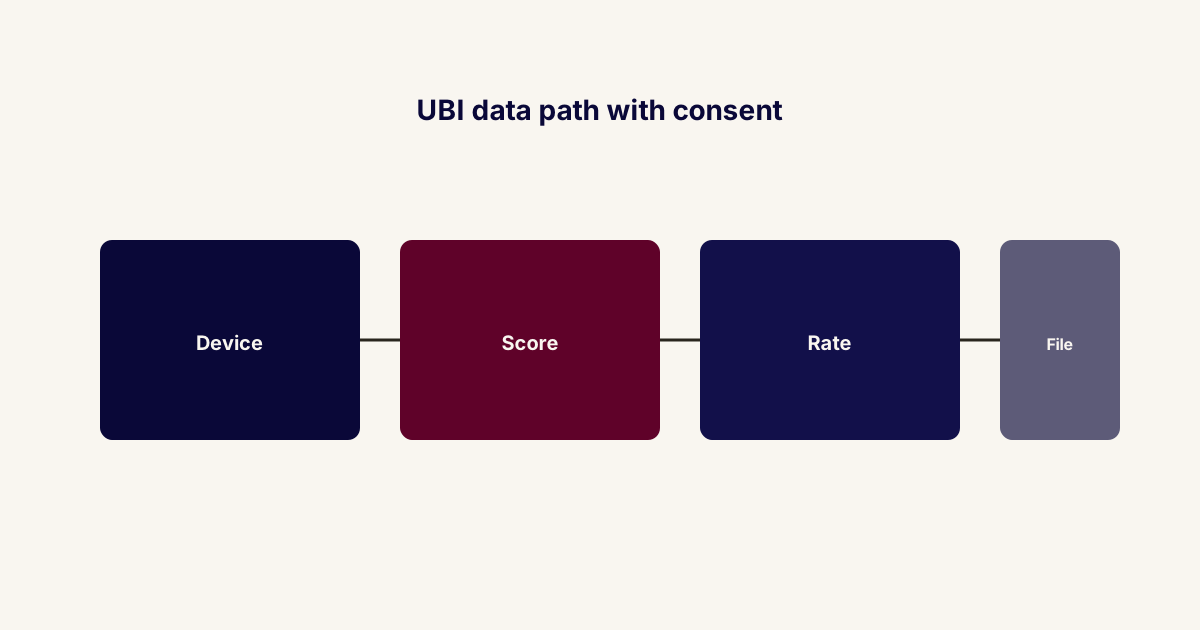
Device strategy directly affects data quality and program fairness. Dedicated OBD-II dongles provide consistent accelerometer placement and power supply, producing stable signal baselines across vehicle types. Smartphone-based programs reduce hardware costs and simplify enrollment but introduce variability from phone placement, operating system differences, and background activity detection accuracy. Product teams must monitor participation rates, score distributions, and loss ratios segmented by device type and channel to detect demographic skew introduced by the data collection mechanism itself.
We can present findings in a working session, map recommendations to your portfolio and risk register, and help you prioritize next steps with clear owners and timelines.
The regulatory environment for telematics pricing varies significantly by jurisdiction. Several states require explicit prior approval of telematics rating factors, complete with actuarial justification and documentation of the scoring methodology. The National Association of Insurance Commissioners has issued guidance encouraging transparency in algorithmic rating, and individual state departments have begun requesting model documentation during market conduct examinations. Carriers that treat regulatory filing as a downstream compliance exercise rather than an integral part of product design risk costly refiling cycles and enforcement actions.
Proxy discrimination represents the most significant legal and reputational risk in telematics pricing. Even when protected class variables are excluded from the model, correlated features can reproduce discriminatory outcomes. Nighttime driving frequency may correlate with occupation and, by extension, with race or income. Short trip distances may correlate with urban density and neighborhood demographics. Rigorous proxy testing requires running the scoring model against synthetic and actual populations, then measuring outcome disparities across protected classes using accepted statistical tests such as adverse impact ratios and standardized mean differences.
A defensible fairness testing program operates at multiple stages. Pre-deployment testing evaluates the model on held-out populations segmented by protected class proxies. Post-deployment monitoring tracks score distributions, tier placement, and premium impacts across demographic groups on a recurring schedule. Remediation protocols define thresholds for acceptable disparity and prescribe actions ranging from feature removal to model retraining when those thresholds are breached. Documentation of each testing cycle must be retained for examiner review and potential litigation discovery.
Model governance for telematics scoring requires version control, reproducibility, and change management discipline that many carriers underinvest in. Every production scoring model should be traceable to a specific training dataset, feature set, hyperparameter configuration, and validation result. When models are updated, the prior version must remain reproducible so that filed methodologies can be demonstrated to regulators months or years after deployment. Model risk management frameworks adapted from banking, such as SR 11-7 principles, provide a useful starting template for insurance contexts.
Customer communication is where fairness commitments become tangible. Policyholders need clear explanations of what data is collected, how scores are calculated, and what actions they can take to improve their rating. Generic disclosures buried in policy documents fail both the transparency objective and the retention opportunity. Leading programs provide real-time driving feedback through mobile applications, translating abstract scores into actionable coaching that reinforces the value exchange between data sharing and premium savings.
Appeals paths for disputed scores are essential and frequently overlooked. A driver whose score drops after a medical emergency, a road hazard avoidance maneuver, or a GPS data anomaly needs a mechanism to request human review. Effective appeals processes include automated detection of anomalous score changes, escalation to trained reviewers, and documented resolution criteria. Without these safeguards, customer complaints escalate to regulators and generate media attention disproportionate to the underlying issue volume.
Fraud signals in telematics data require carefully calibrated responses. GPS spoofing, device tampering, and trip manipulation represent real loss exposure, but over-aggressive automated declines generate complaint volumes that attract regulatory attention and damage brand perception. Carriers should establish tiered fraud response protocols that distinguish between probable device malfunction, suspicious patterns warranting investigation, and confirmed manipulation justifying policy action. Each tier should carry defined evidence thresholds, communication templates, and escalation timelines reviewed by both the special investigations unit and customer experience leadership.

Integration of telematics data with claims investigation offers significant value in reconstructing accident circumstances and identifying fraud indicators. However, this cross-functional data use raises privacy expectations that must be managed explicitly. Policy language and enrollment disclosures should clearly state that telematics data may be used in claims processing. Purpose limitation principles require that data collected for pricing is not repurposed for claims without informed consent, and technical controls should enforce these boundaries at the data access layer.
Effective telematics programs require cross-functional governance structures that bridge actuarial science, data engineering, product management, compliance, and customer experience. Siloed organizations where data scientists build models in isolation, compliance reviews them after the fact, and customer service handles disputes without feedback loops produce programs that are technically functional but operationally fragile. A standing telematics governance committee with representation from each function, meeting on a defined cadence, ensures that scoring changes are evaluated for technical, regulatory, and customer impact before deployment.
State filing teams need technical partners who can reproduce scoring outputs for examiner questions on demand. This requires investment in scoring environment snapshots, test case libraries, and documentation that translates statistical methodology into language accessible to non-technical reviewers. Filing narratives should anticipate common examiner concerns around fairness, transparency, and consumer impact. Carriers that treat the filing process as a collaborative dialogue with regulators, rather than a compliance hurdle, experience faster approvals and fewer objections.
International expansion of telematics programs demands careful jurisdiction-by-jurisdiction analysis. The European Union's General Data Protection Regulation imposes consent and data minimization requirements that differ materially from U.S. state insurance regulations. Markets in Asia and Latin America carry their own data localization, retention, and cross-border transfer rules. Consent frameworks, retention defaults, and scoring transparency obligations are not portable across borders without legal review. Carriers should build modular program architectures that allow jurisdiction-specific configuration without requiring complete platform redesign.
Vendor management in telematics requires attention to data ownership, scoring transparency, and contractual audit rights. Carriers that outsource the full scoring pipeline to a telematics vendor may gain speed to market but surrender the ability to explain, reproduce, or modify scores independently. Contracts should guarantee carrier access to raw data, documented model specifications, and the right to conduct independent validation. Vendor lock-in in telematics scoring is not merely a procurement risk but a regulatory compliance exposure that compounds over time.
Looking ahead, the telematics pricing landscape will be shaped by expanding regulatory expectations, growing consumer awareness of data rights, and increasing sophistication of scoring methodologies incorporating connected vehicle data streams. Carriers that invest now in governance infrastructure, fairness testing rigor, transparent customer communications, and cross-functional organizational models will be positioned to scale UBI programs confidently. Those that treat governance as an afterthought will face mounting regulatory friction, reputational exposure, and competitive disadvantage as the market matures beyond early adopters.