Insights · Report · Industry · Apr 2026
Model governance, fair claims handling alignment, referral workflows, and evidence packages that hold up when regulators and plaintiffs examine special investigations.

Insurance fraud remains one of the industry's most persistent and costly challenges. The Coalition Against Insurance Fraud estimates that fraudulent claims drain tens of billions of dollars annually from the U.S. property and casualty market alone. Organized rings, opportunistic padding, and provider collusion each demand different detection strategies, yet most carriers still rely on a patchwork of rules engines and underfunded special investigations units. The gap between analytic capability and operational execution continues to widen.
Adversaries are becoming more sophisticated. Staged accidents now involve coordinated participants across multiple jurisdictions. Medical providers submit billing patterns designed to stay just below common threshold triggers. Digital channels, while improving customer experience, introduce new vectors for identity manipulation and document fabrication. Carriers that treat fraud analytics as a static scoring exercise rather than a continuously adaptive discipline find their models degrading within months of deployment.
Effective fraud detection begins at first notice of loss. The intake process captures structured fields and free-text narratives that together form the initial signal set for downstream analytics. Carriers that invest in natural language processing at the FNOL stage extract claimant sentiment cues, inconsistency markers, and geographic clustering signals before an adjuster ever touches the file. Early enrichment reduces the time from submission to triage and improves the quality of referrals flowing to the special investigations unit.
Scoring models sit at the center of the detection pipeline, but their design requires careful calibration. Supervised models trained on historical confirmed-fraud labels inherit the biases of past investigation decisions, including which claims were examined and which were never scrutinized. Unsupervised anomaly detection complements label-dependent classifiers by surfacing novel patterns that fall outside historical norms. A blended ensemble approach, combining supervised, unsupervised, and rules-based components, provides both precision on known schemes and sensitivity to emerging tactics.
Model risk management applies to fraud models with the same rigor expected in underwriting and pricing. Regulators increasingly expect carriers to document training data provenance, proxy variable analysis, and the potential for disparate impact on protected classes. Fair claims handling statutes in several states now explicitly address algorithmic decision-making in the investigation context. Carriers should maintain model cards that describe intended use, known limitations, performance metrics by demographic segment, and override policies that adjusters can invoke when scores conflict with observable facts.
We can present findings in a working session, map recommendations to your portfolio and risk register, and help you prioritize next steps with clear owners and timelines.
Transparency in scoring is not a luxury; it is an operational necessity. When adjusters see only a red flag icon without context, they either defer blindly to the score or ignore it entirely. Both responses degrade outcomes. Explainable models that surface the top contributing features for each scored claim enable adjusters to apply professional judgment, document their reasoning, and provide meaningful feedback for model retraining. This feedback loop is the single most important mechanism for sustained model accuracy.
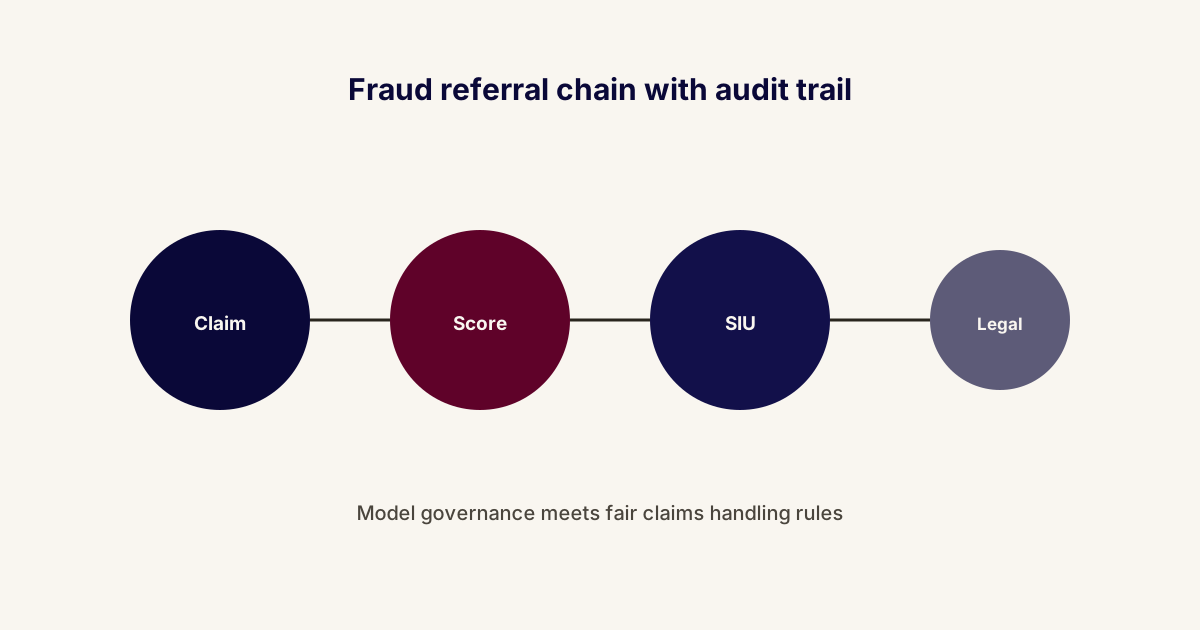
The referral workflow from adjuster to special investigations unit is where many carriers introduce unnecessary risk. Vague referral notes, missing supporting documents, and inconsistent timing create gaps that plaintiffs' attorneys exploit during bad faith litigation. A well-designed referral template captures the specific indicators that triggered suspicion, the actions already taken by the adjuster, and the expected next steps from the SIU. Standardized templates reduce variance and ensure every referral meets a minimum evidentiary threshold before consuming investigator resources.
Timing discipline across the referral chain deserves particular attention. Regulatory frameworks in most jurisdictions impose strict timelines for claims acknowledgment, investigation updates, and coverage determinations. A fraud investigation that silently stalls a claim beyond statutory deadlines exposes the carrier to penalties and reputational damage regardless of whether the underlying suspicion proves valid. SIU case management systems should enforce automated escalation triggers that alert supervisors when investigation milestones approach their deadlines.
Special investigations units function most effectively when they operate as collaborative partners rather than isolated enforcement arms. Joint case conferences between adjusters, SIU investigators, and legal counsel align priorities and prevent duplicated effort. In high-complexity cases involving organized rings or multi-claimant events, a formal war room cadence with weekly status reviews, evidence tracking boards, and clearly assigned action items accelerates resolution. Carriers that silo their SIU from the broader claims operation forfeit coordination advantages that directly impact recovery outcomes.
External data sources amplify detection power but introduce their own quality challenges. Public records databases, social media intelligence platforms, prescription monitoring programs, and industry consortium data each carry licensing obligations, accuracy limitations, and privacy constraints. Stale records and mismatched identity keys generate false positives that waste investigator time and anger honest policyholders. Data stewardship protocols should specify refresh cadences, match confidence thresholds, and escalation procedures when external data contradicts carrier records.
Evidence packaging for legal and regulatory review requires discipline that many investigation teams underestimate. Digital photographs, recorded statements, surveillance footage, telematics extracts, and chat logs must be preserved with chain-of-custody documentation that withstands scrutiny. Metadata integrity matters: timestamps, geolocation tags, and device identifiers should be captured at collection and validated before inclusion in an evidence package. Gaps in the chain give defense counsel ammunition to challenge the admissibility of otherwise compelling findings.
Legal holds and discovery readiness extend beyond traditional document management. Modern claims environments generate evidence across email, mobile devices, cloud storage, collaboration platforms, and telematics systems. Retention schedules should reflect the litigation realities of each jurisdiction where the carrier operates. Premature deletion of relevant communications, even under a routine purge policy, creates spoliation risk once litigation is reasonably anticipated. Proactive legal hold protocols triggered by SIU referral reduce this exposure.

Law enforcement coordination adds another dimension to the investigative process. Carriers that build relationships with state insurance fraud bureaus and federal task forces before a specific case arises benefit from faster information sharing and stronger prosecution outcomes. However, coordination must respect the boundaries between civil investigation and criminal referral. Premature disclosure of claim details to law enforcement without proper authorization can create liability. Clear policies on when and how to engage public agencies protect both the carrier and the claimant's rights.
Performance measurement in fraud analytics demands metrics that go beyond simple dollar recovery. Referral precision, the ratio of confirmed fraud to total referrals, indicates model and adjuster calibration. Investigation cycle time reveals operational bottlenecks. Customer satisfaction scores among claims later cleared of suspicion measure the collateral impact of the program on honest policyholders. Carriers should balance deterrence and recovery objectives with policyholder experience metrics to avoid a regime that maximizes short-term salvage at the expense of long-term retention.
Vendor selection for outsourced SIU services, offshore review centers, and cloud analytics platforms warrants careful due diligence. Contractual provisions should address audit rights, data minimization obligations, breach notification timelines, and performance service levels tied to referral quality rather than volume alone. Offshore operations introduce additional regulatory considerations around data residency and cross-border transfer. These contractual protections belong in the initial agreement, not in amendments negotiated after a data incident or regulatory inquiry.
Cloud analytics platforms offer scalability advantages for carriers processing high claim volumes, but deployment models vary significantly. Some vendors provide fully managed scoring services where claim data leaves the carrier's environment for processing. Others offer containerized models that run within the carrier's cloud tenancy. The choice between hosted and on-premises deployment has direct implications for data sovereignty, latency, and the carrier's ability to audit model behavior. Procurement teams should engage information security and compliance stakeholders before signing platform agreements.
Tabletop exercises remain one of the most cost-effective preparedness investments a carrier can make. Scenarios involving organized accident rings, medical provider collusion networks, catastrophe-related surge fraud, and cyber-enabled identity schemes test coordination across claims, SIU, legal, compliance, and communications teams. Realistic exercises expose gaps in escalation protocols, technology integrations, and decision-making authority that would otherwise surface only during a live event. Carriers that run quarterly tabletops report faster containment times and fewer procedural missteps during actual fraud surges.
Looking ahead, the convergence of generative AI, synthetic media, and deepfake technology will introduce entirely new fraud vectors that current detection models are not equipped to handle. Fabricated medical imaging, synthetic voice recordings used in recorded statements, and AI-generated correspondence will test the integrity of evidence workflows. Carriers that invest now in digital forensics capabilities, media authentication tooling, and investigator training on synthetic content detection will be better positioned to respond as these threats mature from theoretical risk to operational reality.