Insights · Report · Security · Apr 2026
Vendor choreography, step-up authentication, and case management patterns for retail and commercial journeys that must balance conversion with loss prevention.

Digital onboarding volumes have surged across banking, insurance, and fintech while fraud rings have professionalized at an equal pace. Synthetic identities, deepfake selfies, and credential-stuffing toolkits are now available as packaged services on dark-web marketplaces. Point solutions for document scanning, device reputation, and behavioral biometrics each address a narrow slice of the attack surface, but true resilience requires orchestration: a policy layer capable of sequencing verification steps, invoking fallback paths, and adapting to emerging threat vectors without rewriting channel applications.
Orchestration separates identity verification policy from channel code. Rather than embedding vendor-specific SDK calls directly in mobile or web applications, an orchestration engine evaluates a risk context object and determines which verification steps to invoke, in what order, and under what conditions. This decoupling yields three strategic benefits: vendors become replaceable without deployment cycles, risk policies become testable in isolation, and new journeys can be assembled from existing verification building blocks rather than built from scratch.
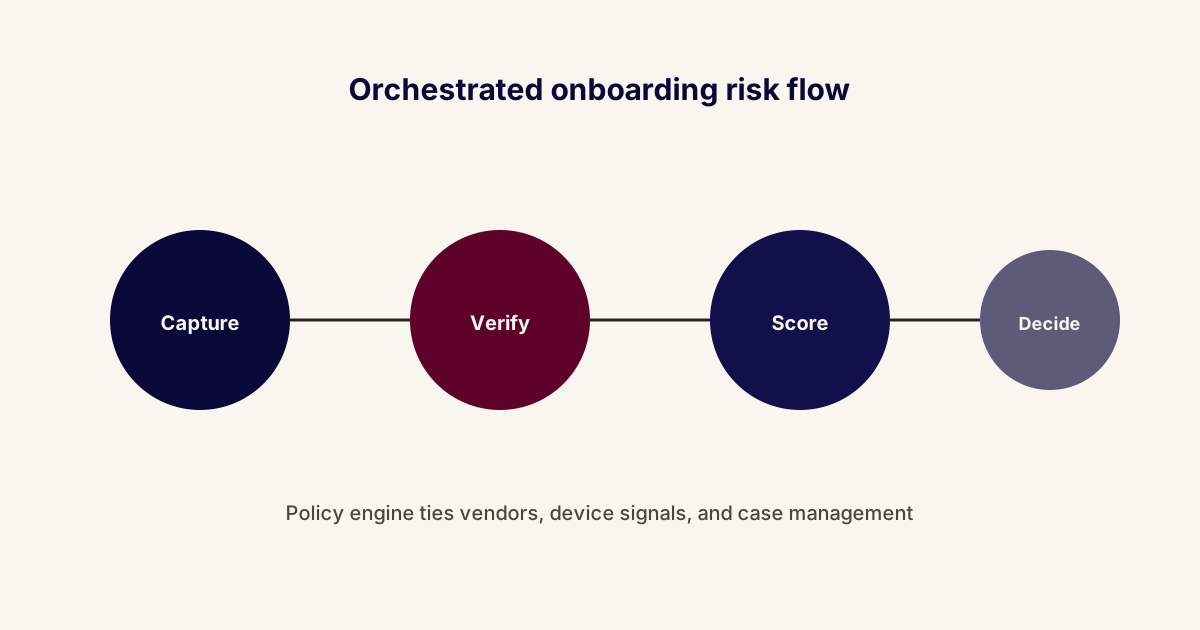
Retail onboarding journeys typically begin with basic data capture, followed by a document scan, a liveness check, and a knowledge-based or one-time-password verification step. The orchestration engine scores initial signals such as device fingerprint, IP geolocation, and email age before deciding whether to request additional evidence. Low-risk applicants complete onboarding in under three minutes. Higher-risk profiles receive targeted step-ups rather than blanket friction, preserving conversion rates while strengthening fraud detection at the margin.
Small business and commercial onboarding introduce complexity that retail flows rarely encounter. Beneficial ownership verification, corporate registry lookups, and multi-signatory authorization extend the journey from minutes to days. Orchestration engines must maintain durable state across sessions, allowing partially completed applications to resume without re-collecting verified data. Timeouts, document expiry windows, and regulatory hold periods all require explicit policy expressions that a rigid, linear workflow engine cannot accommodate gracefully.
We can present findings in a working session, map recommendations to your portfolio and risk register, and help you prioritize next steps with clear owners and timelines.
Document verification remains the foundational identity proofing step for most regulated onboarding journeys. Modern verification engines apply optical character recognition, template matching, hologram detection, and micro-print analysis to assess document authenticity. Classification models identify document type and country of origin, then apply region-specific validation rules for layout, font, and security feature placement. Organizations should evaluate vendors on rejection false-positive rates as aggressively as they evaluate fraud-catch rates, since unnecessary rejections erode customer trust and inflate support costs.
Device intelligence provides a passive, frictionless risk signal that enriches the orchestration context before any active verification step occurs. Device fingerprinting, SIM swap detection, app integrity checks, and network anomaly scoring feed a composite device risk score. When that score exceeds a configurable threshold, the orchestration engine can escalate to a higher-assurance verification path. Crucially, device signals should supplement rather than replace document and biometric checks, because sophisticated fraud operations routinely rotate clean devices to evade fingerprint-based defenses.
Behavioral biometrics add a continuous authentication dimension to the onboarding session. Keystroke dynamics, pointer movement patterns, and touchscreen pressure profiles create a session-level behavioral signature. Deviations from expected human interaction patterns, such as robotic typing cadence or clipboard-paste sequences in name fields, elevate the risk score in real time. These signals are particularly effective against bot-driven attacks and remote access trojan scenarios, where a fraudster controls a legitimate device from a secondary machine.
Step-up authentication should feel purposeful to legitimate applicants. Random friction destroys conversion and trains customers to abandon forms. Risk scores should drive additional checks only when signals cluster around a credible threat pattern. Copy and user experience design matter as much as the verification technology itself: clear, concise explanations of why a selfie or document re-scan is needed reduce drop-off rates significantly compared to generic prompts that leave applicants guessing about the reason for the extra step.
Risk scoring engines consume signals from device, document, biometric, and behavioral layers, then produce a composite score that maps to a discrete decision: approve, step up, refer to analyst, or decline. Threshold calibration requires continuous tuning informed by confirmed fraud cases and false-positive feedback loops. Organizations that set thresholds once at launch and never revisit them inevitably drift toward either excessive approvals or punitive friction as attack patterns and customer demographics evolve over time.
Case management completes the decisioning loop. When automation cannot render a confident verdict, human analysts need packaged evidence presented in a single pane: device graph excerpts, document authenticity annotations, biometric match confidence intervals, and prior account history. Swivel-chair investigations that force analysts to toggle between six vendor dashboards do not scale. Effective case management platforms aggregate evidence, surface recommended actions, and capture analyst decisions as labeled training data that improves the scoring models over subsequent iterations.
Synthetic identity fraud represents the most difficult detection challenge in digital onboarding. Synthetic identities combine real and fabricated identity elements, often anchored by a legitimately issued but thin-file Social Security number or national identifier. These identities pass traditional verification checks because they contain enough authentic data to appear plausible. Detection requires cross-referencing application attributes against consortium data, analyzing credit-file velocity patterns, and identifying anomalous identity element combinations that real individuals almost never exhibit.
Deepfake and injection attacks target biometric verification steps specifically. Presentation attacks range from printed photo overlays to real-time face-swap video streams injected into the camera feed at the operating system level. Liveness detection must therefore operate across multiple vectors: texture analysis for print and screen artifacts, depth estimation for three-dimensional presence, challenge-response prompts such as head turns or blink sequences, and injection detection that validates the camera feed originates from a physical sensor rather than a virtual device driver.

Model governance intersects onboarding when machine learning models rank applicant risk. Regulatory frameworks in the United States, European Union, and United Kingdom increasingly require that automated decision systems demonstrate fairness across protected demographic categories. Organizations should treat onboarding risk scores as models subject to adverse action notice requirements, disparate impact testing, and periodic recalibration. Override logging is equally critical: every instance where a human analyst reverses a model decision must be recorded and reviewed for quality assurance.
Regulatory requirements vary by jurisdiction, product type, and customer segment, making a one-size-fits-all verification flow impractical. Customer identification program rules for US banking differ from eIDAS requirements in Europe and from the tiered KYC frameworks common in emerging markets. Orchestration engines must express these regulatory variants as composable policy modules that can be attached to journey definitions without duplicating core verification logic. Maintaining a regulatory mapping matrix tied to journey configurations prevents gaps that surface during audit examinations.
Procurement guidance for identity verification vendors should emphasize data processing agreements, data minimization obligations for biometric templates, and contractual exit clauses. Vendors that change scoring models without advance notice introduce silent risk drift into the onboarding pipeline. Contracts should mandate model change notifications, validation windows, and rollback provisions. Data residency commitments deserve particular scrutiny for organizations operating across borders, as biometric and identity data often triggers the strictest data localization requirements.
Metrics discipline separates mature onboarding operations from reactive ones. Approval rates, fraud loss ratios, step-up frequency, average verification latency, and case resolution time should be tracked by channel, geography, product, and customer segment. Sudden shifts in any metric often indicate vendor model drift, a new attack campaign, or an unintended policy change rather than a marketing-driven volume fluctuation alone. Automated anomaly detection on these metrics provides early warning that complements the per-application risk scoring pipeline.
Tabletop exercises remain the most cost-effective method for stress-testing onboarding defenses against novel attack scenarios. Synthetic identity rings, coordinated deepfake campaigns, insider-assisted fraud at branch channels, and vendor outage cascades each warrant a dedicated scenario. Cross-functional participation from fraud operations, product, engineering, legal, and compliance teams ensures that response plans address organizational coordination gaps, not just technical detection capabilities. Practice consistently improves mean time to contain without imposing punitive friction on legitimate applicants.
Looking forward, organizations that invest in orchestration-first architectures will adapt faster than those locked into monolithic vendor integrations. The threat landscape will continue to evolve as generative AI lowers the cost of producing convincing forged documents and synthetic media. Defensive advantage belongs to teams that treat identity verification as a continuously tunable pipeline rather than a fixed integration, coupling vendor diversity with rigorous governance, layered signal analysis, and evidence-driven case management to protect conversion rates without conceding ground to increasingly sophisticated fraud operations.