Insights · Report · Strategy · May 2026
Works council consultation, wage and hour analytics boundaries, surveillance optics, and people science models that improve retention without crossing legal or cultural red lines.

People analytics programs promise better retention forecasting, fairer pay equity analysis, and smarter capacity planning. They also risk creating a surveillance culture when data sources quietly expand to include keystrokes, badge swipes, calendar density scores, or always-on chat sentiment without transparent employee communication. The line between operational insight and individual monitoring has never been thinner, and regulatory bodies across multiple jurisdictions are actively redrawing it. This report provides a framework for building analytics capabilities that deliver genuine workforce value while respecting legal boundaries and employee dignity.
The regulatory environment for workforce analytics has intensified since 2024. The EU AI Act classifies employment-related AI systems as high-risk when they influence hiring, performance scoring, or promotion decisions. Conformity assessments, human oversight mechanisms, and detailed technical documentation are now mandatory for those categories. In the United States, Illinois, New York City, Colorado, and Maryland have each introduced disclosure or audit requirements for automated employment decision tools. Organizations operating across jurisdictions face a patchwork of obligations that demand careful legal mapping before analytics deployment.
GDPR remains the anchor regulation for European workforce data processing. Legitimate interest, the legal basis most frequently invoked for analytics, requires a documented balancing test that weighs employer benefit against employee rights. Consent is rarely appropriate in employment contexts because of the inherent power imbalance between employer and worker. Data protection authorities in France, Germany, and the Netherlands have published guidance explicitly cautioning against treating employee consent as freely given when participation affects career outcomes.
Works councils and employee representative bodies hold co-determination rights over monitoring technologies in many European jurisdictions. In Germany, Section 87 of the Works Constitution Act gives councils a binding say on technical systems designed to monitor employee behavior or performance. Treating these consultations as late-stage approval gates rather than early design partnerships consistently produces conflict, delays, and diminished trust. The most effective organizations bring employee representatives into analytics program design before selecting tools or defining data taxonomies.
Employee monitoring practices sit at the center of the ethical tension in workforce analytics. Keystroke logging, screen capture, email scanning, and location tracking generate granular behavioral data that can power productivity models. However, these techniques carry significant legal risk in jurisdictions where proportionality requirements apply, and they reliably damage employee trust even where technically lawful. Research consistently shows that perceived surveillance decreases discretionary effort and increases turnover intent, directly undermining the retention goals that analytics programs claim to support.
We can present findings in a working session, map recommendations to your portfolio and risk register, and help you prioritize next steps with clear owners and timelines.
Distinguishing between aggregate workforce insights and individual-level monitoring is essential for program legitimacy. Analyzing department-level attrition patterns, team engagement trends, or organization-wide pay equity distributions serves clear business purposes without singling out individuals. When analytics output identifies or scores specific employees, the ethical and legal calculus changes substantially. Role-based access controls, small cell suppression rules, and query audit logs help enforce the boundary between organizational intelligence and individual profiling.
Wage and hour analytics deserve particular caution. Inferring off-the-clock work from VPN connections, email timestamps, or application usage without managerial accountability creates class action exposure under the Fair Labor Standards Act and equivalent state regulations. Analytics platforms should flag potential violations for manager review rather than silently accumulating evidence that employees worked unpaid overtime. The liability asymmetry is stark: the same data that could protect employees can instead become plaintiff evidence in wage theft litigation.
Model fairness in hiring and promotion support tools requires structured, repeatable evaluation. Disparate impact analysis, comparing selection rates across protected groups using the four-fifths rule or more sophisticated statistical tests, should be embedded in the development lifecycle rather than performed as a post-deployment audit. The Equal Employment Opportunity Commission has signaled increased scrutiny of algorithmic selection tools, and organizations that cannot demonstrate proactive bias testing face both regulatory risk and reputational exposure in a competitive talent market.
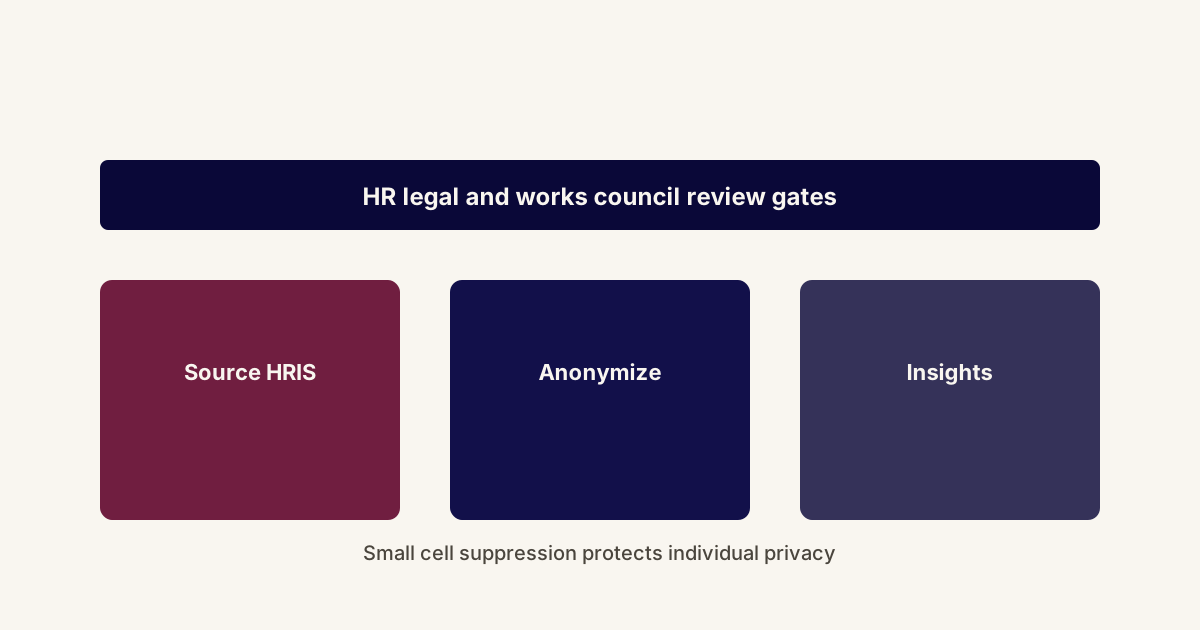
Transparency obligations extend beyond regulatory compliance into organizational culture. Employees who understand what data is collected, how it is processed, and what decisions it informs are far more likely to engage constructively with analytics programs. Employee-facing documentation should use plain language and avoid legal jargon. Effective transparency materials explain the purpose of each data source, the retention period, the aggregation level at which results are used, and the process for raising concerns or requesting corrections.
Data minimization principles should govern every stage of the analytics pipeline. Collecting the minimum data necessary for a defined purpose reduces legal exposure, limits breach impact, and builds employee confidence that the program is purpose-driven rather than opportunistic. Behavioral data in particular should carry shorter retention periods than operational records. Stale sentiment scores, historical keystroke metrics, and archived engagement survey free-text responses rarely improve model accuracy and frequently erode trust when their continued storage becomes visible.
Vendor HR technology stacks introduce subprocessor complexity that many organizations underestimate. A typical enterprise HRIS ecosystem involves a core platform, multiple point solutions for recruiting, learning, engagement, and compensation, and a web of data connectors feeding analytics environments. Each vendor constitutes a data processor under GDPR and equivalent frameworks, requiring documented processing agreements, security assessments, and breach notification chains. Maintaining an automated vendor inventory that flows into RFPs and data protection impact assessments prevents subprocessor sprawl from creating ungoverned data sharing paths.
Cross-border data transfers add another layer of compliance complexity for multinational organizations. Workforce data flowing from European entities to analytics platforms hosted in the United States requires transfer mechanisms such as Standard Contractual Clauses or binding corporate rules, along with supplementary measures that address governmental access risks. Organizations should map analytics data flows geographically and validate that each cross-border transfer has a documented legal mechanism satisfying the requirements of both origin and destination jurisdictions.
Algorithmic transparency requirements are expanding rapidly. The EU AI Act mandates that high-risk AI systems provide sufficient transparency to allow deployers to interpret outputs and use them appropriately. Several U.S. state proposals require employers to disclose when automated systems contribute to hiring or promotion decisions and to provide affected individuals with an opportunity to contest adverse outcomes. Building explainability into analytics models from the design phase is significantly less costly than retrofitting opaque systems after regulatory deadlines arrive.
Establishing an ethics review board for workforce analytics programs provides structured governance without creating bureaucratic bottlenecks. Effective boards include representatives from HR, legal, data science, information security, employee relations, and at least one external member with relevant domain expertise. The board should review new data sources before integration, evaluate model outputs for fairness, assess employee communications for clarity, and conduct periodic retrospective reviews of program outcomes against stated objectives and ethical commitments.
People science models that improve retention without crossing legal or cultural red lines share common characteristics. They operate on aggregated, anonymized data wherever possible. They incorporate human decision-making at every consequential step. They are documented thoroughly enough to survive regulatory inquiry and communicated to employees with candor. They are subject to regular review by a governance body that includes perspectives beyond the analytics team that built and benefits from their continued operation.
Closing recommendations center on three principles. First, lead with transparency by publishing clear, accessible documentation of every analytics program, including data sources, processing purposes, retention schedules, and escalation channels. Second, embed compliance by design by integrating legal review, fairness testing, and data minimization into the analytics development lifecycle rather than treating them as post-deployment checkpoints. Third, treat employee representatives as design partners by engaging works councils, unions, and employee forums early enough to influence program architecture rather than merely ratify finished designs.