Insights · Report · Industry · Apr 2026
PMS and CRS integrations, tokenized payments, franchise consistency, and marketing personalization without turning every hotel into a full cardholder data environment.

Hotels generate extraordinarily rich guest profiles across property management systems, central reservation platforms, loyalty databases, spa booking engines, and food and beverage point-of-sale terminals. Payment card data intersects this guest profile graph at nearly every touchpoint, expanding PCI scope whenever tokenization boundaries and network segmentation controls are absent or poorly maintained. For multi-brand hospitality groups, the challenge intensifies as each acquisition layer introduces legacy payment flows that predate current compliance requirements.
PCI DSS version 4.0 introduces requirements that raise the compliance bar for hospitality operators. Targeted risk analyses now require documented justification for control frequencies, meaning hotels can no longer rely on generic quarterly scan schedules without mapping those cadences to their specific threat environment. Customized approach validation offers flexibility but demands significantly more evidence than the traditional defined approach. Hotels that have deferred their 4.0 transition plans face a narrowing window before mandatory enforcement dates eliminate grandfather provisions.
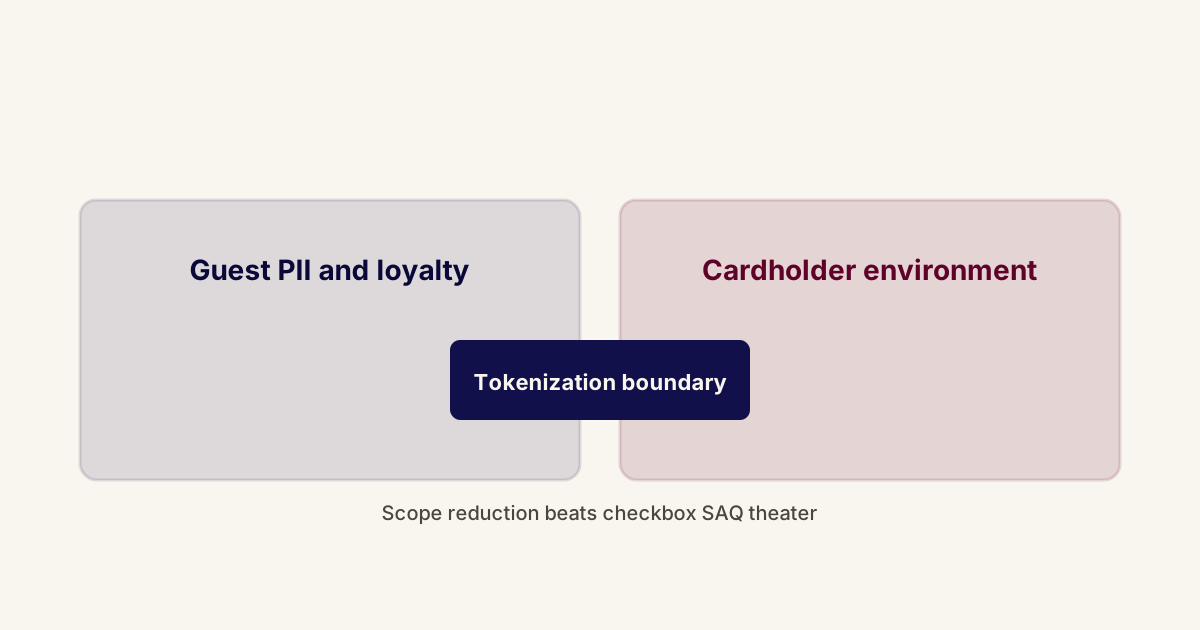
The foundational principle of this report is a hard boundary between the guest profile and loyalty data zone and the cardholder data environment. Tokenization services replace live card numbers with non-reversible tokens at the earliest possible point in the transaction lifecycle, ideally at the payment terminal or hosted payment page before data ever reaches property-level infrastructure. When tokenization is implemented correctly, the property management system stores only a token reference, not a primary account number, which dramatically reduces the systems in scope for PCI assessment.
Point-to-point encryption further strengthens this boundary by ensuring that card data is encrypted from the moment of swipe, dip, or tap and remains encrypted until it reaches the payment processor's hardware security module. Hosted payment fields embedded in online booking flows accomplish the same scope reduction for e-commerce channels by routing card input directly to the processor without the hotel's web server ever handling raw card data. Together, tokenization, P2PE, and hosted fields form a layered defense that shrinks the cardholder data environment to its practical minimum.
We can present findings in a working session, map recommendations to your portfolio and risk register, and help you prioritize next steps with clear owners and timelines.
Loyalty program databases represent a particularly sensitive data store that warrants careful architectural separation. These systems aggregate stay history, tier status, point balances, preference profiles, and redemption records across every brand in a portfolio. When loyalty identifiers are linked directly to stored payment credentials for one-click redemption, the loyalty platform itself enters PCI scope. A cleaner architecture routes redemption transactions through a tokenized payment service, keeping the loyalty engine focused on member engagement without inheriting cardholder data obligations.
Franchise and managed property models introduce significant accountability complexity. Brand standards may mandate specific payment terminal hardware, approved gateway providers, and minimum security configurations, yet the franchisee entity bears the legal obligation for PCI validation at its location. Contracts must explicitly assign responsibility for self-assessment questionnaire completion, quarterly vulnerability scanning, penetration testing cadence, and breach notification timelines. Ambiguity in these contractual terms becomes a liability accelerator when a compromise occurs and legal counsel begins parsing obligations.
Enforcement consistency across a franchise network requires more than contractual language. Brands should deploy standardized security baseline configurations for payment terminals and network infrastructure, automate compliance evidence collection through centralized tooling, and conduct periodic validation audits at a statistically significant sample of franchisee properties. Properties that repeatedly fail validation checks should trigger escalation protocols that include remediation timelines, supplementary training, and, in persistent cases, contractual penalties sufficient to motivate corrective action.
Marketing personalization in hospitality relies heavily on reservation history, stay preferences, dining frequency, and ancillary purchase patterns. Pulling this data into email platforms, mobile push systems, and advertising retargeting audiences demands explicit attention to consent management, frequency capping, and unsubscribe hygiene. Global operations must reconcile varying regulatory frameworks, from GDPR consent requirements in Europe to CCPA opt-out rights in California to emerging data protection statutes in Asia-Pacific markets. A single global suppression and consent orchestration layer simplifies compliance without fragmenting the personalization engine.
Third-party booking channels, including online travel agencies, metasearch engines, and global distribution systems, create duplicate guest profiles that degrade service quality and inflate marketing costs. A guest who books through an OTA and later joins the loyalty program directly may appear as two distinct records, leading to conflicting room preferences, missed recognition at check-in, and redundant promotional emails. Master data management strategies that define merge rules, survivorship logic, and golden record criteria are essential for delivering the personalized experience that drives direct booking conversion.
Identity resolution across booking channels should leverage deterministic matching on email address and phone number as primary keys, supplemented by probabilistic signals such as name similarity and geographic proximity. Automated merge workflows must include conflict resolution rules that prioritize the most recently confirmed data source while preserving historical context. Manual review queues handle edge cases where automated confidence scores fall below defined thresholds, ensuring that aggressive deduplication does not accidentally merge records belonging to genuinely distinct guests.

Operational technology throughout hotel properties increasingly networks back to guest profile systems. Electronic door locks transmit access events, in-room entertainment systems personalize content based on loyalty tier, smart thermostats adjust temperature preferences pulled from guest profiles, and minibar sensors trigger automated billing. Each of these IoT endpoints represents a potential lateral movement path into more sensitive systems if not properly segmented. Hotels should isolate OT devices on dedicated VLANs, enforce deny-by-default firewall policies at the segment boundary, and continuously monitor for default credentials and unpatched firmware.
Cloud migration of property management and central reservation systems offers significant PCI scope reduction opportunities when executed thoughtfully. Moving payment processing to a cloud-native, PCI-certified service provider shifts a substantial portion of control responsibility to the provider under the shared responsibility model. However, hotels must carefully document which controls remain their obligation, particularly around access management, logging, and incident response. Cloud does not eliminate PCI scope; it redistributes it, and misunderstanding that redistribution creates dangerous compliance gaps.
Workforce access to guest data should follow role-based access control patterns with periodic entitlement reviews tied to job function changes. Front desk agents need access to current reservation details and loyalty tier status but not historical folio payment records. Revenue management analysts require aggregated booking data but not individual guest contact information. Seasonal hiring spikes demand automated provisioning and deprovisioning workflows that grant access on the start date and revoke it on the separation date, eliminating the shared password culture that persists at many properties.
Incident response planning in hospitality must account for the distributed nature of hotel operations. A compromise at a single property can expose brand-wide loyalty data if segmentation between the property network and the central loyalty platform is insufficient. Response playbooks should define communication escalation paths that reach brand security leadership within defined time thresholds, outline guest notification procedures that comply with breach disclosure statutes across all operating jurisdictions, and include pre-negotiated forensic investigation retainers that enable rapid deployment of qualified assessors.
Vendor due diligence for payment processors, gateway providers, and technology platform partners deserves rigorous and recurring attention. Annual Attestation of Compliance collection is a minimum requirement, not a comprehensive program. Hotels should validate that processor certifications cover the specific services consumed, review service organization control reports for relevant trust criteria, and maintain contractual rights to audit or receive evidence of remediation when material findings surface. The payment technology ecosystem evolves rapidly, and a vendor certified today may introduce scope-expanding changes in its next release cycle.
Looking ahead, hospitality organizations that establish clear architectural boundaries between guest engagement data and cardholder data environments will operate with lower compliance costs, faster assessment cycles, and reduced breach exposure. The brands that invest in centralized tokenization infrastructure, franchise compliance automation, and privacy-aware personalization engines will outperform peers still treating PCI compliance as an annual checkbox exercise. Guest trust is the ultimate currency in hospitality, and demonstrating disciplined stewardship of personal and payment data is foundational to earning and retaining that trust.