Insights · Report · Industry · Apr 2026
FERPA-aligned roles, learning analytics ethics, vendor subprocessors, and integration patterns that link SIS, LMS, and research systems without oversharing.

Colleges and universities sit at a unique intersection of regulatory obligation, institutional autonomy, and rapid technology adoption. Student data now flows across student information systems, learning management platforms, advising tools, research databases, and third-party analytics services. Each of these systems carries distinct privacy expectations shaped by federal law, state statutes, institutional policy, and community trust. This report provides a governance framework for managing those flows while preserving the educational mission that justifies data collection in the first place.
The Family Educational Rights and Privacy Act remains the foundational statute governing student education records in the United States. FERPA grants eligible students the right to inspect their records, request corrections, and control disclosure to third parties. Institutions must designate which data elements qualify as directory information and provide students with a meaningful opportunity to opt out of directory release. Despite decades of enforcement, many campuses still lack granular directory information categories, defaulting instead to broad opt-in or opt-out toggles that fail to reflect actual disclosure practices.
Consent management for non-directory uses of education records requires careful workflow design. When a student signs a release for a scholarship provider, that consent should be scoped to the specific records needed, the defined purpose, and a clear expiration date. Blanket consent forms that authorize indefinite sharing across unspecified recipients violate the spirit of FERPA and erode student trust. Registrar offices should maintain auditable consent logs that link each disclosure event to the original authorization, enabling rapid response when students revoke permission.
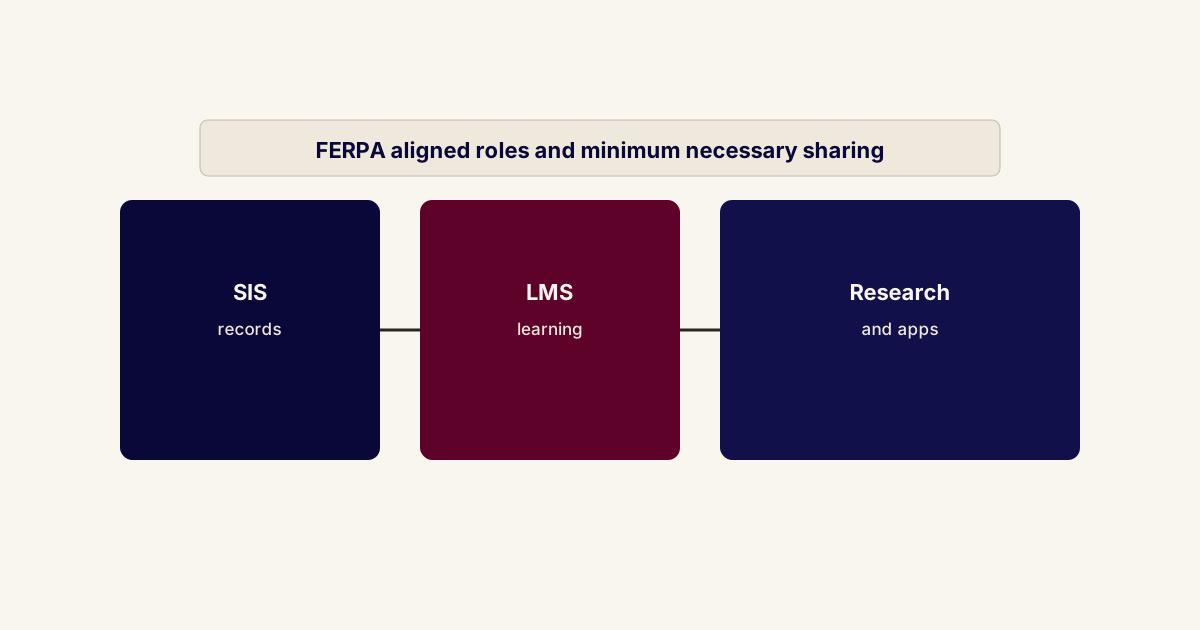
Integration between student information systems and learning management platforms represents the highest-volume data exchange on most campuses. Course rosters, enrollment status, grades, and academic standing propagate between these systems multiple times per day. The minimum necessary principle demands that only the fields required for each integration purpose traverse the boundary. Passing full student demographic records to an LMS when only enrollment and section assignment are needed creates unnecessary exposure and complicates breach notification if the LMS is compromised.
We can present findings in a working session, map recommendations to your portfolio and risk register, and help you prioritize next steps with clear owners and timelines.
Learning analytics programs promise improved retention and student success, but they introduce substantial ethical complexity. Predictive models that flag at-risk students can trigger intrusive interventions if deployed without guardrails. Governance boards overseeing analytics initiatives should include faculty representatives, registrar staff, disability services coordinators, and student government members. Any model output that influences academic standing, financial aid eligibility, or advising pathways deserves a documented human review step and a clearly communicated appeal process for affected students.
The ethical dimension of learning analytics extends beyond accuracy into questions of equity and surveillance. Algorithms trained on historical data risk encoding existing disparities in completion rates across demographic groups. Institutions must audit model performance across race, gender, disability status, and socioeconomic indicators before deployment. Transparency reports that disclose which variables influence predictions, how often interventions are triggered, and what outcomes result from those interventions build the institutional legitimacy that sustains analytics programs over multiple academic cycles.
Vendor ecosystems on campus have expanded dramatically as institutions accelerate online program delivery and digital student services. Each new edtech vendor introduces a subprocessor relationship that must be documented, risk-assessed, and periodically re-evaluated. Subprocessor registers should be maintained in a centralized repository accessible to procurement, information security, and academic leadership. Risk tiers based on data sensitivity, volume, and vendor security posture determine reassessment cadence. A surprise analytics vendor discovered during an audit erodes institutional credibility far more than the cost of proactive due diligence.
Contract negotiations with edtech vendors should address data ownership, retention limits, de-identification standards, and incident notification timelines explicitly. Many vendor agreements include broad language granting the vendor rights to use anonymized or aggregated student data for product improvement. Institutions must scrutinize whether the de-identification methodology meets FERPA safe harbor standards or merely removes obvious identifiers while leaving re-identification vectors intact. Contractual language should prohibit the vendor from combining institutional data with external datasets without explicit written approval.
Single sign-on and automated provisioning reduce the account sprawl that plagues campuses with dozens of integrated applications. SAML and OIDC federations simplify authentication, but they can over-provision access if role definitions are too coarse. A student enrolled in a biology course should not automatically receive access to clinical health records systems simply because both applications sit behind the same identity provider. Attribute-based access control that evaluates enrollment, role, department, and term status at each authorization decision prevents this category of drift.
Periodic access reviews are essential for catching entitlement drift that accumulates over semesters. Students who withdraw, faculty who change departments, and staff who transition between roles frequently retain access to systems they no longer need. Automated deprovisioning triggered by enrollment and employment status changes in the SIS reduces stale access. Where full automation is not feasible, quarterly access certification campaigns that require system owners to confirm each active entitlement provide a compensating control that auditors recognize.
Research computing intersects instructional data privacy when de-identification is imperfect or when researchers seek to link educational records with survey responses, health data, or behavioral observations. Institutional review boards should require data use agreements that specify allowable linkage methods, storage environments, and destruction timelines. Network segmentation between research computing clusters and administrative systems provides a technical barrier against accidental data blending. Training for principal investigators on FERPA obligations, distinct from HIPAA training they may already receive, closes a common awareness gap.
International student data introduces additional complexity as institutions navigate cross-border data transfer requirements. The European General Data Protection Regulation applies when institutions enroll students from EU member states or operate study-abroad programs with European partners. Standard contractual clauses, binding corporate rules, or adequacy decisions must underpin any transfer of personal data outside the European Economic Area. Institutions that rely solely on FERPA compliance without addressing GDPR obligations for their international cohort face regulatory exposure on two continents simultaneously.

Accessibility and equity considerations belong in the same governance narrative as privacy. Surveillance metaphors, such as tracking every click a student makes in an LMS, can undermine good-faith retention programs if students perceive monitoring as punitive rather than supportive. Transparent communication about what data is collected, why it is collected, and how students benefit from its use builds the social license that analytics programs require. Where legally permissible, opt-out pathways for non-essential data collection demonstrate respect for student autonomy without dismantling core institutional functions.
Data retention policies for education records require balancing regulatory minimums against institutional research needs and alumni engagement objectives. FERPA does not prescribe specific retention periods, leaving institutions to define schedules that reflect accreditation requirements, state records laws, and operational necessity. Retention policies should distinguish between permanent academic records such as transcripts, medium-term advising notes, and short-lived system logs. Automated purge routines enforced at the database layer prevent well-intentioned policies from becoming aspirational documents that no system actually implements.
Integration patterns for Learning Tools Interoperability and Caliper-style telemetry deserve particular scrutiny. LTI launches pass user identity and context claims between platforms, creating a data exchange that many institutions fail to document in their records of processing activities. Caliper event streams can capture granular interaction data, including time spent on each page, navigation sequences, and assessment attempt patterns. Default retention for telemetry data should be short, with explicit extension only for approved analytics use cases governed by the institutional review process.
Metrics for campus data governance leadership should be concrete and auditable. Key performance indicators include median time to fulfill student data access requests, percentage of active integrations with documented data flow diagrams, number of vendor contracts reviewed against current privacy standards in the past twelve months, and audit findings related to education records trending year over year. Dashboards that surface these metrics to provosts and chief information officers create accountability loops that sustain governance investment beyond the initial implementation phase.
Data protection impact assessments for edtech pilots should be lightweight enough to avoid stalling innovation yet rigorous enough to catch material risks before student data is exposed. A structured questionnaire covering data categories collected, storage jurisdiction, encryption standards, access controls, retention defaults, and incident response commitments can be completed in a single meeting between the sponsoring academic unit and the privacy office. Piloting without an impact assessment should be treated as a policy exception requiring documented executive approval.
Looking ahead, the student data privacy landscape will grow more complex as artificial intelligence tools enter the classroom, adaptive learning platforms collect richer behavioral signals, and federal rulemaking potentially modernizes FERPA for the digital age. Institutions that invest now in classification discipline for every data flow, governance structures that include student voices, and technical controls that enforce policy at the integration layer will be positioned to adapt without emergency remediation. The campuses that thrive will treat student data privacy not as a compliance burden, but as a competitive differentiator in enrollment and institutional reputation.