Insights · Report · Industry · Apr 2026
API governance, consent propagation, and clinical data quality patterns for health systems modernizing exchanges without creating new silos.

FHIR adoption accelerated once regulators and payers aligned on resource profiles, yet many health systems still operate parallel point-to-point interfaces alongside nascent standards-based channels. The failure mode is not a lack of specifications. It is inconsistent implementation tiers, weak operational ownership of shared APIs, and the absence of clear accountability for integration quality. Organizations that treat FHIR as a compliance checkbox rather than an architecture discipline inevitably replicate the silos they intended to dismantle.
The 2026 regulatory environment has sharpened the stakes. CMS interoperability mandates, the ONC Health IT Certification Program, and state-level health information exchange requirements collectively demand that providers, payers, and public health agencies exchange clinical and administrative data through standardized interfaces. Enforcement is no longer theoretical. Financial penalties, attestation audits, and payer directory requirements now create material consequences for organizations that fall behind on FHIR readiness.
This brief frames interoperability as a product discipline rather than a one-time migration project. A central integration team or platform squad publishes golden implementations, reference test suites, and deprecation calendars. Consumers should never guess which patch version of a server is authoritative. Product thinking means versioned release notes, published SLAs, developer onboarding documentation, and structured feedback loops that treat internal clinical application teams with the same rigor as external partner integrations.
API governance begins with resource profile standardization. Health systems should adopt US Core profiles as a baseline, then layer organization-specific extensions through a managed implementation guide repository. Every extension must include a formal justification, a review date, and a sunset policy. Without this discipline, custom extensions proliferate unchecked, and downstream consumers face an unpredictable schema surface that undermines the interoperability promise FHIR was designed to deliver.
We can present findings in a working session, map recommendations to your portfolio and risk register, and help you prioritize next steps with clear owners and timelines.
Versioning strategy deserves explicit architectural attention. FHIR servers that expose a single undifferentiated endpoint risk breaking consumers with every update. Health systems should maintain parallel API versions during transition windows, enforce deprecation timelines communicated at least two quarters in advance, and provide automated conformance test harnesses that consumers can run against staging environments before cutover. This approach protects clinical workflows from unexpected regressions during server upgrades.
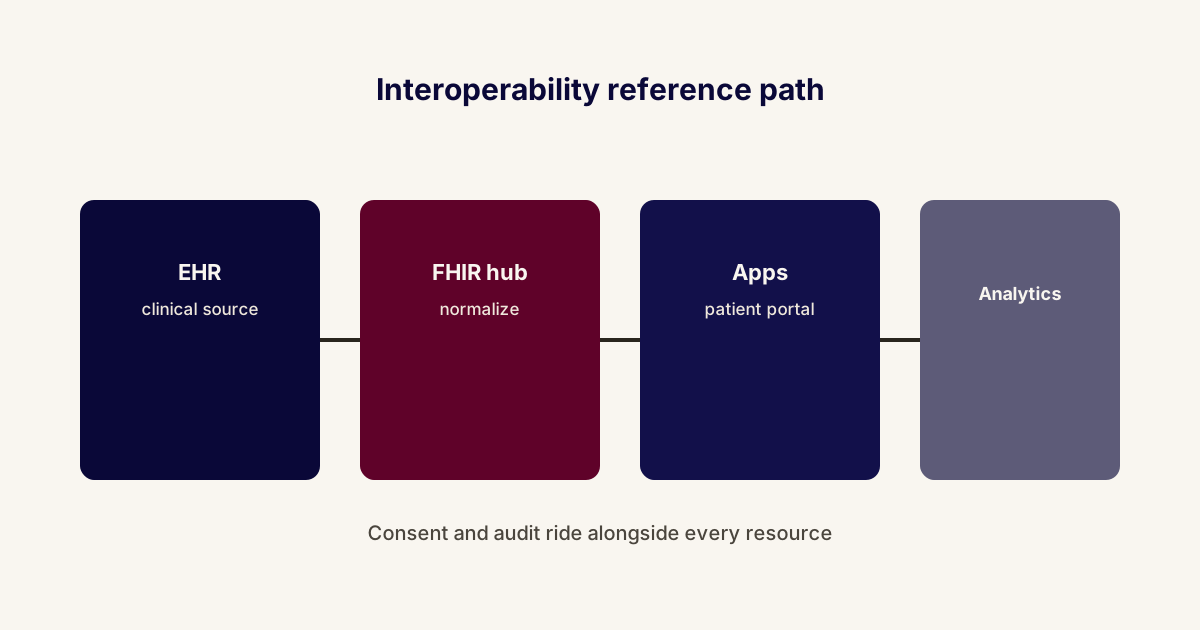
Consent and purpose of use must travel with resources, not reside in separate policy documents disconnected from the data flow. Technical headers, provenance elements, and downstream access policies should align precisely with privacy office definitions. Auditors increasingly sample API transaction logs, not only policy PDFs. A robust consent architecture encodes patient preferences at the resource level, propagates purpose-of-use claims through OAuth token scopes, and enforces access restrictions at the API gateway before data reaches consuming applications.
Privacy regulation complexity compounds the consent challenge. HIPAA minimum necessary requirements, 42 CFR Part 2 substance use disorder protections, state mental health privacy statutes, and emerging reproductive health data shields each impose distinct consent granularity demands. The integration platform must support composable consent policies that evaluate multiple regulatory dimensions simultaneously, rather than relying on a single binary opt-in flag. Failure to segment consent accurately exposes health systems to audit findings, civil penalties, and patient trust erosion.
Clinical data quality is an inseparable component of interoperability. Duplicate patient records, stale problem lists, mismatched medication coding systems, and inconsistent allergy documentation degrade clinical decision support, analytics accuracy, and patient safety outcomes. Health systems should pair every FHIR adoption initiative with corresponding master data management milestones. An interoperability platform that faithfully transmits poor-quality data at high speed merely accelerates the propagation of clinical risk across organizational boundaries.
Terminology mapping requires dedicated investment. SNOMED CT, ICD-10, LOINC, RxNorm, and CPT each serve distinct clinical and administrative purposes, yet overlapping concepts create ambiguity when resources cross system boundaries. A terminology services layer that provides canonical mapping tables, version-aware crosswalks, and automated validation against preferred value sets prevents the coding drift that gradually undermines data comparability. This layer should be centrally governed but accessible as a shared service to all integration consumers.
Vendor negotiation represents a critical dimension of FHIR strategy that many health systems underinvest in. Bulk data export performance, subscription webhook reliability, rate limit configurations, and production incident support SLAs vary dramatically across EHR vendors and release versions. Academic sandbox performance does not predict enterprise reliability under real clinical volumes. Procurement teams should require load-tested throughput guarantees, documented failover behavior, and contractual remedies for API availability breaches as standard terms in EHR agreements.
Subscription and notification patterns deserve careful architectural treatment. FHIR Subscriptions enable event-driven workflows such as admission notifications, lab result routing, and care gap alerts. However, subscription management at scale introduces its own operational complexity. Health systems must implement subscription lifecycle governance, including automated health checks, dead-letter handling for failed notifications, and capacity planning models that account for notification fan-out during high-census periods. Without this discipline, subscription backlogs silently delay time-sensitive clinical communications.

Security architecture receives a dedicated section in this brief because healthcare data exchange surfaces a uniquely complex threat model. OAuth 2.0 scopes aligned with SMART on FHIR launch contexts provide granular authorization for patient-facing and clinician-facing applications. Mutual TLS secures business-to-business feeds between health systems, payers, and health information exchanges. Secrets rotation for system service accounts should follow automated schedules with zero-downtime credential rollover. Break-glass access must be rare, comprehensively logged, and time-boxed to prevent privilege escalation.
Zero-trust principles should extend beyond perimeter controls into the integration layer itself. Every API request, whether originating from an internal clinical application or an external partner, should carry verifiable identity claims and be subject to policy evaluation at the point of enforcement. Network location alone must not confer trust. This posture reduces the blast radius of compromised credentials and ensures that lateral movement through integration pathways is constrained by the same authorization logic applied at the front door.
The brief concludes with a maturity ladder that guides health systems from basic read-only APIs to event-driven care coordination and population health analytics. Level one establishes patient demographic and clinical summary retrieval. Level two introduces write-back capabilities for care plans and clinical notes. Level three enables real-time event subscriptions for admission, discharge, and transfer workflows. Each level lists prerequisite committee approvals, staff training needs, and capital implications so that CFOs and clinical leadership see a sequenced, defensible investment plan.
Levels four and five address population analytics and cross-organizational data sharing. At these stages, health systems operate governed data products built on FHIR bulk export pipelines, de-identification services, and research consent frameworks. The integration platform transitions from a transactional middleware layer to a strategic data asset that supports value-based care analytics, quality measure reporting, and clinical research collaborations. Reaching these levels demands sustained executive sponsorship and multiyear funding commitments.
Organizational change management is as important as technical architecture. Clinical informaticists, compliance officers, revenue cycle analysts, and software engineers must collaborate through standing interoperability governance committees with clear decision rights. Without cross-functional ownership, FHIR projects stall in pilot phases because no single department possesses the authority to resolve the policy, workflow, and technology trade-offs that production-scale interoperability inevitably surfaces.
Appendices include sample integration test suites, RFP evaluation rubrics for EHR vendor FHIR capabilities, and template data sharing agreements pre-reviewed for HIPAA alignment. These artifacts are designed to shorten procurement and legal review cycles without weakening safety, privacy, or operational requirements. Health systems can adapt the templates to local regulatory contexts and organizational risk tolerance, reducing the time from strategy approval to first production data exchange by several months.