Insights · Report · Industry · Apr 2026
Botting, real-money trading, chargebacks, virtual currency compliance, and player fairness narratives for studios operating always-on economies.

Live service games have evolved from entertainment products into persistent economic systems that process billions of dollars in virtual transactions annually. Free-to-play titles with in-game currencies, player-driven marketplaces, and seasonal battle passes create layered economies that attract the same fraud typologies seen in financial services. Studios that treat economy governance as an afterthought face cascading consequences: eroded player trust, regulatory scrutiny, payment processor penalties, and revenue leakage that compounds across every live season.
This report organizes the threat landscape into five interconnected domains: automation abuse, real-money trading networks, payment and chargeback fraud, virtual currency regulatory compliance, and insider compromise of operational tooling. Each domain requires distinct detection telemetry, policy frameworks, enforcement mechanisms, and player communication strategies. Studios that apply a single anti-fraud playbook across all five categories consistently underperform those that resource each domain independently with tailored risk models and dedicated operational capacity.
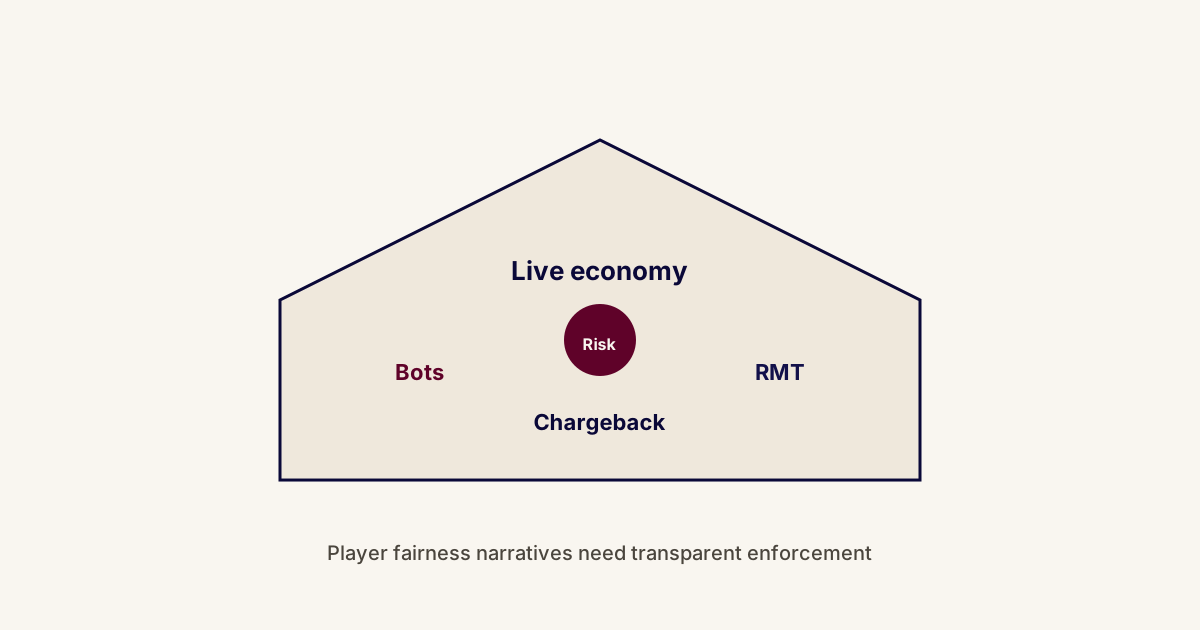
Automation abuse remains the most visible fraud category in live games. Botting networks farm currency, materials, and progression milestones at industrial scale, then funnel harvested assets into real-money trading pipelines. Modern bot operators deploy headless clients with behavioral randomization that evades simple heuristic detection. Effective countermeasures combine server-side telemetry, including session duration distributions, input entropy scoring, and pathing analysis, with periodic client integrity attestation to raise the cost of operating at scale.
Beyond traditional botting, exploit-driven automation targets economy mechanics directly. Duplication glitches, auction house timing exploits, and crafting loop vulnerabilities can inject unbounded virtual value into a closed economy within hours of discovery. Economy health monitoring systems should track aggregate supply metrics for every fungible asset class with anomaly thresholds calibrated to seasonal event baselines. Automated circuit breakers that throttle or suspend affected subsystems limit damage while investigation teams assess root cause and scope.
We can present findings in a working session, map recommendations to your portfolio and risk register, and help you prioritize next steps with clear owners and timelines.
Real-money trading operations have matured into sophisticated supply chains. Professional RMT organizations recruit players in lower-cost regions, operate account farms using compromised credentials, and maintain storefronts on third-party platforms that rival legitimate retail experiences. Disruption strategies must target the full value chain rather than individual accounts. Cooperation with platform operators to delist storefronts, velocity controls on peer-to-peer transfers, and graph analysis that identifies mule account clusters all reduce the economic viability of RMT at its operational margins.
The intersection of RMT and account security creates a compounding risk surface. Credential stuffing campaigns fueled by breached password databases supply the raw accounts that RMT operators need for farming and laundering. Studios should enforce multi-factor authentication on accounts with high-value inventories, implement login anomaly detection that factors device fingerprint, geolocation shift velocity, and session overlap patterns, and maintain breach correlation feeds that flag compromised credentials before abuse materializes in game telemetry.
Payment fraud in gaming follows patterns distinct from traditional e-commerce. Stolen credit cards are used to purchase premium currency, which is then laundered through gifting mechanics or marketplace transactions before the original cardholder disputes the charge. The resulting chargebacks carry both direct financial loss and indirect costs through processor penalty programs. Studios with chargeback ratios exceeding network thresholds risk losing access to card processing entirely, a scenario that represents an existential threat for titles dependent on direct card-on-file monetization.
Friendly fraud, where legitimate purchasers dispute valid transactions, complicates the chargeback landscape further. Parents disputing purchases made by minors, buyers experiencing remorse after impulse spending, and players seeking to retain purchased items while recovering funds all contribute to dispute volumes that blend genuine fraud with policy abuse. Effective mitigation requires robust purchase confirmation flows, spending velocity alerts, parental control frameworks, and compelling representment evidence packages that include device fingerprints, login history, and in-game usage of disputed items.
Payment orchestration architecture directly influences fraud model effectiveness. Studios operating globally must route transactions through regional acquirers, support local payment methods ranging from carrier billing to prepaid cards, and accommodate regulatory requirements that vary by jurisdiction. Each payment method carries a different fraud profile and dispute mechanism. Instrument fragmentation complicates device fingerprinting and cross-method velocity checks. Documentation of fraud model assumptions at the payment method level is essential, as vendor changes or acquirer migrations can silently invalidate detection rules.
Virtual currency and randomized reward mechanics attract regulatory attention in an expanding number of jurisdictions. Belgium and the Netherlands have classified certain loot box implementations as gambling. Australia, the United Kingdom, and several US states are advancing legislation that mandates probability disclosure, spending limits, or age-gated access. Studios should classify every randomized mechanic against a regulatory matrix before engineering ships probability tables. Legal review cycles that run in parallel with feature development prevent costly post-launch redesigns and reduce the risk of enforcement actions that damage brand reputation.
Beyond gambling classification, virtual currency systems increasingly intersect anti-money laundering and consumer protection frameworks. Convertible virtual currencies that enable player-to-player value transfer may trigger financial services registration requirements in certain jurisdictions. Studios that allow real-money cashout of virtual balances, even indirectly through marketplace mechanisms, should consult with financial regulatory counsel to assess licensing obligations. Proactive compliance program design is materially less expensive than retroactive remediation following regulatory inquiry.
Machine learning models are now central to fraud detection pipelines in live games, scoring player behavior across dimensions that include transaction velocity, social graph anomalies, progression rate deviation, and session fingerprint consistency. However, deploying ML-driven enforcement against paying customers demands rigorous fairness review. False positive bans levied against legitimate high-spending players generate viral social media backlash, customer support escalation storms, and lasting brand damage that far exceeds the revenue protected by the detection. Threshold tuning must balance precision against the asymmetric cost of wrongful enforcement.

Appeals and human review workflows serve as critical safety nets for automated enforcement systems. High-value accounts and first-time offenders should route through human adjudication queues staffed by specialists trained in both fraud analysis and player empathy. Resolution time targets matter: a banned player who waits fourteen days for review has already lost engagement momentum and is unlikely to return regardless of outcome. Studios should publish enforcement transparency reports that disclose aggregate ban volumes, overturn rates, and average resolution times to build community confidence in the fairness of moderation systems.
Player support tooling presents a unique security design challenge in fraud operations. Support agents need sufficient context to explain enforcement decisions and assist with account recovery, but exposing detection signal details creates a reverse-engineering vector that sophisticated fraud operators will exploit. Role-based access controls should segment fraud signal visibility by agent tier, with detailed detection rationale restricted to specialized trust and safety teams. Audit logging of every agent action on flagged accounts provides both quality assurance and insider threat detection coverage.
Insider threats from compromised or malicious administrative access represent a high-impact, low-frequency risk that many studios underestimate. Game master tools capable of spawning items, adjusting currency balances, or modifying account states are potent instruments of fraud when misused. Controls should include just-in-time privilege elevation with manager approval, dual authorization for bulk operations, immutable audit trails stored outside the production environment, and periodic access certification reviews that revoke dormant privileges. Penetration testing of admin tool authentication should appear on every quarterly security assessment cycle.
Cross-platform economies introduce additional governance complexity. A title available on console, PC, and mobile may operate separate storefronts with different pricing, refund policies, and payment providers, yet share a unified in-game economy. Fraud actors exploit these seams by purchasing currency on the platform with the weakest fraud controls and transferring value to the platform where it commands the highest resale price. Unified cross-platform transaction ledgers and consistent enforcement policies across all storefronts are prerequisites for closing these arbitrage gaps.
Incident preparedness for economy-scale events deserves the same rigor that studios apply to infrastructure disaster recovery. Tabletop exercises should simulate scenarios including mass duplication exploits during a major content launch, coordinated account takeover waves tied to a newly published credential dump, and payment processor outages that leave pending transactions in ambiguous states. Runbooks developed from these exercises should define escalation paths, communication templates for both internal stakeholders and the player community, and rollback procedures for economy state restoration.
Metrics and executive reporting transform raw enforcement data into actionable governance narratives. Key indicators include false positive rate on automated bans, average dispute resolution time by category, revenue leakage estimates segmented by abuse type, and chargeback ratio trends by payment method and region. Dashboards should contextualize metrics against seasonal event calendars and content release timelines, since fraud volume correlates directly with player population peaks. Executive audiences need narrative summaries that connect enforcement investment to player retention and lifetime value impact, not raw ban counts presented without business context.
Looking ahead, the convergence of user-generated content economies, blockchain-adjacent asset systems, and increasingly global player bases will expand the attack surface for live game fraud. Studios that invest in modular detection architectures, cross-functional trust and safety teams that bridge engineering and legal, and transparent player communication frameworks will be best positioned to operate healthy economies at scale. Economy governance is not a cost center to be minimized but a competitive advantage that sustains the player trust on which every live service business ultimately depends.