Insights · Report · Research · Sep 2025
Event-driven patterns, API management consolidation, and the return of well-governed batch where it still wins.

Enterprise integration strategy is at an inflection point. Organizations that once standardized on a single middleware bus now operate hybrid estates spanning event brokers, API gateways, managed file transfers, and cloud-native iPaaS connectors. The proliferation of integration styles has outpaced governance maturity, leaving many firms with duplicated data flows, inconsistent error handling, and limited end-to-end observability. This report examines the patterns, platform choices, and organizational models that separate high-performing integration practices from expensive technical debt.
Event-driven architecture has become the default recommendation for customer-facing digital journeys. Order placement, payment confirmation, shipping notifications, and loyalty point accrual all benefit from asynchronous, loosely coupled communication that scales independently at each stage. Apache Kafka, Amazon EventBridge, and Azure Event Grid have matured into production-grade platforms capable of sustained throughput at enterprise scale. However, adopting event-driven patterns without investing in schema governance and consumer group management introduces fragility that surfaces under peak load conditions.
A persistent anti-pattern emerges when teams conflate real-time with right-time. Not every business event requires sub-second propagation. Inventory snapshots consumed by a planning engine every fifteen minutes deliver identical business outcomes at a fraction of the infrastructure cost compared to continuous streaming. Integration architects should classify each data flow by its freshness requirement, throughput profile, and failure tolerance before selecting a transport mechanism. This classification exercise alone prevents overengineering that inflates cloud spending without proportional value.
Batch integration remains the optimal choice for reconciliation workloads, regulatory reporting extracts, and finance close processes. General ledger postings, intercompany eliminations, and statutory consolidation runs demand deterministic, sequenced processing with clear audit boundaries. Attempting to retrofit these inherently sequential operations into event-streaming topologies creates unnecessary complexity, increases error surface area, and complicates auditability. Well-governed batch, with scheduling transparency, dependency tracking, and retry semantics, continues to outperform event-first alternatives for these use cases.
We can present findings in a working session, map recommendations to your portfolio and risk register, and help you prioritize next steps with clear owners and timelines.
API management is undergoing significant consolidation. Gateway vendors are absorbing identity providers, rate limiting engines, and developer portal capabilities into unified platforms. This convergence simplifies procurement but can obscure critical differences in extensibility. Teams evaluating API management solutions should test custom authentication plugin support, header transformation flexibility, and the ability to shape traffic based on tenant-level quotas. Feature comparison matrices rarely capture these operational nuances that determine production success.
The merger of API gateways with identity and policy enforcement layers reflects a broader shift toward zero-trust networking principles at the application edge. Service mesh technologies such as Istio and Linkerd push mutual TLS and fine-grained authorization into the data plane, reducing reliance on centralized policy engines. Organizations should evaluate whether their API gateway can delegate enforcement to a mesh sidecar without duplicating policy logic, a failure mode that causes inconsistent access decisions across ingress and east-west traffic.
GraphQL federation has introduced new integration complexity for organizations operating multiple bounded contexts. A federated supergraph promises a single query surface for front-end consumers, but it demands rigorous schema ownership contracts between contributing teams. Without clear field-level ownership, naming conventions, and deprecation protocols, federated graphs drift toward monolithic coupling disguised as loose integration. Schema registries with breaking change detection and automated compatibility checks serve as essential guardrails for federated architectures at scale.
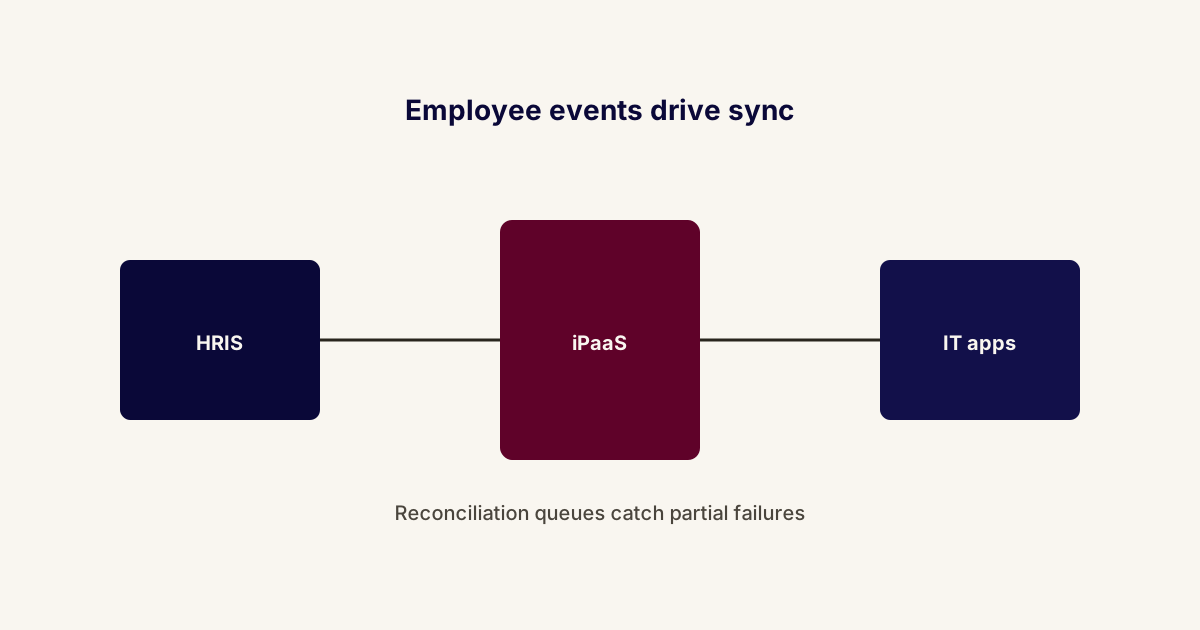
Integration platform as a service, commonly called iPaaS, appeals to organizations seeking rapid connector deployment with minimal custom code. Vendors such as MuleSoft, Boomi, and Workato offer pre-built adapters for hundreds of SaaS applications, reducing time to first integration from weeks to days. The trade-off surfaces when business logic embedded in low-code canvas flows exceeds what the visual tooling can express cleanly. At that threshold, teams face a choice: accept opaque platform-specific constructs or migrate critical logic to version-controlled application code.
Custom integration platforms built on open-source frameworks offer maximum flexibility at the cost of higher operational responsibility. Apache Camel, Spring Integration, and lightweight serverless orchestrators allow teams to express complex transformation and routing logic in familiar programming languages with full test coverage. Organizations with strong platform engineering teams and high integration change velocity often find that the long-term total cost of ownership for custom platforms compares favorably to iPaaS subscription fees, especially when connector requirements concentrate around a small number of core systems.
Data mesh principles are reshaping integration ownership models. Rather than centralizing all data movement through a shared integration team, data mesh distributes responsibility to domain-aligned product teams that publish and consume data products through self-serve infrastructure. This model reduces bottlenecks and improves data quality at the source, but it requires mature platform capabilities including automated schema registration, lineage capture, access policy enforcement, and cost attribution. Without these platform guardrails, distributed ownership devolves into distributed chaos.

Observability across heterogeneous integration estates demands a unified telemetry strategy. Distributed tracing with correlation identifiers propagated through message headers, API calls, and batch job metadata enables end-to-end visibility regardless of transport mechanism. Organizations should standardize on OpenTelemetry for instrumentation and invest in trace-aware alerting that surfaces latency anomalies and error cascades before they propagate downstream. Integration monitoring that only reports component health without request-level tracing provides a dangerously incomplete operational picture.
Error handling and retry strategy design remain underinvested areas in most integration architectures. Dead letter queues, circuit breakers, exponential backoff policies, and poison message isolation each address different failure modes. A comprehensive error taxonomy that maps each failure class to a specific recovery mechanism, along with clear escalation paths for human intervention, prevents the silent data loss that plagues loosely monitored integration estates. Automated reconciliation checks that compare source and target record counts close the loop on reliability assurance.
Integration governance should operate as a lightweight enablement function rather than an approval bottleneck. A curated catalog of approved integration patterns, reusable connector templates, and security baseline configurations empowers domain teams to move quickly within safe boundaries. Governance reviews shift from pre-deployment gate checks to continuous compliance scanning that flags deviations from architectural standards after deployment. This approach preserves developer velocity while maintaining the consistency that large-scale integration estates require.
Vendor lock-in risk intensifies as integration platforms accumulate proprietary state. Message schemas stored in vendor-specific formats, transformation logic expressed in non-portable domain languages, and routing rules embedded in platform configuration rather than application code all increase switching costs. Mitigation strategies include maintaining canonical data models in version control independent of any platform, abstracting vendor-specific connectors behind stable internal interfaces, and periodically validating that critical flows can execute on an alternative runtime.
AI-assisted integration development is an emerging capability that warrants cautious adoption. Code generation tools can accelerate boilerplate connector scaffolding and mapping logic, but generated transformations still require rigorous validation against edge cases, null handling semantics, and character encoding boundaries. Organizations piloting AI-assisted integration should establish review gates that treat generated artifacts identically to human-authored code, subjecting every transformation to the same test coverage and schema conformance requirements.
Looking ahead, the integration landscape will continue to fragment across event, API, file, and emerging protocol categories. Organizations that thrive will be those that invest in classification discipline for each integration flow, platform engineering capabilities that reduce per-integration cost, and observability infrastructure that provides request-level tracing across every transport. The winners will not be those who pick a single pattern, but those who govern a portfolio of patterns with clarity, consistency, and operational rigor.