Insights · Report · Industry · Apr 2026
DER growth, transmission coordination, OT defensive architecture, and regulatory reporting patterns for utilities modernizing while adversaries target industrial control systems.

Grid modernization is accelerating across North America, Europe, and parts of Asia Pacific as utilities replace aging infrastructure with digitally instrumented assets. The convergence of operational technology with enterprise IT systems and cloud analytics platforms creates an attack surface that expands with every smart meter deployment, every distributed energy resource interconnection, and every third-party analytics feed. Adversaries with demonstrated interest in energy infrastructure are refining techniques that exploit the seams between legacy serial protocols and modern IP-based networks.
This report provides a layered defensive framework aligned to common utility operating structures. We address bulk electric system operations, substation and distribution automation, distributed energy resource management, and the enterprise IT layer that consumes operational data for planning, customer programs, and regulatory reporting. The guidance draws on advisory engagements with investor-owned utilities, municipal power agencies, and rural electric cooperatives across multiple NERC reliability regions.
The boundary between operational technology and information technology continues to blur as utilities adopt cloud-hosted SCADA historians, remote substation access platforms, and machine learning models that ingest real-time telemetry. Each integration point introduces network paths that legacy risk assessments never contemplated. Organizations that treat OT security as a subset of IT security misunderstand the domain entirely. Safety, reliability, and deterministic response times govern OT priorities, and cybersecurity controls must accommodate these constraints rather than override them.
NERC CIP standards remain the regulatory baseline for registered entities operating bulk electric system assets. Cloud migration does not eliminate evidence requirements for electronic access control, system security management, change management, and incident reporting. Organizations must map cloud provider roles and responsibilities to on-premises CIP equivalents with explicit documentation. Shared responsibility models that leave ambiguous gaps between utility obligations and cloud provider commitments create audit findings that compound quickly when regional entities conduct spot compliance evaluations.
Evidence collection workflows deserve particular attention in hybrid environments. Log aggregation from cloud-hosted historians, container orchestration platforms, and on-premises relay management systems must converge into a single evidence repository that auditors can traverse without switching tools. Retention policies should align to the longest applicable CIP standard requirement, currently six years for certain access records. Automated evidence tagging reduces manual classification burden and prevents the discovery gaps that trigger enforcement actions during compliance reviews.
We can present findings in a working session, map recommendations to your portfolio and risk register, and help you prioritize next steps with clear owners and timelines.
Distributed energy resources introduce millions of grid-edge endpoints that communicate through a mix of cellular, Wi-Fi, and proprietary radio protocols. Each solar inverter, battery storage controller, and smart thermostat represents a potential pivot point if compromised. Authentication at enrollment, firmware integrity verification during updates, and vendor network segmentation collectively reduce this risk. Utilities should require DER aggregators to demonstrate compliance with IEEE 2030.5 security profiles and to submit annual penetration test summaries as a condition of interconnection agreements.
Substation automation programs replace electromechanical relays with intelligent electronic devices that communicate over Ethernet-based protocols such as IEC 61850. While these upgrades improve fault isolation speed and enable remote configuration, they also expose protection systems to network-borne threats previously confined to enterprise environments. Hardened switches with port-level access control lists, protocol-aware firewalls that inspect GOOSE and MMS traffic, and physically segmented engineering workstations form the minimum viable security posture for modernized substations.
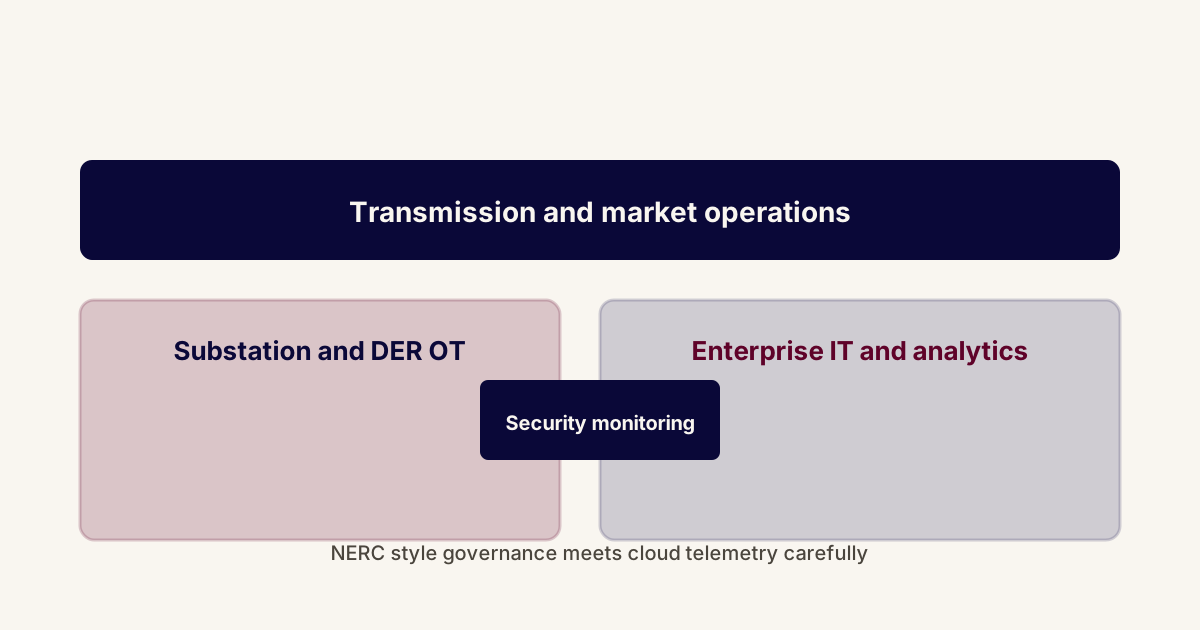
A defensible architecture segments the utility network into clearly defined security zones connected through controlled conduits. The Purdue model, adapted for electric utility operations, places field devices and protection relays in the lowest zones, SCADA servers and historians in intermediate zones, and enterprise applications in upper zones. Each zone boundary enforces explicit allow-list rules. Flat networks that allow unrestricted lateral movement between control centers and corporate email servers represent an unacceptable residual risk that must be addressed before further digitization proceeds.
Data diodes and unidirectional security gateways provide hardware-enforced isolation for the most sensitive operational zones. Real-time telemetry flows outward to enterprise analytics and market reporting systems without permitting any inbound traffic that could carry commands or malware. Organizations deploying these devices should validate that the diode vendor supports the specific industrial protocols in use, including DNP3, IEC 61850, and ICCP. Misconfigured diodes that silently drop critical data undermine both security objectives and operational visibility.
Supply chain risk management for SCADA and industrial control system components demands scrutiny beyond traditional IT procurement checklists. Firmware provenance, hardware integrity attestation, and manufacturing origin documentation matter when adversaries have demonstrated the ability to embed persistent backdoors in embedded systems. Utilities should maintain an approved vendor registry that includes security assessment scores, mandate software bill of materials disclosures for all programmable components, and conduct periodic factory audits for critical path equipment.
Data sharing with independent system operators, regional transmission organizations, and weather service providers requires formal API governance. Third-party analytics platforms should receive aggregated or anonymized telemetry feeds wherever operationally feasible. Contracts governing these integrations should define breach notification timelines, subprocessor approval requirements, and data retention limits. Rate limiting and anomaly detection on outbound API endpoints prevent bulk data exfiltration scenarios that standard perimeter controls alone may not flag during routine monitoring.
The threat landscape facing electric utilities has evolved well beyond opportunistic ransomware. Nation-state adversaries have conducted reconnaissance campaigns against grid operators on multiple continents, probing for footholds in VPN concentrators, exposed remote desktop services, and vendor support tunnels. Ransomware groups have shifted from purely extortion-driven attacks to operations that target safety-critical systems for maximum leverage. Threat intelligence programs tailored to the energy sector, whether operated internally or sourced from sector-specific ISACs, are now a baseline expectation rather than an advanced capability.
Incident response planning for utility OT environments differs fundamentally from enterprise IT playbooks. Isolating a compromised substation controller may trigger protective relay miscoordination that cascades into load shedding events. Response procedures must be co-authored by protection engineers, system operators, and cybersecurity analysts, with explicit decision trees that weigh cyber containment actions against grid reliability consequences. Tabletop exercises that simulate coordinated cyber-physical attacks, run at least twice annually, build the cross-functional muscle memory that written plans alone cannot provide.
Workforce development remains a persistent bottleneck across the utility sector. Protection engineers rarely hold cybersecurity certifications, and security analysts seldom understand relay settings or load flow dynamics. Cross-training programs that rotate staff through both disciplines, supplemented by joint tabletop exercises and shared on-call rotations, reduce the siloed assumptions that cause both outages and breaches. Utilities that invest in combined OT security analyst roles report faster mean time to detect and shorter investigation cycles compared to organizations maintaining entirely separate teams.
Capital planning for cyber resilience should speak the language of reliability indices, insurance posture, and regulatory exposure rather than abstract threat scores. Investment committees respond to outcome-linked metrics: reduction in unplanned outage minutes attributable to cyber events, insurance premium trajectory, and audit finding closure rates. Fear-based budget requests that rely on dramatic breach narratives without quantified business impact erode credibility over successive funding cycles. Disciplined risk quantification anchored to operational outcomes sustains investment through leadership transitions.
Regulatory reporting obligations continue to expand beyond NERC CIP. State public utility commissions, the Department of Energy, and CISA each maintain reporting channels with distinct timelines, classification requirements, and evidence formats. A unified incident documentation workflow that captures technical indicators, operational impact, and timeline details at the point of detection enables parallel reporting without duplicated effort. Organizations that maintain pre-drafted reporting templates for each regulatory channel reduce disclosure latency and minimize the risk of inconsistent statements across agencies.
Looking ahead, the convergence of grid modernization investment, distributed energy proliferation, and escalating adversary sophistication will compress the timeline for utilities still operating with minimal OT security programs. Organizations that build layered defenses now, anchored to regulatory baselines but extending well beyond compliance minimums, will navigate this transition from a position of operational strength. Those that delay will find remediation costs compounding as both the attack surface and the regulatory burden expand in parallel. Appendices include sample DMZ gateway patterns, data diode deployment guides, and vendor questionnaire excerpts tailored for SCADA integrators.