Insights · Report · Industry · May 2026
Sponsor bank partnerships, KYC orchestration, ledger truth, and marketing claims hygiene when non-banks surface accounts, cards, and lending inside consumer apps.

Embedded finance allows consumer brands, vertical SaaS platforms, and marketplace operators to distribute deposit accounts, payment cards, and lending products inside familiar digital experiences. This distribution model has attracted billions in venture funding and reshaped consumer expectations, yet the regulatory reality remains unchanged: behind every branded fintech card sits a chartered bank, a licensed program manager, and a dense web of consumer protection obligations. When marketing velocity outpaces compliance infrastructure, the consequences surface as consent order findings, frozen customer funds, and partnership terminations that damage all parties involved.
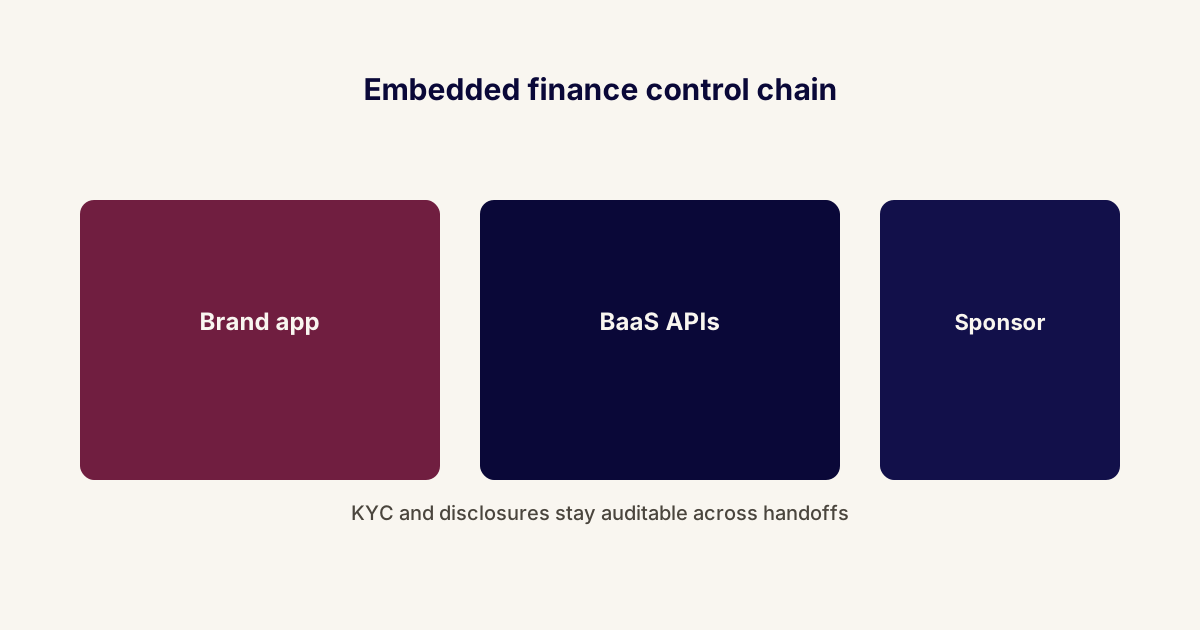
This report examines the governance architecture required to operate embedded finance programs at scale. It maps responsibilities across four tiers, brand application, BaaS middleware platform, sponsor bank compliance, and card network or processor, and identifies the control gaps that emerge when RACI assignments remain informal or undocumented. Organizations planning to launch or expand BaaS partnerships will find actionable frameworks for KYC orchestration, ledger reconciliation, change management, data governance, and exit planning that reduce regulatory exposure while preserving go-to-market agility.
The sponsor bank model underpinning most embedded finance programs creates a unique principal-agent challenge. The bank holds the charter and bears ultimate regulatory accountability, yet the brand controls the user interface, acquisition funnel, and day-to-day customer relationship. BaaS middleware platforms sit between these two parties, translating API calls into core banking transactions. Each layer introduces latency in compliance feedback loops: a risk flag raised by the bank may take days to propagate into the brand experience, by which time thousands of additional accounts may have been opened under the same deficient process.
Regulators have responded to this structural fragmentation with intensified examination pressure. The OCC, FDIC, and state banking departments have issued guidance clarifying that third-party risk management expectations apply fully to BaaS relationships. Sponsor banks must demonstrate that they maintain substantive oversight of every program partner, not merely contractual representations. For brands, this translates into mandatory participation in compliance monitoring, joint audit rights, and real-time data sharing obligations that many technology-first teams initially underestimate.
We can present findings in a working session, map recommendations to your portfolio and risk register, and help you prioritize next steps with clear owners and timelines.
Customer identification program and anti-money-laundering workflows represent the first and most visible governance challenge in embedded finance. Digital onboarding promises sub-minute account opening, but the underlying CIP requirements, identity verification, beneficial ownership collection for business accounts, and OFAC screening, demand orchestration that scales without cutting corners. Programs that launch with manual review queues as a temporary stopgap accumulate compliance debt rapidly, because every application processed outside the automated control path requires retroactive remediation during the next exam cycle.
Effective KYC orchestration layers multiple identity verification providers behind a unified decisioning engine. Document verification, knowledge-based authentication, device intelligence, and biometric matching each carry distinct false-positive and false-negative profiles. A well-governed program defines waterfall rules that escalate ambiguous applicants through progressively more rigorous checks, rather than defaulting to blanket manual review. This orchestration logic should be version-controlled, tested against synthetic identities, and subject to the same change approval process as the bank core system configuration.
Transaction monitoring in embedded finance programs introduces complexity that traditional bank-operated channels rarely encounter. The brand application may process micropayments, subscription charges, peer-to-peer transfers, and earned wage advances through a single program, each generating transaction patterns that confound generic suspicious activity detection models. Sponsor banks must insist on program-specific tuning of monitoring scenarios, calibrated to the expected transaction mix, and brands must supply the contextual data, such as order history or employment verification, that enriches alert triage and reduces false positives.
Ledger reconciliation between brand subledgers and bank core systems constitutes the financial backbone of program governance. Every customer balance displayed in the brand application must reconcile, to the penny, with the corresponding position on the sponsor bank general ledger. Daily reconciliation with aged break analysis, suspense account monitoring, and automated escalation of unresolved items is not optional but essential. Programs that defer reconciliation during high-growth periods risk discovering material discrepancies only when a customer complaint, regulatory inquiry, or partnership dispute forces a full account-level review.
The reconciliation challenge intensifies when programs support multiple funding mechanisms. A single BaaS program may combine direct deposit, ACH debit funding, card load transactions, and promotional credit issuance, each flowing through different settlement networks with distinct clearing timelines. Effective ledger governance requires mapping every funding path to its settlement lifecycle, maintaining memo-post and hard-post distinction, and ensuring that customer-facing available balance calculations never permit spending against unsettled funds unless the program has explicitly underwritten that float risk.
Change management for pricing, fee structures, and terms of service demands joint approval workflows that span all program participants. When a brand marketing team unilaterally adjusts interchange revenue sharing assumptions, reduces monthly fees, or introduces promotional APR offers without coordinating through the bank compliance review process, the resulting disclosures may violate Truth in Lending, Truth in Savings, or Electronic Fund Transfer Act requirements. A formal change advisory board that includes representatives from the brand product team, BaaS platform operations, and sponsor bank compliance should review every customer-facing modification before deployment.
Marketing claims hygiene receives insufficient attention in most BaaS program governance frameworks. Consumer-facing advertising, social media content, influencer partnerships, and in-app promotional messaging all fall within the scope of UDAAP expectations and Regulation Z or DD disclosure requirements. Sponsor banks bear regulatory accountability for misleading claims made by their program partners, even when the bank had no involvement in creating the content. Pre-publication review workflows, prohibited claims libraries, and automated scanning of partner marketing assets reduce this exposure without creating bottlenecks that frustrate growth-oriented brand teams.

Data sharing and privacy governance across the BaaS value chain require purpose-limitation agreements that go beyond generic data processing addenda. Underwriting models may require transaction history and income data. Fraud detection systems need device fingerprints and behavioral analytics. Marketing optimization teams request demographic segmentation data. Each use case demands a distinct legal basis, retention schedule, and deletion procedure documented in a program-specific data sharing agreement. Ad hoc data exports between parties introduce uncontrolled copies that complicate breach notification and regulatory response obligations.
Incident response coordination across program participants exposes governance gaps that tabletop exercises rarely anticipate. When a data breach originates at the BaaS platform layer but affects customer records held under the sponsor bank charter, determining notification responsibility, timeline ownership, and remediation cost allocation requires pre-negotiated incident response protocols. Programs that rely on generic vendor management playbooks discover during actual incidents that contractual ambiguity delays notification, escalation chains are unclear, and customer communication templates conflict between parties.
Complaint management in embedded finance programs requires unified tracking even when resolution authority is distributed. A customer who contacts the brand about an unauthorized transaction may need remediation that only the sponsor bank can authorize. Routing logic must ensure that complaint classification, regulatory reporting timelines, and provisional credit decisions align with Regulation E requirements regardless of which party receives the initial contact. Complaint trend analysis aggregated across all intake channels provides early warning signals for systemic product or process failures.
Exit planning deserves architectural investment from the earliest stages of partnership negotiation, not as a contractual afterthought appended during final legal review. Customer account portability, card reissuance logistics, direct deposit re-routing, data migration, and regulatory notification obligations all require technical specifications and operational runbooks. Programs that neglect exit planning discover during partnership wind-downs that customer data is entangled across systems, card networks require months of lead time for BIN migration, and regulatory approvals for account transfers introduce timelines that conflict with contractual termination dates.
Program governance metrics should track operational health across the full partnership stack. Application approval rates and onboarding completion funnels reveal CIP friction. First payment default curves compared to channel-specific expectations surface underwriting model drift. Complaint rates segmented by acquisition partner and product type identify problematic distribution channels. Reconciliation break aging reports measure ledger integrity. Exam finding closure rates and remediation timelines quantify the speed at which compliance issues are resolved. Together, these indicators form a governance dashboard that gives boards and regulators confidence in program sustainability.
Looking forward, regulatory convergence across federal and state jurisdictions will raise the governance floor for all embedded finance participants. Proposed interagency guidance on bank-fintech arrangements, evolving state money transmitter licensing interpretations, and increasing CFPB scrutiny of earned wage access and buy-now-pay-later products embedded within brand applications will require governance frameworks that adapt quickly to new requirements. Organizations that invest now in modular compliance architectures, clearly documented RACI matrices, and automated monitoring controls will navigate this tightening environment from a position of operational strength rather than reactive remediation.