Insights · Report · Risk · May 2026
Wallet screening, tax receipt valuation, custody choices, and board governance when nonprofits accept digital assets from anonymous or pseudonymous supporters.

Digital asset donations have shifted from a fringe fundraising channel to a material revenue stream for mission-driven organizations across education, healthcare, and environmental conservation. Bitcoin, Ethereum, stablecoins, and tokenized securities now appear on nonprofit balance sheets alongside traditional equity and cash gifts. Yet the compliance infrastructure required to accept these assets responsibly lags well behind donor enthusiasm, creating governance gaps that expose organizations to sanctions risk, tax penalties, and reputational harm.
Total reported cryptocurrency charitable contributions exceeded four billion dollars globally in 2025, a figure that understates the true volume because many gifts flow through donor-advised fund intermediaries that aggregate and anonymize origin wallets. Regulatory bodies in the United States, United Kingdom, European Union, and Singapore have each signaled tighter disclosure expectations for nonprofit recipients. Organizations that treat crypto acceptance as a marketing initiative rather than a compliance program will find themselves unprepared when enforcement actions begin in earnest.
A formal gift acceptance policy must precede the first significant digital asset donation. This policy should define which tokens the organization will accept, establish minimum and maximum gift thresholds, specify the compliance screening workflow, and assign clear roles for legal counsel, the finance committee, and development staff. Policies drafted after a large gift arrives inevitably reflect crisis decision-making rather than deliberate governance, and they rarely survive the scrutiny of an external audit or regulatory inquiry.
Wallet screening forms the first line of defense against sanctions exposure and money laundering risk. Before acknowledging any crypto gift, organizations must verify the sending address against the Office of Foreign Assets Control sanctions list, Interpol databases, and known darknet marketplace clusters. This screening should occur automatically at the point of deposit, not days later during a manual reconciliation cycle. Delayed screening creates a window during which tainted funds may be commingled with operating reserves, complicating remediation.
Blockchain analytics platforms such as Chainalysis, Elliptic, and TRM Labs provide risk scoring and cluster attribution for most major networks. However, these tools carry inherent limitations. Privacy coins, cross-chain bridges, and mixing protocols can obscure transaction provenance to a degree that no commercial tool fully resolves. Organizations should document the analytics vendor selected, the risk threshold calibrated for automatic acceptance versus manual review, and the escalation path when a wallet score falls in an ambiguous range.
We can present findings in a working session, map recommendations to your portfolio and risk register, and help you prioritize next steps with clear owners and timelines.
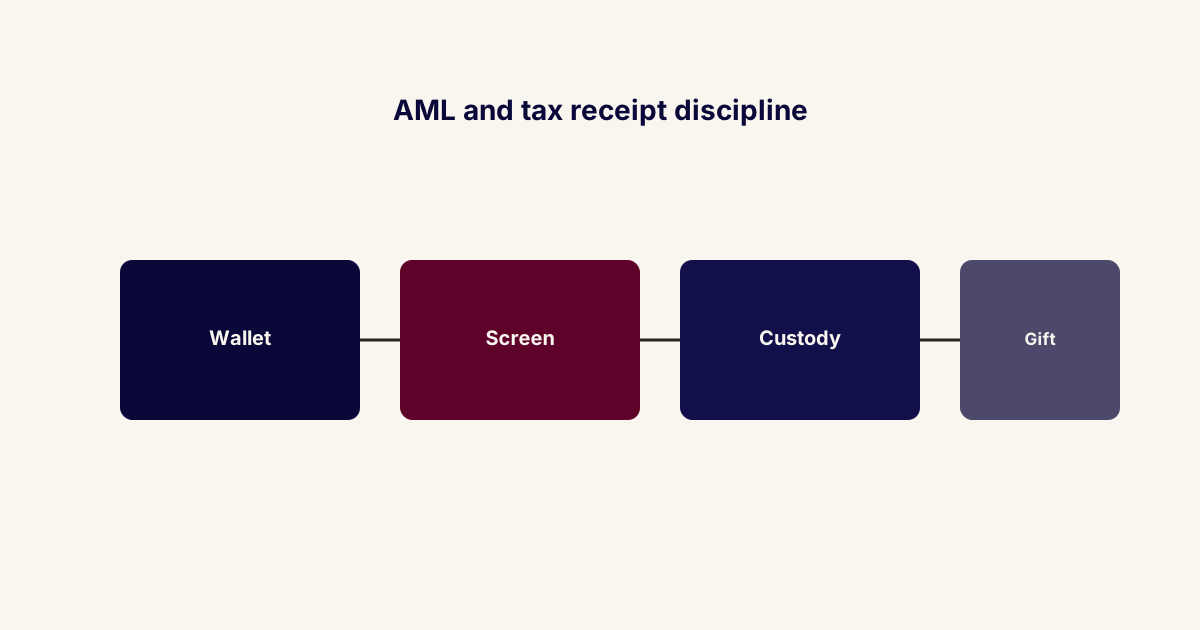
Tax receipt valuation represents one of the most operationally complex aspects of accepting volatile digital assets. In the United States, the IRS requires that noncash charitable contributions exceeding five thousand dollars be supported by a qualified independent appraisal. For publicly traded cryptocurrencies, fair market value at the exact time of receipt may substitute, but the organization must capture and retain a verifiable timestamp, the exchange rate source, and the methodology used to determine value.
Timing precision matters because crypto prices can swing five to ten percent within a single hour. A receipt issued using the daily closing price on a major exchange may differ materially from the actual value at the block confirmation timestamp. Organizations should adopt a written valuation methodology that specifies the exchange reference, the time granularity (block confirmation versus hourly average versus daily close), and any adjustments for illiquid tokens. Auditors will test these records during every financial statement review.
The immediate liquidation versus holding debate divides nonprofit finance committees sharply. Immediate conversion to fiat currency eliminates market risk and simplifies accounting, but it forfeits potential appreciation that long-term holders may capture. A middle-ground approach converts a defined percentage upon receipt and retains a smaller allocation in a segregated digital asset reserve governed by an investment policy addendum. This hybrid strategy requires board-approved parameters for rebalancing triggers, maximum portfolio concentration, and emergency liquidation authority.
Custody model selection carries consequences for operational security, insurance coverage, and fiduciary liability. Third-party custodians regulated as qualified custodians or trust companies offer institutional-grade key management, insurance policies, and SOC 2 audited controls. Self-custody, while eliminating vendor fees and counterparty risk, demands dedicated hardware security modules, geographically distributed key shards, and staff with specialized cryptographic expertise. Most small to mid-size nonprofits lack the internal capacity to execute self-custody safely.
Organizations choosing vendor custody should evaluate the custodian's regulatory status, insurance limits relative to assets under management, disaster recovery procedures, and the contractual terms governing asset segregation during insolvency. The collapse of several centralized crypto platforms in recent years underscores that counterparty diligence for digital asset custodians must be at least as rigorous as the diligence applied to traditional banking relationships. Annual vendor reassessment should be codified in policy, not left to informal relationship management.
Anonymous and pseudonymous donations present a tension unique to blockchain-native fundraising. Donor privacy is a legitimate philanthropic value, yet grant agreements, government contracts, and accreditation standards may require the organization to identify the source of restricted funds. Establishing a clear policy that distinguishes unrestricted gifts, where pseudonymous donations may be acceptable below a defined threshold, from restricted contributions, where full donor identification is mandatory, resolves this tension before it becomes a compliance crisis.
Know Your Donor procedures should be risk-proportionate. For small unrestricted gifts below a board-defined ceiling, automated wallet screening alone may suffice. For gifts above that ceiling, or for any contribution designated for a specific program, the organization should collect the donor's legal name, jurisdiction of residence, and a signed attestation regarding the source of funds. These graduated controls mirror established anti-money laundering frameworks in traditional banking and demonstrate regulatory seriousness to auditors and grantors alike.

Board education is not optional. Trustees bear ultimate fiduciary responsibility for organizational assets, and many board members lack familiarity with blockchain technology, sanctions compliance obligations, and the reputational dynamics of on-chain transparency. A structured onboarding module should cover the mechanics of wallet screening, the volatility profile of accepted tokens, custody insurance limitations, and the scenarios in which accepting a gift could expose the organization to legal or public relations liability.
Legal counsel and the development team must co-own donor communications related to digital asset gifts. Marketing language that oversimplifies tax benefits or implies guaranteed valuations creates liability. Gift acknowledgment letters should reference the organization's valuation methodology, clearly state that the donor is responsible for independent tax advice, and disclose any immediate liquidation policy that may affect the asset's fair market value between pledge and conversion. Precision in language protects both the donor relationship and the organization's compliance posture.
Integration with CRM platforms and the general ledger demands unique identifiers that link wallet addresses to donor records without duplicating entries or losing audit trail continuity. Many nonprofit accounting systems were not designed for noncash, high-frequency, volatile asset classes. Custom middleware or purpose-built integrations should map each deposit event to a donor profile, record the raw and converted values, capture the exchange rate at conversion, and post the appropriate journal entries to both the contribution revenue and digital asset holding accounts simultaneously.
Incident response playbooks must address scenarios that have no direct analog in traditional fundraising. Key compromise events require immediate asset migration to a new wallet, notification to the custodian and law enforcement, and forensic analysis of the compromised infrastructure. Law enforcement requests for transaction history demand pre-built export capabilities and designated points of contact. Fraudulent donation reversals, while technically impossible on most blockchains, may still generate donor disputes that the development team must resolve through established escalation procedures.
The regulatory horizon continues to shift. The Financial Action Task Force travel rule, the European Union Markets in Crypto-Assets regulation, and evolving IRS guidance on digital asset reporting each impose new obligations that nonprofit recipients must track. Designating a compliance officer or external advisor responsible for monitoring regulatory developments and translating them into policy updates ensures the organization does not fall behind. Quarterly regulatory horizon scans, documented and presented to the finance committee, formalize this vigilance.
Operational metrics provide the feedback loop that sustains program integrity over time. Key indicators include average time from deposit to tax receipt issuance, the percentage of incoming gifts screened automatically versus escalated for manual review, wallet rejection rates and the reasons behind them, custody transfer completion times, and reconciliation variance between the blockchain ledger and the general ledger. Dashboards that surface these metrics to leadership enable proactive course correction before compliance gaps widen into reportable findings.
Organizations that build this compliance infrastructure now, before regulatory enforcement matures and donor volumes accelerate further, will capture a meaningful fundraising advantage. Donors with significant digital asset holdings actively seek nonprofits that can accept gifts smoothly, issue accurate receipts promptly, and demonstrate credible governance. Those that delay will face compounding remediation costs, constrained fundraising capacity, and heightened scrutiny from auditors, grantors, and regulators operating in an increasingly structured digital asset landscape.