Insights · Report · Security · May 2026
Prime and subcontractor evidence packages, SBOM depth, CMMC style maturity, and contract flow-down tactics that reduce audit scramble before deliverable gates.

Defense programs operate under the assumption that adversaries will probe the weakest link in a supply chain rather than assault a prime contractor's hardened perimeter directly. This assumption is well supported by incident data. Over the past three years, publicly reported compromises of defense subcontractors have outpaced prime-level breaches by a ratio of roughly four to one. Attestation regimes exist to push evidence requirements down through multiple tiers, yet inconsistent interpretation across contracts creates redundant work, inflated compliance costs, and a false sense of security that masks genuine risk.
This report provides a practical framework for defense industrial base organizations seeking to formalize supply chain cyber attestation in 2026. Drawing on advisory engagements with prime contractors, tier-two and tier-three subcontractors, and Department of Defense acquisition offices, we present a rollup model that aligns evidence depth to component criticality. The guidance is relevant to program managers, supply chain risk officers, information security teams, and contract administrators who must balance audit rigor with operational throughput.
The Cybersecurity Maturity Model Certification program, now entering its operational phase, establishes a baseline vocabulary for defense supply chain security. However, CMMC certification alone does not resolve the attestation challenge. Certification captures a point-in-time snapshot of a contractor's security posture, while adversary tactics evolve continuously. Organizations that treat certification as a finish line rather than a recurring milestone expose themselves to drift between assessment cycles. Continuous attestation, anchored to quarterly evidence refreshes, closes this gap.
A tiered attestation model assigns evidence expectations proportional to the criticality and sensitivity of the components a supplier provides. Tier one suppliers delivering mission-critical firmware or weapon system software warrant the deepest scrutiny, including independent third-party assessments, full software bill of materials disclosure, and continuous monitoring telemetry. Tier two suppliers contributing non-critical subsystems may satisfy requirements through annual self-assessments cross-referenced against prime-published control baselines. Tier three vendors supplying commercial off-the-shelf commodities need only map existing SOC 2 or ISO 27001 reports to the prime's control framework with documented gap acceptance.
We can present findings in a working session, map recommendations to your portfolio and risk register, and help you prioritize next steps with clear owners and timelines.
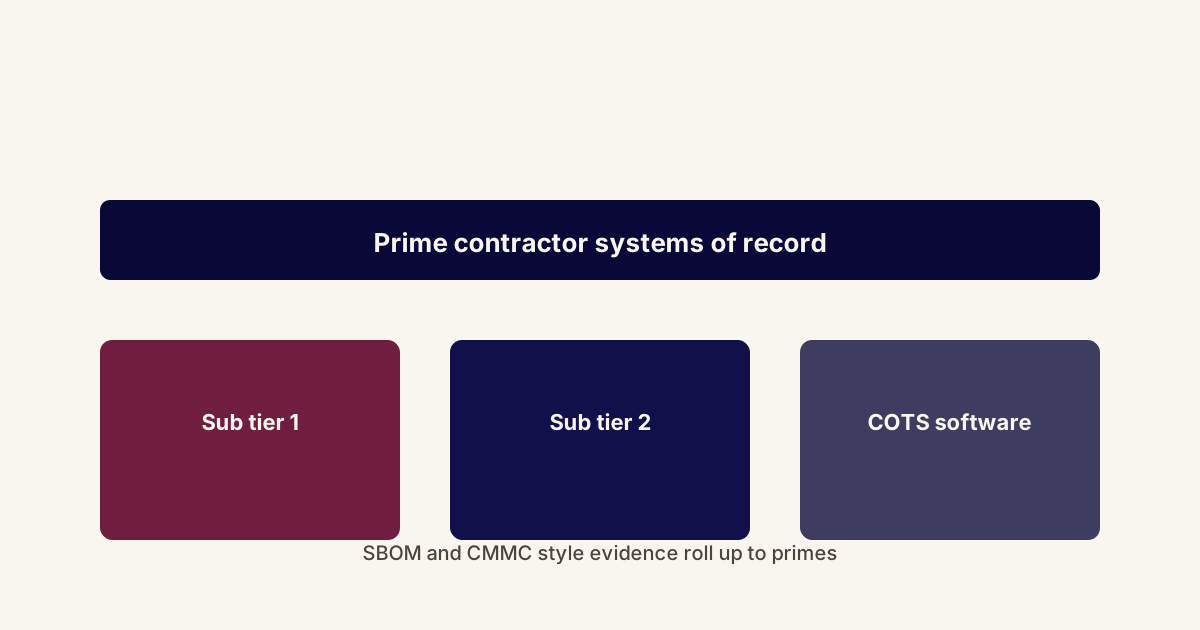
Software bills of materials have become a centerpiece of supply chain attestation, but depth rules remain poorly defined across most contracts. A shallow top-level inventory that lists direct dependencies without traversing the transitive dependency tree misses the vulnerabilities that matter most in embedded firmware and real-time operating system environments. Depth requirements should scale with system criticality. Mission-critical weapon system software warrants full transitive enumeration down to the library level, while administrative tools may only require two levels of dependency resolution.
SBOM formats also demand standardization. The industry has converged on SPDX and CycloneDX as the dominant serialization standards, yet many subcontractors still submit flat spreadsheets that cannot be ingested by automated vulnerability correlation engines. Primes should mandate machine-readable SBOM delivery in one of these two formats, with a defined schema version, and reject submissions that lack the minimum required fields: supplier name, component name, version string, and known vulnerability cross-references. Automation at the ingestion boundary dramatically reduces the manual labor that currently consumes weeks of analyst time before each deliverable gate.
Controlled unclassified information handling intersects every communication channel in a defense program, from email threads and file shares to SaaS collaboration platforms and cloud development environments. Too many organizations treat CUI compliance as a checkbox exercise layered onto existing workflows rather than an architectural concern. Architecture reviews should map every CUI data path, classify each segment according to sensitivity markings, and enforce encryption, access control, and audit logging requirements at each boundary. When collaboration moves to a new platform, the CUI data flow map must be updated before classified material traverses the new path.
Evidence package standardization is the single most impactful improvement a prime contractor can make to reduce attestation friction across its supply base. When each program office invents its own questionnaire format, subcontractors that serve multiple primes spend more time reformatting answers than actually improving their security posture. We recommend that primes adopt a common evidence package template that aligns to NIST SP 800-171 control families, includes structured fields for artifact references, and provides a machine-readable manifest that automated compliance platforms can ingest without manual transcription.
Contract flow-down clauses remain the enforcement mechanism for supply chain attestation, yet many flow-down provisions are drafted in vague language that gives subcontractors wide latitude to self-interpret requirements. Effective flow-down clauses specify the exact control baseline, the evidence format, the submission cadence, the remediation timeline for identified gaps, and the contractual consequence of non-compliance. Ambiguity in any of these dimensions invites inconsistency and erodes the evidentiary chain that program managers rely on when certifying deliverables.
Foreign ownership, control, or influence screening is a critical but frequently neglected component of supply chain attestation. Most programs perform FOCI screening at contract award, then never revisit the question. Changes in beneficial ownership, board composition, or financing arrangements can occur at any point during a multi-year program. We recommend that primes require subcontractors to self-certify their FOCI status at every annual renewal and to provide immediate notification of material changes. Automated corporate registry monitoring services can supplement self-certification by flagging ownership changes that subcontractors might delay reporting.
Incident reporting timelines under defense contract clauses are significantly tighter than commercial norms. The 72-hour reporting window mandated by DFARS 252.204-7012 demands that subcontractors maintain detection and triage capabilities sufficient to identify a reportable incident, assess its scope, and notify both the prime and the DoD Cyber Crime Center within that compressed window. Joint response playbooks, pre-negotiated between primes and their critical subcontractors, reduce the confusion that arises when two organizations simultaneously attempt to notify the same government contact with contradictory facts.
Tabletop exercises that simulate a subcontractor breach scenario are among the most effective tools for validating joint response readiness. We recommend that primes conduct at least one cross-organizational tabletop per year with each tier-one subcontractor, rotating scenarios to cover ransomware, insider threat, supply chain injection, and denial of service. After-action reports from these exercises should feed directly into the attestation evidence package, demonstrating not only that controls exist on paper but that operational teams can execute them under pressure.

Commercial off-the-shelf vendors present a unique attestation challenge. COTS providers serve thousands of customers and typically refuse to complete bespoke security questionnaires for individual defense programs. Rather than entering a compliance standoff, primes should develop a COTS mapping methodology that translates the vendor's existing SOC 2 Type II report, ISO 27001 certificate, or FedRAMP authorization into the program's control framework. Where the mapping reveals gaps, the prime documents an explicit risk acceptance decision rather than demanding that the vendor modify its product for a single customer.
Plans of action and milestones deserve disciplined lifecycle management rather than the one-time documentation treatment they often receive. Every identified gap should have a named owner, a remediation target date, interim compensating controls, and a verification procedure that confirms closure. Primes should track mean time to close POA&M items across their supply base and flag subcontractors whose remediation velocity consistently lags. Persistent open items beyond their target date should trigger escalation to the program's risk board for formal disposition.
Automation plays an increasingly vital role in scaling attestation across large supplier portfolios. Manual evidence review does not scale when a major weapon system program involves hundreds of subcontractors across dozens of countries. Governance, risk, and compliance platforms that ingest structured evidence packages, correlate findings against the control baseline, and surface anomalies for human review reduce analyst workload by an order of magnitude. Investment in GRC tooling pays for itself within the first assessment cycle for programs with more than fifty in-scope suppliers.
Subcontractor onboarding is the first and most critical control point in the attestation lifecycle. Security requirements should be communicated before contract execution, not discovered after work begins. A pre-award security questionnaire, combined with a clear statement of the attestation cadence and evidence format expectations, allows prospective subcontractors to price compliance into their proposals. This transparency reduces post-award disputes and prevents the scramble that occurs when a subcontractor realizes mid-program that it lacks the infrastructure to meet its contractual obligations.
Workforce training across the supply chain remains an underinvested area. Attestation is not solely a technology problem. Human errors, from misconfigured access controls to misdirected CUI emails, account for the majority of security incidents in the defense industrial base. Primes should require evidence that subcontractor personnel handling controlled information have completed role-specific training within the past twelve months. Training records, including completion dates and topic coverage, should be part of the standard evidence package submitted at each attestation cycle.
Closing metrics provide the quantitative foundation for continuous improvement. We recommend that program offices track five key indicators: percentage of in-scope suppliers meeting minimum attestation scores, mean time to close POA&M items, defect density found during joint assessments, subcontractor incident reporting latency measured against the 72-hour threshold, and evidence package rejection rate at the automated validation boundary. Quarterly dashboards that surface these metrics to program leadership create accountability and highlight systemic weaknesses before they become exploitable vulnerabilities.
The companion checklist available for download consolidates the recommendations in this report into an actionable format. It includes a tiered attestation scoping worksheet, an evidence package template aligned to NIST SP 800-171 revision three, a COTS vendor mapping matrix, a joint incident response playbook outline, and a POA&M lifecycle tracker. Each artifact has been reviewed against current DFARS clause language and CMMC assessment guidance and is designed for adoption with minimal customization by programs of any scale.