Insights · Report · Data & AI · Mar 2026
Identity resolution, consent enforcement, and governed activation paths for firms that must prove lineage and access control to supervisors.

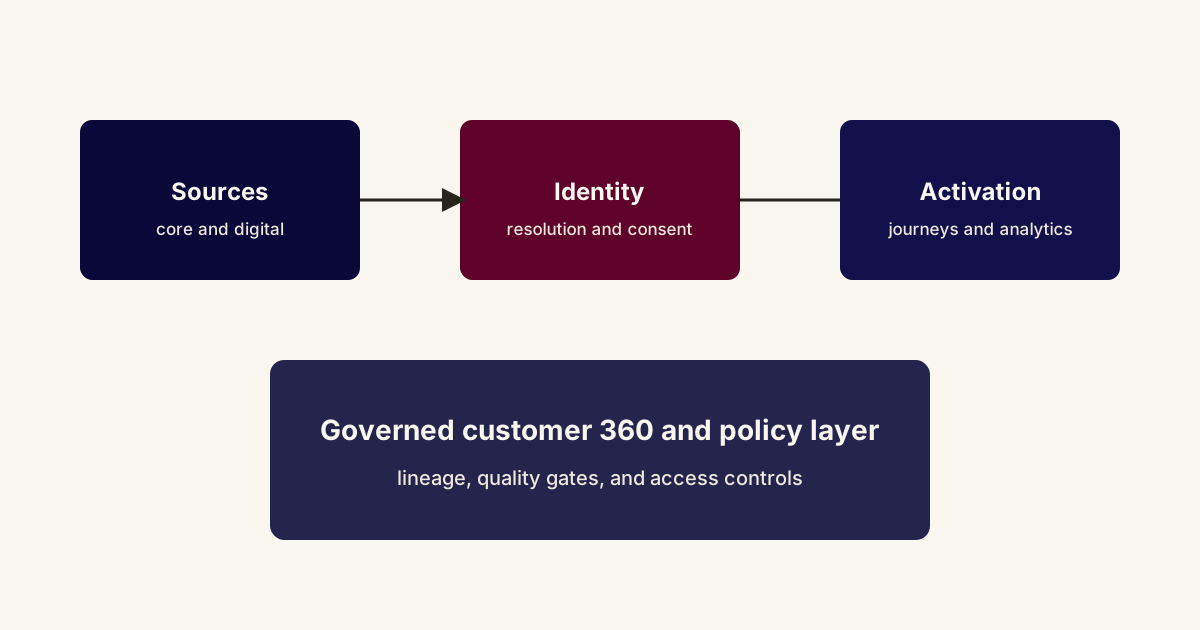
Customer data platform initiatives in banking and insurance occupy a unique intersection of competing pressures. Marketing teams demand sub-second audience activation, compliance officers require demonstrable consent lineage, and model risk committees insist on explainable inputs. Architecture patterns that succeed in regulated financial services treat privacy, lineage, and access control as first-class product requirements rather than audit afterthoughts bolted on before a regulatory examination.
The stakes are substantially higher than in retail or media verticals. A misstep in customer identity merging can trigger fair lending violations, inaccurate insurance pricing, or erroneous Suspicious Activity Report filings. Regulators across the OCC, FCA, APRA, and EIOPA now expect firms to demonstrate how a given customer profile was assembled, which source systems contributed each attribute, and what consent basis authorized each downstream use. This report provides the reference architectures, control patterns, and decision frameworks required to meet those expectations.
Retail banking presents the most fragmented identity landscape. A single household may hold checking accounts, savings vehicles, mortgage products, and credit cards, each originated through a different channel with a different onboarding workflow. Core banking platforms often assign separate customer identifiers per product line, creating duplicate profiles that undermine cross-sell analytics and inflate marketing spend. Deterministic matching on tax identification numbers resolves a meaningful share of duplicates, but regulatory restrictions on using those identifiers for marketing purposes limit their utility as universal join keys.
Probabilistic identity resolution fills the gap by scoring candidate matches on combinations of name variants, normalized addresses, device fingerprints, and behavioral signals such as login cadence. The critical governance requirement is a match confidence threshold that is tunable per use case. A threshold appropriate for a personalized website banner is far too permissive for a consolidated credit exposure calculation. Architecture teams should expose confidence scores as first-class attributes on the unified profile so that consuming applications can apply their own risk-appropriate cutoffs.
Wealth management adds relational complexity. A single client may act as an individual account holder, a trust beneficiary, a corporate signatory, and a family office principal simultaneously. The customer data platform must model these roles as distinct relationship edges rather than collapsing them into a single entity. Failure to preserve role granularity produces misleading assets-under-management calculations and can breach Chinese wall requirements between advisory and brokerage functions.
We can present findings in a working session, map recommendations to your portfolio and risk register, and help you prioritize next steps with clear owners and timelines.
Property and casualty insurance introduces yet another identity paradigm. Policyholders, named insureds, claimants, and third-party litigants interact with the carrier through overlapping but legally distinct relationships. A claimant on one policy may simultaneously be a loyal policyholder on another. Merging those identities without contextual separation distorts loss ratios and can bias fraud scoring models. The reference architecture isolates policy-context identity from enterprise-level identity, linking them through governed crosswalks that preserve the original relationship semantics.
Life and annuity carriers face the longest customer lifecycles in financial services, sometimes spanning decades between policy issuance and benefit disbursement. Data platforms must accommodate identifier drift as customers change names, addresses, and contact channels over twenty or thirty year horizons. Periodic re-verification campaigns, triggered by life events such as beneficiary changes or policy loans, provide natural opportunities to refresh identity anchors without introducing friction into routine servicing interactions.
Consent management in financial services operates under a dual regime. Privacy regulations such as GDPR, CCPA, and LGPD define consent as a legal basis for processing personal data. Simultaneously, sector-specific rules, including the Gramm-Leach-Bliley Act in the United States, impose opt-out and information-sharing notice obligations that apply regardless of broader privacy consent. The customer data platform must enforce both layers, routing activation requests through a policy engine that evaluates jurisdiction, product line, consent status, and regulatory classification before releasing any audience segment.
Purpose limitation is the operational translation of consent into enforceable system behavior. Each data attribute entering the platform should carry metadata tags indicating the purposes for which it was collected: servicing, marketing, underwriting, fraud detection, or regulatory reporting. Activation channels, whether batch file exports, reverse ETL pipelines, or real-time API lookups, must filter attributes based on the purpose declared by the requesting system. A campaign management tool requesting email addresses for a cross-sell offer should never receive attributes collected solely for anti-money laundering screening.
Data lineage in a customer data platform extends beyond traditional ETL job tracking. Regulators expect firms to reconstruct the provenance of any attribute that influenced a customer-facing decision: which source system produced it, when it was ingested, how it was transformed, and whether it passed quality validation gates. Column-level lineage captured at ingestion time, paired with transformation lineage recorded by the orchestration layer, creates an audit chain that satisfies both model risk management and data protection impact assessment requirements.
Quality and lineage are inseparable in practice. A lineage graph that cannot confirm whether a customer address was validated against a postal authority database within the past twelve months provides incomplete assurance. Minimum viable data quality service level agreements should specify freshness thresholds, completeness targets, and accuracy benchmarks for every attribute tier. Attributes feeding pricing models, underwriting engines, or regulatory calculations warrant the strictest quality gates, while attributes supporting low-risk personalization can tolerate wider tolerances.
Activation architecture determines how unified customer profiles reach the systems that act on them. Batch exports remain dominant for large-scale campaign execution and regulatory reporting extracts. Reverse ETL pipelines synchronize curated profile attributes into CRM platforms and service clouds on hourly or daily cadences. Event-driven streams power real-time triggers such as next-best-action recommendations during call center interactions or instant fraud alerts during claims intake. API lookup endpoints serve low-latency decisioning systems that cannot tolerate the delay of even a streaming pipeline.
Each activation path introduces its own threat surface. Batch exports risk excessive data extraction when file-level access controls are coarser than attribute-level consent permits. Reverse ETL connections can accumulate stale service account credentials that persist long after the original integration owner has left the organization. Event streams may inadvertently propagate personally identifiable information into log aggregation systems that lack appropriate retention controls. API endpoints require rate limiting, mutual TLS authentication, and response payload filtering to prevent downstream systems from harvesting attributes beyond their declared purpose.

Security architecture reviews should treat each activation path as a discrete data flow with its own risk assessment, control inventory, and periodic recertification schedule. The report includes a checklist template that maps common activation patterns to the NIST Cybersecurity Framework and aligns control expectations with the supervisory guidance published by the Basel Committee on Banking Supervision and the International Association of Insurance Supervisors.
Analytics sandboxes represent a frequently underestimated risk vector. Data scientists and actuaries require broad access to customer attributes for exploratory modeling, yet sandbox environments often operate with weaker access controls than production systems. When a sandbox query inadvertently joins sensitive health indicators with marketing identifiers, the resulting dataset may violate both privacy regulations and internal ethical use policies. Governed sandboxes enforce attribute-level masking rules, session-scoped access grants, and automated scanning that flags potential policy violations before results can be exported.
The build-versus-buy decision for customer data platform components defies a single universal answer. Identity resolution engines vary enormously in their support for probabilistic matching, household modeling, and temporal identity management. Feature stores range from lightweight key-value caches to full-featured platforms with point-in-time correctness guarantees essential for regulatory backtesting. Journey orchestration tools differ in their ability to enforce consent-aware branching logic. Each component should be evaluated independently against a weighted scorecard that reflects the firm's regulatory posture, existing technology estate, and internal engineering capacity.
Vendor lock-in risk deserves particular scrutiny. Several prominent customer data platform vendors bundle identity resolution, consent management, and activation orchestration into a single proprietary stack with limited data portability. When regulatory requirements change or a vendor's roadmap diverges from the firm's architecture strategy, migration costs can be prohibitive. Contracts should specify data export formats, API access guarantees during transition periods, and clear intellectual property boundaries for any models trained on the firm's customer data.
Implementation sequencing matters as much as architecture design. Firms that attempt a full-scope deployment across all business lines simultaneously face compounding integration complexity and stakeholder fatigue. A phased approach that begins with a single product line, establishes governance patterns through operational experience, and then expands scope incrementally produces more durable outcomes. The first phase should target a business line with manageable data volume, a motivated business sponsor, and a near-term regulatory examination that creates natural urgency.
Organizational alignment is the most common failure mode we observe in customer data platform programs. Technology teams optimize for pipeline throughput, marketing teams optimize for activation speed, and compliance teams optimize for auditability. Without a shared operating model that defines ownership boundaries, escalation paths, and joint success metrics, these competing priorities produce architectural compromises that satisfy no stakeholder fully. A dedicated data product owner, empowered to adjudicate trade-offs and accountable to a cross-functional steering committee, is the minimum viable governance structure.
The appendices accompanying this report provide practical artifacts designed for immediate operational use. These include request-for-proposal evaluation language for identity resolution and consent management vendors, sample golden record definitions for retail banking and property and casualty insurance, access review test cases aligned to SOX and DORA expectations, and a decision record template that captures build-versus-buy trade-offs in a format suitable for board-level review. Each artifact has been refined through engagements with regulated institutions across North America, the European Union, and the Asia-Pacific region, and is intended to reduce rework when internal audit or supervisory examiners request repeatable evidence.