Insights · Report · Industry · Apr 2026
Smart building telemetry, tenant isolation, lease data rights, and cybersecurity for landlords digitizing access control, HVAC optimization, and occupant experience apps.

Commercial real estate has entered a data-intensive era. Landlords now deploy smart building platforms that ingest badge swipe logs, HVAC zone telemetry, elevator call patterns, Wi-Fi association records, and conference room occupancy signals. The promise is compelling: lower operating costs, improved tenant satisfaction, and differentiated amenities that justify premium rents. Yet the volume and granularity of data these systems collect have outpaced the governance structures meant to protect tenant privacy and ensure equitable use.
This report provides a comprehensive trust framework for commercial proptech deployments in 2026. Drawing on advisory engagements with Class A office portfolios, mixed-use developers, and institutional landlords across North America and Western Europe, we outline the contractual, technical, and organizational controls necessary to build durable tenant confidence. The guidance is designed for property technology teams, asset managers, leasing counsel, and cybersecurity leaders responsible for smart building programs.
Tenants are asking harder questions before signing leases. Prospective occupants in regulated industries, particularly financial services, healthcare, and government contractors, now include building data practices in their due diligence checklists. Ambiguous answers about who can access badge swipe histories, whether occupancy analytics feed third-party benchmarking services, or how long visitor records are retained have delayed lease executions by weeks in multiple engagements we observed during 2025.
The root cause is a misalignment of expectations. Landlords view building telemetry as an operational asset that belongs to the property. Tenants view any data generated within their demised premises as confidential business information. Neither perspective is entirely wrong, but without a shared taxonomy that classifies data by origin, sensitivity, and purpose, disputes are inevitable. A trust layer that sits between tenant applications and landlord platforms resolves this tension through policy enforcement rather than legal argument alone.
We propose a three-tier data classification model. The first tier covers infrastructure telemetry, including chiller performance, riser temperatures, and common area foot traffic, which the landlord owns and may use freely for building optimization. The second tier encompasses tenant-attributable data, such as floor-level occupancy counts and HVAC setpoint preferences, requiring explicit consent before aggregation or sharing. The third tier includes personally identifiable information like badge holder names and biometric templates, subject to the strictest retention and access controls.
We can present findings in a working session, map recommendations to your portfolio and risk register, and help you prioritize next steps with clear owners and timelines.
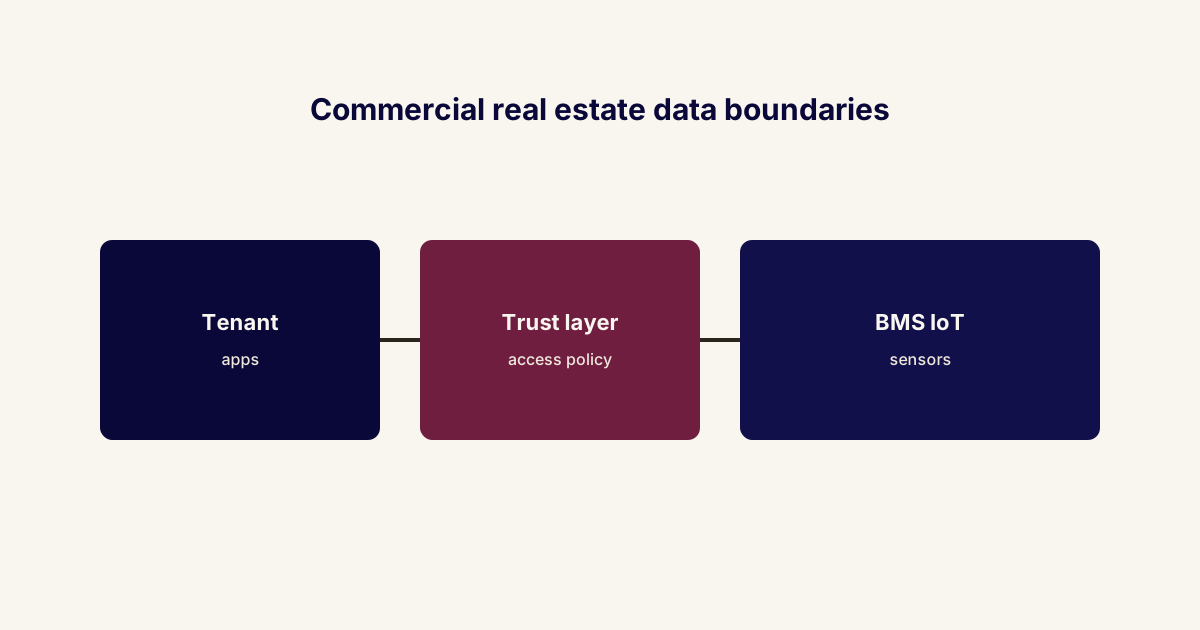
Access control systems sit at the intersection of physical security and data governance. Modern credential platforms issue mobile badges, log entry and exit timestamps, and integrate with visitor management portals. When these systems feed data into landlord analytics dashboards, tenants lose visibility into who can query their employees' movement patterns. Policies should enforce named-purpose access, meaning that every query against tenant-attributable credential data must reference an approved use case and be logged in an immutable audit trail.
IoT device lifecycle management is a frequently overlooked governance surface. Smart building sensors, controllers, and edge gateways often run embedded firmware that receives infrequent updates. A compromised BACnet controller or an unpatched IP camera on a shared riser can provide lateral movement into tenant corporate networks. Landlords must maintain a device inventory with firmware version tracking, enforce certificate rotation schedules, and contractually require vendors to deliver security patches for the full expected service life of each device.
Network segmentation is the technical foundation of tenant data isolation. Building management system traffic, tenant corporate traffic, guest Wi-Fi traffic, and IoT sensor traffic should each reside on separate VLANs with firewall rules that default to deny. Shared risers and telecommunications rooms require documented demarcation points. Penetration testing scoped to cross-segment traversal should be conducted annually, and results shared with tenant security teams under mutual nondisclosure to maintain collaborative trust.
Mixed-use properties introduce identity complexity that single-use buildings rarely face. A single development may host office tenants, retail shoppers, residential occupants, hotel guests, and coworking members. Each population has distinct consent expectations and regulatory treatment. Retail visitors passing through a common lobby should not be subjected to the same facial recognition screening applied to secure office floors. Role-based access policies, enforced at the network and application layers, must cleanly separate these populations.
Captive portal disclosures for guest and common-area Wi-Fi networks deserve more attention than they typically receive. Many properties still present generic terms of service that fail to mention occupancy analytics, dwell-time measurement, or MAC address collection. Regulators in the European Union and several US states increasingly view these omissions as material nondisclosures. Clear, concise portal language that names each data category, its purpose, and its retention period reduces both regulatory risk and tenant friction.
ESG reporting creates a secondary data flow that often bypasses tenant consent frameworks entirely. When landlords cite occupancy-based energy efficiency metrics in sustainability disclosures, they implicitly rely on tenant-attributable data. If tenants did not agree to have their floor-level consumption patterns included in public marketing materials or investor presentations, the landlord faces both reputational and legal exposure. Measurement methodologies for ESG claims must map directly to the data sharing scopes consented to in the lease addendum.
Vendor lock-in is an underappreciated risk in commercial proptech procurement. Proprietary access control platforms, visitor management systems, and building analytics dashboards frequently store data in closed formats with limited export capabilities. When a landlord decides to switch vendors, or when a tenant requests a copy of their own occupancy data, extraction becomes a costly, time-consuming project. Procurement evaluations should weight open API availability, standard data export formats, and contractual portability clauses alongside feature comparisons.
Cybersecurity incident response in multi-tenant buildings demands coordinated playbooks that span both landlord and tenant security teams. A breach of the building access control system may expose tenant employee identities and movement patterns, while a compromised tenant endpoint connected to building Wi-Fi could propagate laterally into shared infrastructure. Finger-pointing during notification windows amplifies harm and extends exposure. Pre-agreed escalation paths, joint tabletop exercises, and shared communication templates reduce response time significantly.
Notification obligations compound the urgency. Under the EU General Data Protection Regulation, breach notifications must reach supervisory authorities within seventy-two hours. Under various US state laws, tenant employees whose personal data was exposed may be owed direct notification within similar timeframes. Landlord and tenant counsel must pre-negotiate who bears notification responsibility for each data tier, who drafts the public statement, and how forensic investigation costs are allocated between the parties.
Lease addenda should formalize the entire data governance relationship. We recommend clauses that define the data classification tiers, enumerate permitted analytics use cases, name approved subprocessors, establish retention and deletion schedules aligned to the lease term plus any legally required minimums, and grant tenants the right to audit landlord data practices annually. These clauses should be co-owned by leasing counsel and the property technology team to ensure enforceability matches technical capability.
Program health metrics provide the ongoing accountability mechanism that static lease clauses cannot. We recommend tracking consent coverage rate, measuring the percentage of active data flows covered by explicit tenant authorization. Additional metrics include mean time to fulfill tenant data access requests, audit finding closure rate, and the number of cross-segment penetration test findings remediated within agreed timelines. Quarterly reporting to both landlord asset management and tenant facility contacts sustains trust over multi-year lease horizons.
The downloadable companion package accompanying this report includes a model lease data processing addendum, a three-tier data classification matrix template, an IoT device inventory and firmware tracking worksheet, a joint incident response playbook outline, and a quarterly proptech governance scorecard. Each template has been reviewed against current GDPR, CCPA, and emerging US federal privacy legislation expectations. Property teams can adopt these resources with minimal customization to establish a defensible, tenant-aligned proptech trust framework.