Insights · Report · Strategy · May 2026
Activity data pipelines, emission factor governance, audit trails for removals, and disclosure readiness when investors compare software-generated footprints across portfolios.

Climate software vendors promise automated carbon footprints, yet assurance failures persist when organizations treat these platforms as marketing tools rather than auditable financial-grade systems. Activity data arrives stale, emission factors mismatch regional electricity grids, and removal credits lack durable chain-of-custody evidence. As investors begin comparing software-generated footprints across portfolios, the gap between disclosure theater and genuine measurement integrity is becoming a material risk factor for capital allocation decisions.
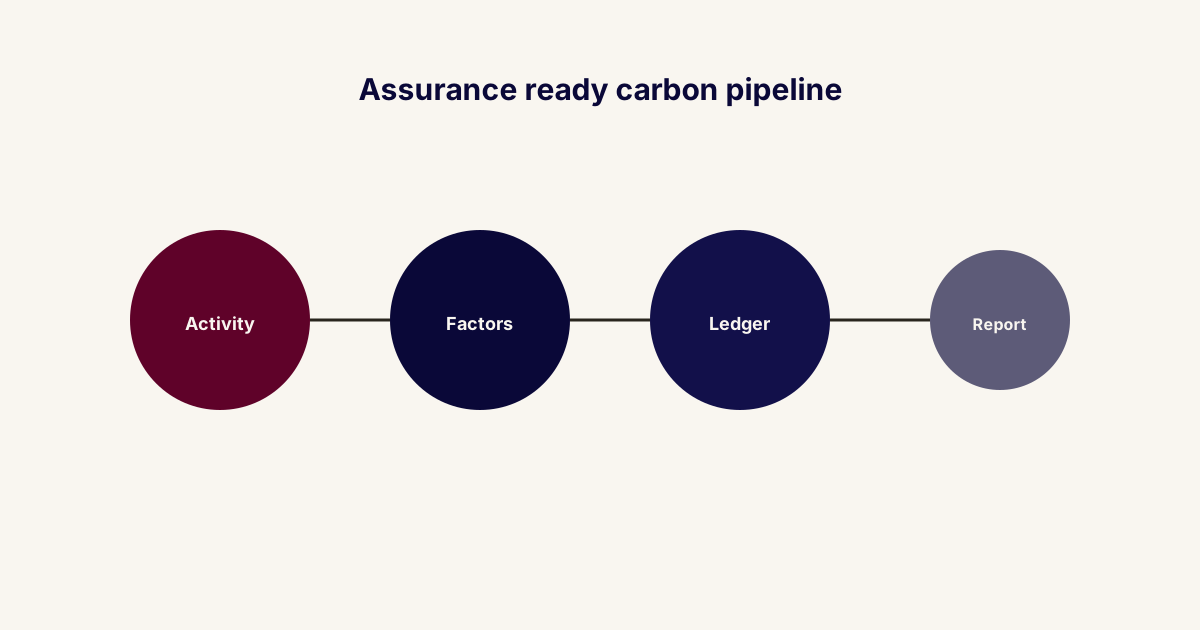
This report sequences the critical stages of carbon accounting: ingestion, normalization, factor application, uncertainty quantification, and disclosure export. Each stage demands clear data ownership, complete version history, and formal change approval workflows suitable for external assurance review. Organizations that skip these governance layers will discover, often during a regulator inquiry or investor due diligence cycle, that their reported numbers cannot withstand even moderate scrutiny.
Activity data pipelines form the foundation of every credible carbon footprint. Utility invoices, fuel purchase records, fleet telematics, and building management system feeds all carry distinct formats, latency profiles, and quality risks. Mature organizations normalize these inputs through a centralized ingestion layer that timestamps every record, flags gaps, and reconciles totals against financial accounts payable data. Without this reconciliation step, carbon reports drift from economic reality and auditors raise material findings.
The challenge intensifies for multinational operations. A facility in Southeast Asia may report electricity consumption in kilowatt-hours from a monthly utility statement, while a European campus streams fifteen-minute interval data from smart meters. Normalization engines must handle unit conversions, time zone alignment, currency-denominated energy purchases, and estimated versus metered splits. Documenting these transformation rules in version-controlled configuration files is essential for reproducibility across reporting periods.
We can present findings in a working session, map recommendations to your portfolio and risk register, and help you prioritize next steps with clear owners and timelines.
Emission factor governance deserves the same rigor organizations apply to financial reference data. Factors sourced from IPCC databases, national inventory agencies, and commercial providers each carry update cycles, geographic applicability constraints, and uncertainty ranges. When a platform silently updates its factor library mid-reporting-period, previously calculated footprints shift without any change in underlying activity. Effective-dating each factor version, maintaining a detailed change log, and requiring sign-off before updates propagate prevents this silent recalculation problem.
Scope 1 and Scope 2 emissions, while conceptually simpler than downstream supply chain categories, still present measurement challenges that organizations routinely underestimate. Fugitive emissions from refrigerant leaks demand engineering estimates rather than direct metering. Market-based Scope 2 calculations require matching energy attribute certificates to consumption periods with contractual precision. Dual reporting of both location-based and market-based figures, reconciled in a single system, prevents the conflicting numbers that erode stakeholder confidence.
Scope 3 complexity demands structured partner data sharing agreements well beyond informal spreadsheet exchanges. Procurement teams should embed carbon data fields, quality grades, and methodological transparency requirements alongside price and service level terms in supplier contracts. Category-level screening estimates may suffice for immaterial spend segments, but primary data collection from top-tier suppliers becomes unavoidable as disclosure frameworks tighten. A tiered engagement model balances data quality ambitions against supplier relationship friction.
Carbon removal and offset modules require fraud-resistant architecture, not merely good intentions. Every credit must carry a globally unique serial number linked to a recognized registry. Retirement events should trigger immutable ledger entries that third-party verifiers can independently audit. Double-counting risks escalate when organizations operate across voluntary and compliance markets simultaneously. Architectural controls that enforce one-to-one retirement matching and surface registry status in real time belong in the platform core data model from day one.
Audit trail completeness separates assurance-ready platforms from reporting tools that merely generate charts. Every calculation should be traceable from the disclosed figure back through the factor applied, the normalization rule invoked, and the raw source record ingested. Immutable append-only logs, cryptographic hashes on exported reports, and role-based access controls that prevent retroactive edits form the minimum viable control environment for limited or reasonable assurance engagements under emerging regulatory standards.
Disclosure readiness varies dramatically by jurisdiction and framework. The European Sustainability Reporting Standards, the SEC climate disclosure rule, California SB 253 and SB 261, and the International Sustainability Standards Board each impose distinct boundary definitions, materiality thresholds, and assurance level expectations. Organizations operating across multiple regulatory regimes benefit from a modular reporting architecture that maintains a single data spine while generating jurisdiction-specific output packs, reducing scramble when rules tighten or new mandates emerge.
Scenario analysis for transition risk should connect to the same data lineage as compliance reports. When internal strategy models and external disclosures draw from divergent datasets, leadership faces embarrassment when numbers disagree in the same board presentation. Linking scenario modeling tools to the carbon accounting ledger through shared reference data and consistent boundary definitions ensures that a two-degree pathway analysis and an annual sustainability report tell a coherent, defensible story.
IT sustainability teams increasingly face pressure to quantify the carbon footprint of their own application portfolios. Aligning application-level carbon proxies, derived from cloud provider usage data and energy proportional allocation models, with finance-grade cost allocation methodologies strengthens credibility. When the technology estate carbon narrative diverges from the financial narrative, skeptical board members and informed investors quickly notice the inconsistency. Unified allocation keys across both domains eliminate this vulnerability entirely.
Technology selection criteria should prioritize data lineage transparency, factor library governance capabilities, and integration depth with enterprise resource planning and procurement systems. Vendor demonstrations that focus on dashboard aesthetics over audit trail completeness signal a product designed for marketing teams rather than assurance professionals. Procurement evaluations should include a control environment assessment modeled on SOC 2 Type II criteria, verifying that the vendor internal controls support the accuracy of hosted calculations.
Internal audit functions play a critical role in sustaining carbon data integrity between external assurance cycles. Sample control tests should include emission factor table drift detection, orphaned activity records that lack corresponding financial transactions, duplicate removal claims across reporting periods, and boundary completeness checks against legal entity registers. Automating these tests within continuous monitoring platforms reduces reliance on annual point-in-time reviews and surfaces anomalies closer to their origin.
Looking ahead, the convergence of mandatory assurance requirements, investor-driven data standardization, and regulatory enforcement actions will compress the timeline for organizations still relying on spreadsheet-based carbon accounting. Firms that invest now in auditable data pipelines, governed factor libraries, and modular disclosure engines will navigate this transition from a position of strength. Those that delay will find remediation costs compounding as stakeholder expectations and regulatory penalties escalate in tandem.