Insights · Report · Research · Mar 2026
What award-winning IT organizations align on before scaling analytics and generative programs: ownership, funding, and guardrails in one view.

Every CIO entering 2026 faces the same inflection point: analytics and generative AI programs have moved past proof-of-concept stage, yet the operating models designed for traditional IT projects cannot absorb the pace, risk profile, or cross-functional demands these programs introduce. Organizations that scale successfully treat the transition as an enterprise design challenge, not a technology procurement exercise.
Our research across 140 enterprises reveals a consistent pattern. The organizations that passed both enterprise risk gates and innovation velocity benchmarks share a small set of structural commitments around ownership, funding, and guardrails. Those commitments are neither exotic nor expensive, but they must be made explicitly and early, before technical debt and political friction compound beyond repair.
The first structural commitment is joint venture governance between the CIO office and business units. Programs that win treat data products and model operations as shared responsibilities rather than delegated mandates. The CIO office provides platform capabilities, security baselines, and architecture standards. Business units contribute domain expertise, use-case prioritization, and outcome accountability. Neither side operates in isolation.
Funding mechanisms determine whether AI programs stall at the pilot stage or reach production at enterprise scale. Traditional annual project votes create bottlenecks because they force teams to justify experimental workloads alongside deterministic infrastructure projects. Leading organizations supplement capital budgets with consumption-based funding pools tied to measurable adoption metrics that everyone, from finance to engineering, trusts and can audit independently.
Consumption metrics work best when they are layered. At the infrastructure level, teams track compute hours, storage volume, and API call counts. At the product level, metrics shift to active users, decision frequency, and model inference latency. At the business level, the conversation turns to revenue influence, cost avoidance, and customer satisfaction lift. This layered approach prevents gaming while preserving line-of-sight from spend to impact.
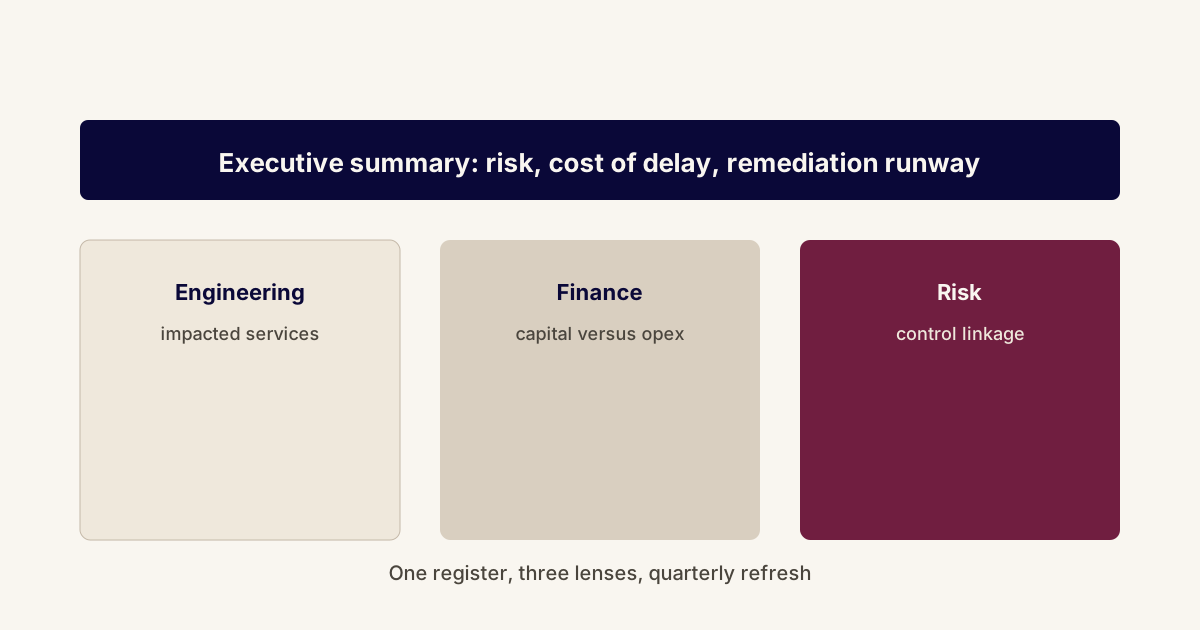
We can present findings in a working session, map recommendations to your portfolio and risk register, and help you prioritize next steps with clear owners and timelines.
Data product ownership is the second structural pillar. Every data asset that feeds an analytical or generative workload needs a named owner with authority over schema changes, quality thresholds, and access policies. Without clear ownership, data pipelines degrade silently. Quality issues surface only after downstream models produce unreliable outputs, at which point remediation costs have already multiplied.
Effective data product teams operate with product management discipline. They maintain service-level objectives for freshness, completeness, and accuracy. They publish contracts that downstream consumers can depend on, and they instrument pipelines so that violations trigger alerts before they cascade. This discipline borrows heavily from site reliability engineering and applies it to data supply chains.
Model operations governance is the third pillar. Generative AI introduces risks that traditional analytics programs never encountered: hallucination, prompt injection, intellectual property exposure, and reputational harm from biased outputs. A single governance framework cannot address all model types equally. Instead, leading CIOs implement tiered approval paths that match the level of scrutiny to the risk profile of each workload.
Low-risk workloads, such as internal summarization tools with human review loops, proceed through lightweight self-certification. Medium-risk workloads that touch customer data or influence financial decisions require security review, bias testing, and a defined rollback procedure. High-risk workloads, including autonomous decision agents and externally facing generative interfaces, demand full evaluation harnesses with red-team exercises and legal sign-off before production release.
Evaluation harnesses deserve dedicated investment. A robust harness includes benchmark datasets, adversarial test suites, regression checks against prior model versions, and automated scoring pipelines. Without these assets, teams rely on subjective judgment calls that cannot survive audit scrutiny. Organizations that build evaluation infrastructure early find that it accelerates rather than slows deployment, because teams spend less time debating quality in meetings.
Executive dashboards must surface model drift, incident counts, usage trends, and cost trajectories in a single consolidated view. Separating operational health from business performance creates blind spots that only become visible during a crisis. The best dashboards we reviewed link real-time inference monitoring to quarterly business reviews, ensuring that senior leaders see both the pulse and the trajectory of their AI portfolio.
Organizational readiness extends beyond governance structures. Talent strategy is a prerequisite that many CIOs underestimate. Scaling AI programs requires not only data scientists and ML engineers but also data product managers, AI ethics specialists, and prompt engineers who understand domain context. Workforce planning should map current capabilities against target operating model requirements, identifying gaps that internal upskilling or targeted hiring must fill within defined timelines.

Change management is equally critical. Business users who do not trust AI outputs will route around them, creating shadow processes that undermine both adoption metrics and risk controls. Successful organizations invest in structured literacy programs that teach line managers how models make recommendations, what confidence scores mean, and when human override is appropriate. Trust is built through transparency, not through mandates.
Platform strategy decisions shape the cost curve for years. CIOs must choose between centralized AI platforms, federated toolchains managed by individual business units, or hybrid architectures that standardize infrastructure while allowing domain-specific tooling at the application layer. Each approach carries trade-offs in cost efficiency, speed of adoption, and vendor lock-in risk. The right choice depends on organizational structure and existing technology maturity.
Vendor evaluation criteria should extend beyond feature checklists. Enterprises need to assess data residency guarantees, model fine-tuning flexibility, interoperability with existing data catalogs, and contractual protections around training data usage. Procurement teams that treat AI vendor selection like commodity software purchasing expose the organization to compliance surprises and integration costs that dwarf the initial license fees.
Steering committee effectiveness is the mechanism that converts structural commitments into sustained momentum. Committees that receive pre-read materials with embedded discussion prompts produce decisions in meetings rather than scheduling follow-up workshops. Each section of this brief ends with targeted questions designed to force prioritization: which workloads qualify for fast-track approval, where funding pools need rebalancing, and which talent gaps pose the greatest near-term risk.
Implementation sequencing matters. Organizations that attempt to launch governance frameworks, platform migrations, and talent programs simultaneously overwhelm their change capacity. Our recommended phasing starts with ownership mapping and funding model alignment in the first quarter, followed by tiered governance rollout in the second quarter, platform consolidation in the third, and maturity benchmarking in the fourth. Each phase produces measurable artifacts that feed the next.
Use this brief as a committee pre-read for your next steering meeting. Each section pairs diagnostic context with decision prompts so that conversations produce commitments, not additional analysis requests. The organizations that pull ahead in 2026 will be those that resolve ownership, funding, and guardrail questions before technical complexity makes those conversations exponentially harder.