Insights · Report · Operations · Mar 2026
What separates scripted exercises from adaptive rehearsals, and how firms connect BCDR evidence to technology incident response without duplicating work.

Tabletop exercises remain the most accessible tool for stress-testing business continuity plans, yet most organizations treat them as annual compliance rituals. Participants read from a script, declare theoretical success, and return to daily operations without internalizing a single lesson. This maturity study draws on anonymized interviews with continuity leaders across financial services, healthcare, logistics, and global retail to identify the behaviors that separate performative exercises from genuinely adaptive rehearsals.
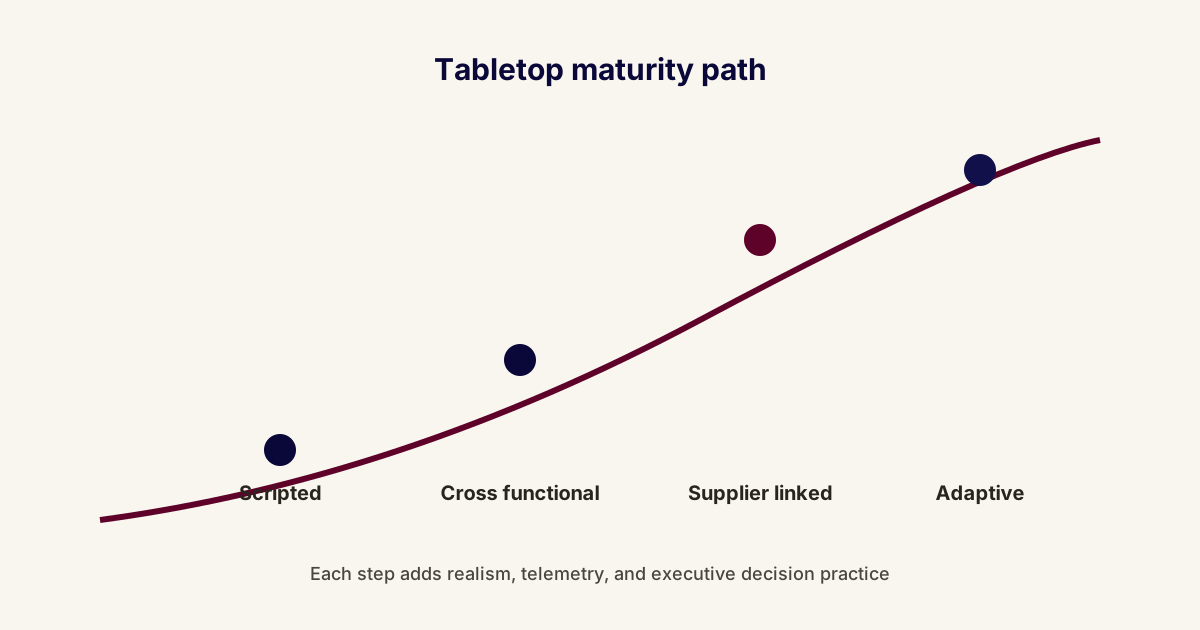
The study introduces a four-level maturity model calibrated against observable outcomes, specifically the speed and coherence of real incident responses. Organizations at the lowest maturity level conduct one exercise per year, involve a single department, and exclude supplier dependencies entirely. At the highest level, firms run quarterly adaptive scenarios that rotate across business units, inject realistic communication breakdowns, and require executives to practice regulatory notifications under tightly compressed time constraints.
Between these extremes lies the critical transition from scripted to semi-structured exercises. Level two programs introduce variable injects during the session, forcing participants to deviate from prepared responses. Level three programs go further by including cross-functional teams, external partners, and deliberate information asymmetry where different groups receive conflicting intelligence about the simulated incident. This progression mirrors how real crises unfold: messy, fragmented, and resistant to predetermined playbooks.
A defining characteristic of high-maturity programs is the deliberate inclusion of decision friction. Rather than presenting participants with clean problem statements, facilitators withhold key data, introduce contradictory reports from simulated field teams, and compress decision windows to minutes instead of hours. The goal is not to overwhelm participants but to build the cognitive muscle memory required when a real ransomware attack or regional outage leaves leadership teams operating with incomplete information.
We can present findings in a working session, map recommendations to your portfolio and risk register, and help you prioritize next steps with clear owners and timelines.
One of the strongest findings in this study concerns the integration of business continuity and technology incident response. In many organizations, BCDR teams and site reliability engineering groups maintain entirely separate runbooks, escalation paths, and communication channels. When an actual incident strikes, executives receive conflicting timelines, duplicate status updates, and contradictory recovery estimates. The result is slower decision-making at precisely the moment when speed matters most.
The study recommends establishing a unified crisis coordination model where business continuity and technology teams operate from a shared incident channel with clearly defined authority rules. A single customer-impact narrative should flow from this channel to executive leadership, legal counsel, and external communications. Organizations that adopted this unified approach during our study period reduced their mean time to accurate executive briefing by more than forty percent compared to peers running parallel processes.
Data backup and recovery testing deserves a far more prominent role in tabletop exercises than most organizations currently afford it. Firms that incorporate restore validation into their scenarios consistently uncover silent data corruption, credential rotation gaps, and region failover assumptions that have never survived contact with production dependencies. A backup that cannot be restored within the board-approved recovery time objective is not a backup. It is an expensive liability disguised as insurance.
The study provides a curated scenario library designed to challenge organizations at every maturity level. Entry-level scenarios include a prolonged data center power failure affecting a single application. Advanced scenarios simulate ransomware with selective data destruction targeting financial close systems, simultaneous cloud region loss during peak transaction volume, a critical third-party SaaS outage during month-end processing, and partner API degradation coinciding with a high-profile marketing launch. Each scenario includes minimum participant requirements, recommended pre-reads, and explicit success criteria.
Scenario design follows several principles that differentiate valuable exercises from theatrical ones. First, every scenario must force at least one decision that has no clearly correct answer, creating space for genuine debate among participants. Second, scenarios should test dependencies rather than isolated capabilities, because real incidents cascade across interconnected systems. Third, the scenario must include a communication dimension, requiring teams to draft customer notifications, board updates, or regulatory disclosures under time pressure.
Post-exercise metrics are essential for converting tabletop investment into measurable organizational improvement. The study recommends tracking five core indicators: time to activate crisis communications, time to convene legal and privacy stakeholders, percentage of critical systems with validated recovery objectives matching board-approved tolerances, number of decisions made versus deferred during the exercise, and the ratio of new findings to previously identified gaps. Tracking these metrics over successive exercises reveals whether the program is genuinely maturing or merely repeating familiar motions.

Procurement and vendor management teams play a surprisingly influential role in BCDR readiness. The study includes a dedicated vendor chapter that equips procurement leaders with contract language requiring joint exercises, shared telemetry feeds, and named technical counterparts available during incidents. The strongest suppliers arrive prepared with runbooks that interlock with the client's own recovery procedures. A PDF certificate of business continuity, however official it may appear, provides negligible assurance during a real outage unless the supplier has rehearsed alongside your teams.
Regulatory expectations around operational resilience continue to tighten across jurisdictions. Financial regulators in the European Union, the United Kingdom, and parts of Asia-Pacific now require demonstrable evidence that firms test their continuity plans under realistic conditions. Tabletop exercises that produce documented decision logs, identified gaps, and remediation timelines serve as compelling evidence of compliance. Organizations that treat exercises purely as internal learning events miss the opportunity to build a regulatory evidence portfolio that satisfies auditors and supervisors simultaneously.
Board-level reporting on BCDR readiness remains inconsistent across industries. Many boards receive a green status indicator once per year, typically after the annual tabletop, with no visibility into the quality of the exercise or the severity of findings. The study recommends a quarterly dashboard that presents recovery objective attainment rates, open remediation items from previous exercises, and a concise risk narrative describing the scenarios the organization has not yet tested. This approach transforms BCDR from a compliance checkbox into a strategic governance conversation.
The final section of the study addresses remote and hybrid work, a dimension that fundamentally alters crisis leadership dynamics. Coordination habits refined in a shared conference room do not translate automatically to distributed teams operating across multiple time zones. Facilitators must design exercises that account for asynchronous communication, degraded video conferencing, and the absence of physical cues that signal urgency. Our research found that small facilitation details, such as structured check-in rotations and explicit handoff protocols, improved distributed exercise outcomes far more than expensive simulation platforms.
Organizations beginning their maturity journey should start with two concrete steps. First, run a tabletop that includes at least one cross-functional team and one external dependency. Second, measure the time from scenario injection to the first accurate customer-impact statement reaching executive leadership. These two actions alone will expose coordination gaps, communication bottlenecks, and assumption failures that no written plan can anticipate. Maturity is built through repeated, honest practice, not through documentation volume.
This study is designed to serve as both a diagnostic tool and a roadmap. Continuity leaders can benchmark their current programs against the maturity model, identify specific gaps at each level, and prioritize investments that yield the greatest improvement in real-world incident outcomes. The accompanying scenario library, metrics framework, and vendor assessment templates are available to organizations that engage with our advisory practice for a structured maturity assessment.