Insights · Report · Industry · Apr 2026
Sensor programs, MRO digital threads, regulator expectations, and human factors when algorithms suggest interventions that touch airworthiness.

Predictive maintenance has moved from experimental to operational across major carriers worldwide. Airlines operating narrow-body and wide-body fleets now ingest continuous telemetry from engines, auxiliary power units, environmental control systems, and landing gear assemblies. The promise is clear: fewer aircraft-on-ground events, optimized spare parts positioning, and reduced unscheduled maintenance. Yet this promise depends entirely on governance structures that preserve the safety culture aviation has built over decades of hard-won regulatory discipline.
The economic case for predictive analytics in aviation is compelling but frequently overstated by vendors. Realistic projections must account for sensor instrumentation costs, data transmission bandwidth from aircraft to ground systems, cloud or on-premise compute infrastructure, and the organizational investment required to retrain engineering and maintenance personnel. Airlines that approach predictive maintenance as a technology procurement exercise rather than an operational transformation initiative consistently underperform their business case assumptions within the first eighteen months.
Aircraft generate enormous volumes of telemetry, yet only a fraction reaches analytical pipelines in usable form. Engine health monitoring systems produce structured parameter snapshots at fixed intervals, while flight data recorders capture a broader set of parameters at variable rates. Quick access recorders supplement these streams with additional operational context. The challenge lies not in data volume but in data curation: aligning timestamps across systems, resolving sensor drift, and establishing provenance records that auditors can trace from raw capture through every transformation step.
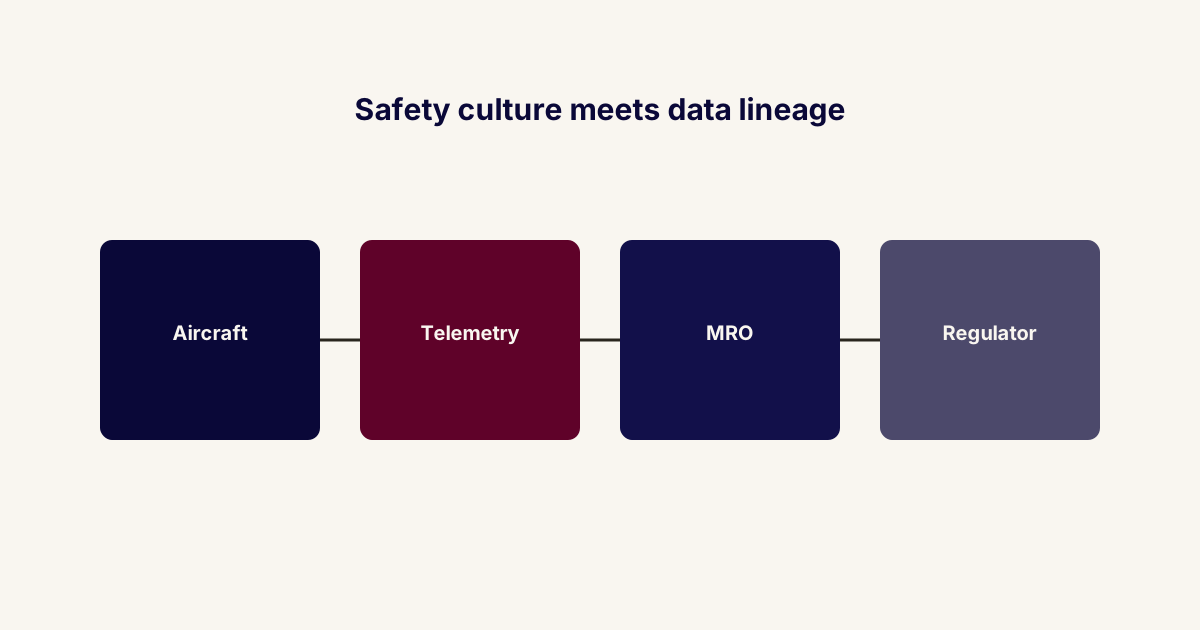
Data lineage from aircraft sensors through airline data lakes, MRO work order systems, and airworthiness directive tracking forms the backbone of any credible analytics program. Gaps in lineage undermine confidence during regulatory audits and internal safety reviews. Every transformation applied to raw sensor data, whether filtering, interpolation, or feature engineering, must be versioned and reproducible. Organizations that treat data lineage as optional documentation rather than a first-class engineering requirement will face escalating compliance costs as regulators sharpen their digital oversight capabilities.
We can present findings in a working session, map recommendations to your portfolio and risk register, and help you prioritize next steps with clear owners and timelines.
Model validation in aviation demands rigor well beyond typical industrial applications. False alarm rates carry operational consequences that extend past simple nuisance. Mechanics who receive excessive spurious alerts develop alarm fatigue, leading to delayed responses or, worse, informal workarounds that bypass the alerting system entirely. Validation protocols should include operational false alarm analysis alongside statistical accuracy metrics, with explicit thresholds negotiated between data science teams and line maintenance leadership before deployment begins.
The digital thread connecting OEM design intent, operator engineering orders, and MRO execution records represents one of the most challenging integration problems in aviation analytics. Proprietary data formats, contractual restrictions on data sharing, and inconsistent part numbering conventions create friction at every interface. Airlines must negotiate data rights as part of engine and component contracts, ensuring that the telemetry generated by their operations remains accessible for independent analytical use rather than locked behind OEM vendor platforms.
Model lifecycle management deserves the same structured oversight that airlines apply to software in certified avionics systems. While predictive maintenance models do not directly control flight-critical functions, their outputs influence maintenance decisions that affect airworthiness. A formal model registry should track training data provenance, validation results, deployment history, and performance monitoring metrics. Retraining triggers should be defined in advance, tied to statistical drift detection rather than arbitrary calendar schedules.
Safety culture in aviation is built on the principle that human certifying staff bear ultimate responsibility for releasing aircraft to service. Predictive analytics must reinforce this principle, presenting model outputs as advisory information that enriches engineering judgment rather than prescriptive directives that replace it. Display interfaces should communicate uncertainty ranges alongside point predictions, enabling maintenance controllers to weigh algorithmic recommendations against their own operational experience and contextual knowledge of fleet conditions.
The human factors dimension extends beyond interface design into organizational dynamics. When algorithms flag a component for early replacement, the resulting cost and schedule pressure can create tension between engineering conservatism and commercial operations. Clear escalation protocols, documented in maintenance organization procedures and approved by the relevant aviation authority, ensure that safety-critical decisions remain insulated from commercial pressure regardless of what the analytics platform recommends for a given flight cycle.
Regulatory expectations for predictive maintenance vary across jurisdictions but are converging toward common themes. The European Union Aviation Safety Agency has published guidance on the use of data analytics in continuing airworthiness management. The Federal Aviation Administration continues to evolve advisory circulars addressing digital recordkeeping and condition-based maintenance. Operators pursuing analytics programs should map their documentation and approval workflows to the specific regulatory framework governing their air operator certificate rather than assuming a generic compliance posture.
Cybersecurity for connected fleets presents a unique threat surface that spans multiple operational domains. Aircraft data links, ground-based data aggregation platforms, and cloud analytics environments each introduce distinct vulnerability classes. Network segmentation must isolate maintenance data planes from passenger-facing systems such as inflight entertainment and connectivity networks. Third-party analytics vendors require carefully scoped access controls governed by the principle of least privilege, with contractual provisions for security audits and incident notification timelines.

Spare parts logistics undergo fundamental change when demand signals shift from calendar-based schedules to condition-based predictions. Procurement and finance teams need synchronized scenario planning to avoid both costly stockouts that ground aircraft and excess inventory that ties up working capital. Integration between predictive maintenance platforms and enterprise resource planning systems should flow in both directions, with prediction confidence intervals informing safety stock calculations and actual consumption data feeding back into model calibration loops.
Workforce development is among the most underestimated success factors in predictive maintenance adoption. Avionics technicians, licensed aircraft engineers, and maintenance planners all require targeted upskilling to interpret model outputs, understand uncertainty quantification, and provide structured feedback to data science teams. Training programs should emphasize practical interpretation skills over theoretical data science literacy, ensuring that frontline personnel can engage critically with algorithmic recommendations rather than accepting or ignoring them wholesale.
Change management must address institutional resistance with empathy and transparency. Maintenance organizations have decades of accumulated expertise encoded in informal practices and professional judgment. Introducing algorithmic decision support without acknowledging this expertise breeds resentment and passive non-compliance. Successful programs position analytics as tools that amplify experienced judgment, dedicating time for maintenance professionals to validate model outputs against their operational knowledge during controlled pilot phases before wider rollout.
International operators face additional complexity from heterogeneous regulatory references across multiple states of design and registry. A carrier operating under overlapping airworthiness requirements may need to maintain parallel documentation sets for the same analytics program. Harmonization efforts through ICAO and bilateral agreements are progressing but remain incomplete. The practical approach is to build modular compliance documentation that can be assembled into jurisdiction-specific packages without duplicating the underlying technical validation work.
Financial justification for predictive maintenance programs should extend beyond direct maintenance cost reduction. Improved dispatch reliability carries revenue protection value that often exceeds parts savings. Reduced unscheduled maintenance events lower passenger compensation costs under regulatory frameworks such as EC 261. Insurance underwriters increasingly recognize data-driven maintenance programs as risk mitigators, creating potential premium reduction pathways. Business cases that capture these secondary benefits present a far more accurate picture of program economics.
Closing recommendations center on measurable KPIs that connect analytics investment to operational outcomes. Track unscheduled removal rate trends by component family, mean time from alert generation to maintenance action, first-time-right rates for predictive work orders, and audit findings related to digital maintenance records year over year. Governance boards should review these metrics quarterly, adjusting model parameters and organizational processes based on evidence rather than vendor-driven enthusiasm. The goal is a self-improving system grounded in safety culture, operational discipline, and transparent accountability.