Insights · Report · Data & AI · Oct 2025
A self-assessment covering model inventory, human oversight, and documentation expectations emerging from supervisory guidance.

Supervisory bodies across major jurisdictions are converging on a common expectation: organizations deploying artificial intelligence must demonstrate structured governance before regulators come asking. The EU AI Act, NIST AI Risk Management Framework, and sector-specific guidance from financial and healthcare regulators all point toward the same core controls. Yet most enterprises still lack a consolidated view of where their AI governance stands relative to these emerging requirements.
Our AI Governance Readiness Scorecard translates regulatory language into a practical self-assessment instrument. Rather than mapping every clause of every framework, the scorecard distills supervisory expectations into five control domains: model inventory and classification, data sourcing and lineage, evaluation and deployment gating, human oversight and escalation, and post-production monitoring. Each domain is scored on a maturity scale from ad hoc through optimized, giving leadership teams a clear baseline.
The first control domain, model inventory, is the foundation upon which all other governance capabilities depend. Organizations cannot govern what they have not catalogued. A complete inventory captures model purpose, owner, training data provenance, deployment environment, and downstream business processes affected. Without this registry, risk teams lack the visibility needed to prioritize oversight investment, and audit functions have no reliable starting point for periodic reviews.
Classification of models by risk tier is the immediate next step after inventory. Not every algorithm warrants the same depth of scrutiny. A product recommendation engine and a credit underwriting model carry fundamentally different consequences when they fail. The scorecard applies a tiering rubric based on decision impact, data sensitivity, regulatory exposure, and reversibility of outcomes. High-tier models trigger mandatory human review gates, while lower-tier systems may proceed through automated validation pipelines.
Data sourcing controls address the upstream quality problem that undermines even well-architected models. The scorecard evaluates whether organizations maintain data lineage records, enforce consent and licensing compliance for training sets, and apply bias detection scans before data enters model pipelines. Weak data governance is the single most common root cause of model failures we observe in practice, and supervisory examiners increasingly treat data controls as inseparable from model risk management.
We can present findings in a working session, map recommendations to your portfolio and risk register, and help you prioritize next steps with clear owners and timelines.
Evaluation harnesses represent the technical testing discipline that sits between development and production deployment. The scorecard assesses whether teams maintain versioned test suites, execute performance benchmarks against holdout data sets, and run fairness and robustness stress tests before promotion. Organizations with mature evaluation practices maintain a separation between the team that builds the model and the team that validates it, preventing the conflicts of interest that lead to confirmation bias in testing.
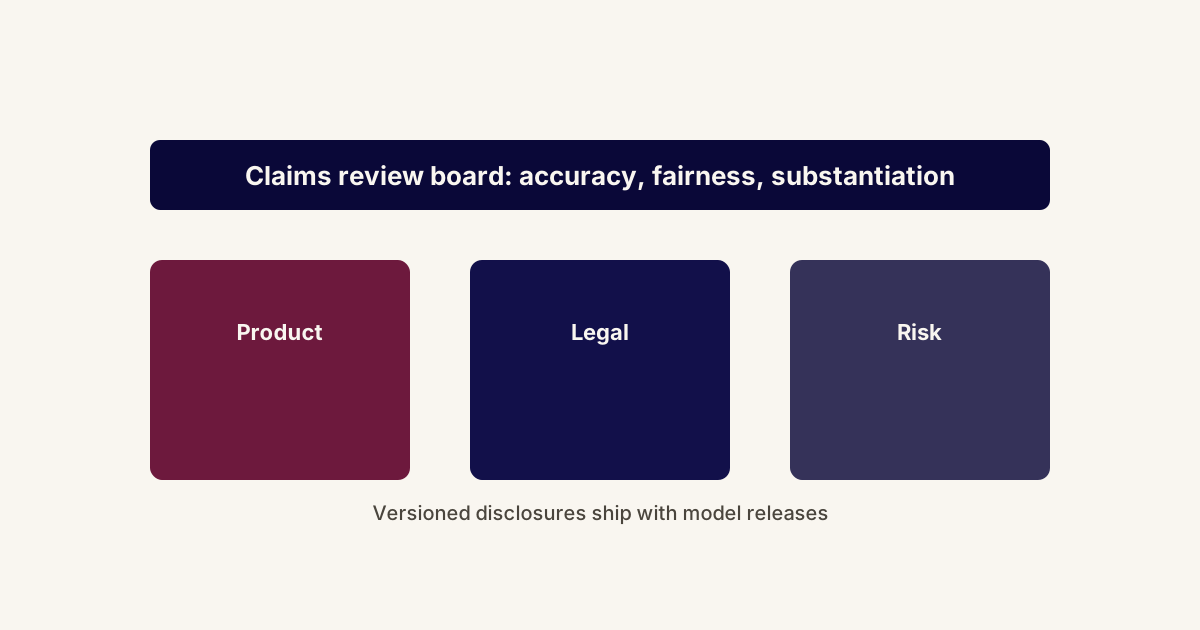
Deployment gating is the control point where technical readiness meets organizational accountability. The scorecard examines whether formal sign-off authority exists, whether deployment checklists are enforced through tooling rather than honor systems, and whether rollback procedures are documented and tested. In regulated industries, deployment gates often require sign-off from risk, compliance, and the business unit, not just the data science team that built the model.
Human oversight requirements vary dramatically by use case, and the scorecard captures this nuance through a tiered escalation framework. Fully autonomous decisions on low-impact, easily reversible outcomes may require only periodic audit sampling. High-impact decisions affecting individuals, such as lending, hiring, or clinical recommendations, demand real-time human-in-the-loop review with documented override authority. The critical design question is not whether humans are involved, but whether they have the context, training, and authority to meaningfully intervene.
Documentation expectations from regulators are becoming more prescriptive with each supervisory cycle. The scorecard evaluates whether model documentation covers intended use, known limitations, performance metrics, training data characteristics, and ongoing monitoring thresholds. This documentation must be accessible to non-technical stakeholders, including board members and external auditors, who need to form independent judgments about model risk without reading source code.
Post-production monitoring is where many governance programs collapse. Models that perform well at launch degrade over time as input distributions shift, business contexts evolve, and upstream data sources change without notice. The scorecard assesses whether organizations track prediction drift, feature importance stability, and outcome feedback loops. Effective monitoring programs define explicit thresholds that trigger automatic retraining, manual review, or temporary model suspension when performance deteriorates beyond acceptable bounds.
Incident response for AI-specific failures requires protocols distinct from traditional IT incident management. When a model produces discriminatory outcomes, generates harmful content, or makes systematically incorrect predictions, response teams need predefined playbooks that cover technical remediation, stakeholder communication, regulatory notification, and affected-party redress. The scorecard evaluates whether these playbooks exist, whether they have been tested through tabletop exercises, and whether escalation paths reach senior leadership within defined timeframes.
Third-party and vendor model governance is a growing blind spot. Many organizations consume AI capabilities through SaaS platforms, API services, or embedded vendor models without applying the same governance rigor they would to internally developed systems. The scorecard includes a dedicated section for vendor due diligence covering model transparency, contractual audit rights, data handling commitments, and incident notification obligations. Procurement teams must be equipped to ask the right questions before contracts close.

Cross-functional accountability is a recurring weakness the scorecard is designed to surface. AI governance cannot live exclusively within the data science organization, the compliance department, or the IT risk function. Effective programs distribute responsibilities across first-line model owners, second-line risk and compliance teams, and third-line internal audit. The scorecard maps each control to an accountable role, making gaps in ownership immediately visible during the assessment session.
Integration with existing enterprise risk and control frameworks prevents AI governance from becoming an isolated silo. Organizations that already maintain SOX controls, operational risk frameworks, or ISO management systems should extend those structures rather than building parallel programs. The scorecard identifies connection points where AI-specific controls can feed into existing risk registers, control testing schedules, and committee reporting cadences without duplicating effort.
Board and committee reporting on AI governance remains underdeveloped at most organizations. Directors need concise, decision-grade information about model risk exposure, governance maturity trends, and material incidents. The scorecard provides a summary output format designed for committee consumption, translating technical maturity scores into business risk language that non-technical directors can evaluate and challenge effectively.
The scorecard completion methodology is deliberately collaborative. We recommend assembling security, legal, data science, product, and compliance leads in a single 90-minute working session. This cross-functional format surfaces disagreements about current capabilities that would remain hidden in siloed self-assessments. The facilitated discussion itself often delivers as much value as the final scores, because it forces alignment on what governance maturity actually means in practice within the specific organizational context.
Scoring outputs are calibrated for action rather than shelf-ware. Each domain score maps to a recommended remediation roadmap with prioritized initiatives, estimated resource requirements, and suggested sequencing. Organizations consistently find that addressing model inventory gaps first accelerates progress in every other domain, because visibility into the model portfolio is the prerequisite for targeted oversight investment.
Continuous improvement cadences keep the scorecard relevant as both the regulatory landscape and organizational AI maturity evolve. We recommend quarterly reassessment for high-risk domains and semi-annual review for stable areas. Each cycle should incorporate lessons from incidents, regulatory updates, and changes in the model portfolio. Organizations that treat governance readiness as a living practice, rather than a point-in-time assessment, consistently outperform peers when supervisory examinations arrive.