Insights · Report · Industry · Apr 2026
Co-op data pools, equipment telemetry, buyer provenance claims, and farmer trust patterns for agritech platforms connecting field IoT to downstream markets.

Precision agriculture now generates more data per hectare than most manufacturing floors produce per production line. Soil moisture probes, multispectral drone imagery, variable rate seeders, and combine yield monitors collectively emit terabytes of telemetry each growing season. Yet the governance frameworks surrounding this data remain strikingly immature. Farmers, cooperatives, equipment manufacturers, input suppliers, and downstream buyers all claim legitimate interests in the same data streams, and the absence of clear rules erodes trust at every handoff point.
This report examines the structural, contractual, and technical dimensions of agricultural data collaboration in 2026. Drawing on advisory engagements with cooperatives across North America, the European Union, and parts of Sub-Saharan Africa, we propose a layered governance architecture that balances farmer sovereignty with the commercial and public interest benefits of data pooling. The guidance is relevant to agritech platform vendors, cooperative boards, commodity traders, and agricultural policy makers seeking scalable models.
Farmers rightly treat field-level data as both a competitive asset and a privacy concern. Yield maps reveal management skill, input records expose cost structures, and GPS boundaries outline land tenure. When platforms centralize this information without transparent governance, adoption stalls. Surveys conducted in the American Midwest during 2025 showed that nearly forty percent of growers who trialed a precision platform subsequently revoked data sharing permissions, citing unclear downstream use as the primary reason.
Trust is not rebuilt by marketing language alone. It requires enforceable, auditable consent mechanisms embedded in the platform itself. We recommend a tiered opt-in architecture where each farmer selects from clearly defined sharing scopes: anonymized regional benchmarks, buyer-facing provenance attestations, and research or academic partnerships. Each scope carries its own retention window, revocation procedure, and revenue sharing formula. When a farmer revokes consent for one scope, the platform must demonstrably purge or re-anonymize records within a contractually specified timeframe.
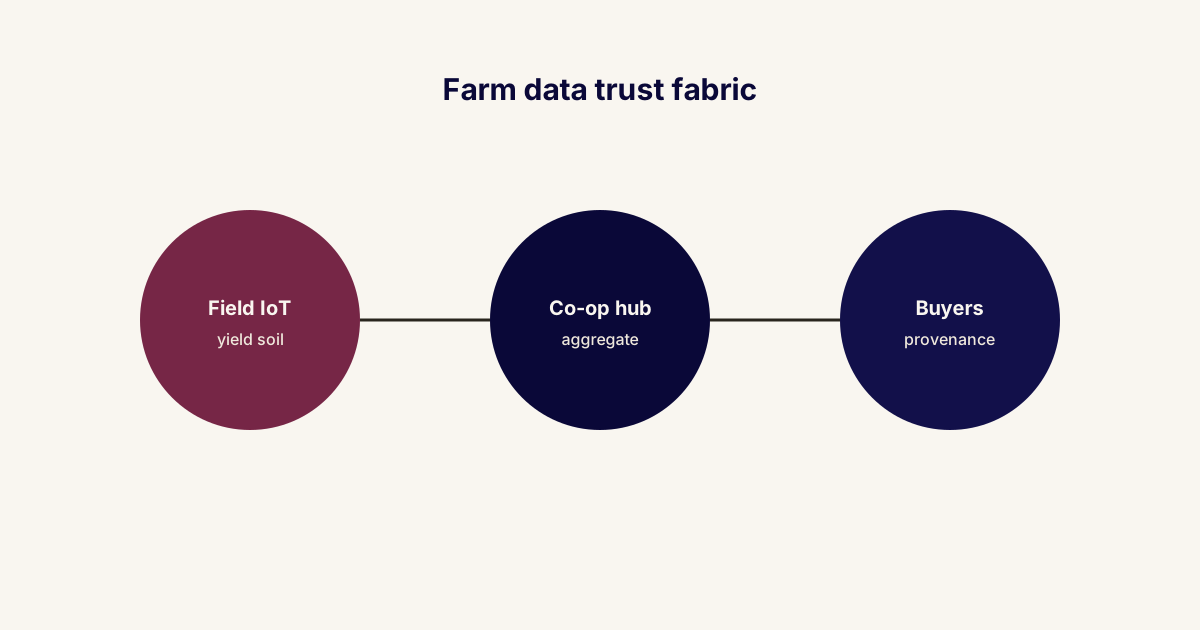
Cooperative aggregation provides the most natural vehicle for data pooling in agriculture. Unlike venture-backed platforms that monetize data to satisfy investor returns, cooperatives can distribute data revenue to contributing members. The aggregation hub sits between individual farm systems and external consumers, applying differential privacy techniques to benchmark datasets and issuing verifiable credentials for provenance claims. Cooperative bylaws should be amended to define data as a distinct asset class, complete with contribution obligations, voting rights on data partnerships, and audit committee oversight.
We can present findings in a working session, map recommendations to your portfolio and risk register, and help you prioritize next steps with clear owners and timelines.
Equipment OEMs introduce significant complexity into the data custody chain. Modern tractors and harvesters transmit telemetry to manufacturer clouds as a condition of warranty and remote diagnostics. Farmers often do not realize that planting depth, engine load, and guidance line data are simultaneously stored by the OEM, the dealer, and the precision platform. Contracts should explicitly state who may train machine learning models on raw telemetry, who retains backup copies after a subscription lapses, and whether firmware updates can alter the data collection scope without renewed consent.
Cloud analytics vendors occupy a similarly ambiguous position. Many offer free or subsidized agronomic dashboards in exchange for access to field-level datasets that feed proprietary recommendation engines. When those recommendation engines are later licensed to input suppliers, the farmer effectively subsidizes a product sold back to them at a markup. Governance charters must require analytics vendors to disclose all derivative uses of contributed data and to share licensing revenue through a formula approved by the cooperative board.
Downstream commodity buyers increasingly demand traceability for sustainability, food safety, and brand differentiation claims. Retailers marketing low-carbon grain, deforestation-free soy, or regenerative beef need verifiable evidence that traces inputs and practices back to the field. Cryptographic anchors, such as hash-chained event logs or digitally signed harvest certificates, add genuine evidentiary value when integrated into existing audit workflows. However, organizations should resist the impulse to deploy full blockchain networks where a simple append-only log with third-party attestation would suffice.
Blockchain theater, the practice of introducing distributed ledger infrastructure primarily for its marketing cachet, inflates cost without proportional audit benefit. In engagements with three multinational grain traders during 2025, we found that pilot blockchain provenance programs consumed four to seven times the budget of equivalent hash-chain solutions while delivering identical assurance outcomes. The guiding principle is straightforward: link immutable records only where they satisfy a regulatory or contractual burden of proof, and select the lightest infrastructure that meets that burden.
Rural connectivity remains a binding constraint on precision data architectures. Large portions of productive farmland in every major agricultural region lack reliable cellular coverage, and satellite broadband latency is still too high for real-time streaming during planting and harvest windows. Edge preprocessing must be a first-class design concern, not a footnote. Field controllers should normalize, compress, and batch telemetry locally, then synchronize through store-and-forward queues when connectivity resumes. Tolerant sync windows, configurable per data type, prevent stale readings from corrupting time-sensitive analytics.
Power availability compounds the connectivity challenge. Solar-charged edge gateways with low-power wide-area network radios offer a pragmatic deployment model for remote paddocks. Architecture reviews should evaluate total cost of ownership across a five-year horizon, including panel degradation, battery replacement, and firmware maintenance logistics. Designing for intermittent power and bandwidth from the outset avoids costly retrofits that plague platforms originally built for well-connected demonstration farms.
Cybersecurity threats in agriculture have escalated sharply. GPS spoofing can misdirect autonomous equipment, ransomware has shut down cooperative grain elevators, and compromised weather application integrations have fed manipulated forecasts into irrigation schedulers. The convergence of operational technology and information technology on the farm demands the same network segmentation discipline practiced in industrial manufacturing. OT-adjacent controllers, including guidance systems, variable rate applicators, and grain dryer PLCs, should reside on isolated network segments with monitored jump hosts as the sole administrative access path.

Cooperatives often lack dedicated security staff, making shared security operations centers a practical model. Regional cooperative federations can pool resources to fund a centralized monitoring service that ingests logs from member networks, correlates threat intelligence specific to agricultural supply chains, and dispatches incident response playbooks tailored to harvest-critical timelines. Insurance carriers are beginning to offer premium reductions for cooperatives that demonstrate participation in such shared defense programs.
Cross-border data transfers add regulatory layers that agritech platforms frequently underestimate. Grain traded from Brazil to the European Union, or dairy telemetry shared between New Zealand and Chinese processors, must comply with overlapping data protection regimes. Standard contractual clauses, adequacy decisions, and sector-specific derogations each carry implementation costs. Platforms that operate across jurisdictions should maintain a living data transfer impact assessment, updated at least annually, that maps every cross-border flow to a documented legal basis.
Subsidy and environmental reporting obligations create additional governance surface area. When field-level data underpins carbon credit calculations or fertilizer reduction incentive payments, the integrity requirements escalate. Audit trails must demonstrate that no data was altered between collection and submission. Regulators in the EU Common Agricultural Policy reform and the USDA Climate Smart Commodities program are signaling that platform-certified data will soon carry presumptive evidentiary weight, raising the stakes for governance failures.
Program health metrics should extend beyond simple adoption counts. We recommend tracking farmer participation rate segmented by cooperative size, data freshness measured against agreed service level targets, dispute resolution cycle time when a buyer challenges a batch certificate, and revenue per contributing hectare returned to farmers through the cooperative. Dashboards that surface these metrics to the cooperative board on a quarterly basis create accountability and highlight governance gaps before they become trust-breaking incidents.
Vendor selection criteria deserve explicit governance attention. Cooperative boards should evaluate agritech partners against a scorecard that weights data portability, API openness, contractual exit provisions, and incident disclosure history alongside traditional measures of agronomic accuracy and user experience. Lock-in risk is particularly acute in agriculture, where switching costs spike during the narrow planting and harvest windows that define commercial viability.
We close with a set of actionable deliverables included in the downloadable companion package. These include a model data charter aligned to common cooperative bylaws, a sample Data Protection Impact Assessment questionnaire for cross-border grain traders, a consent scope matrix template mapping data types to sharing tiers, and a cybersecurity segmentation checklist adapted for mid-size cooperative networks. Each template has been reviewed against current EU, US, and Mercosur regulatory expectations and is designed to be adopted with minimal legal customization.