Insights · Article · Security · Feb 2026
How field services, OT gateways, and SaaS identities meet in a single policy fabric.

Zero trust is not a VPN replacement. It is a way to reason about identity and device posture wherever work happens. That includes technicians on tablets, partners in shared SaaS tenants, and legacy equipment that will never run an agent.
The perimeter has dissolved. Remote work, cloud adoption, and the proliferation of connected devices have pushed critical workflows to locations that traditional firewalls cannot protect. Edge computing in manufacturing, energy, and logistics means that processing happens closer to physical equipment, often over cellular or satellite links. Securing these distributed endpoints requires a model that trusts nothing by default and verifies everything continuously.
Operational technology environments present unique security challenges because many industrial controllers and sensors were designed decades before cybersecurity became a priority. These devices often lack encryption, cannot receive patches, and communicate over proprietary protocols. A zero trust approach acknowledges these constraints and wraps compensating controls around the assets rather than demanding that every device authenticate in the same way a modern laptop would.
Field technicians represent one of the most complex identity challenges in zero trust deployments. They carry tablets and ruggedized devices into environments with intermittent connectivity, work across multiple client sites in a single day, and often share diagnostic equipment. Their access needs change rapidly depending on the task, making static role assignments both impractical and risky. Context-aware policies must account for location, time, and device health simultaneously.
SaaS platforms add another dimension to edge security. Organizations now rely on dozens of cloud applications where employees, contractors, and partners access sensitive data through federated identities. When a third-party vendor logs into a shared analytics dashboard with a personal device, the organization must evaluate trust at every layer. Single sign-on alone is insufficient without conditional access rules that factor in session risk and behavioral anomalies.
We facilitate small-group sessions for customers and prospects without requiring a slide deck, focused on your stack, constraints, and the decisions you need to make next.
Segmentation buys time; continuous verification buys confidence. We design policies so a compromised credential cannot traverse both corporate IT and operational technology without an explicit, logged escalation path.
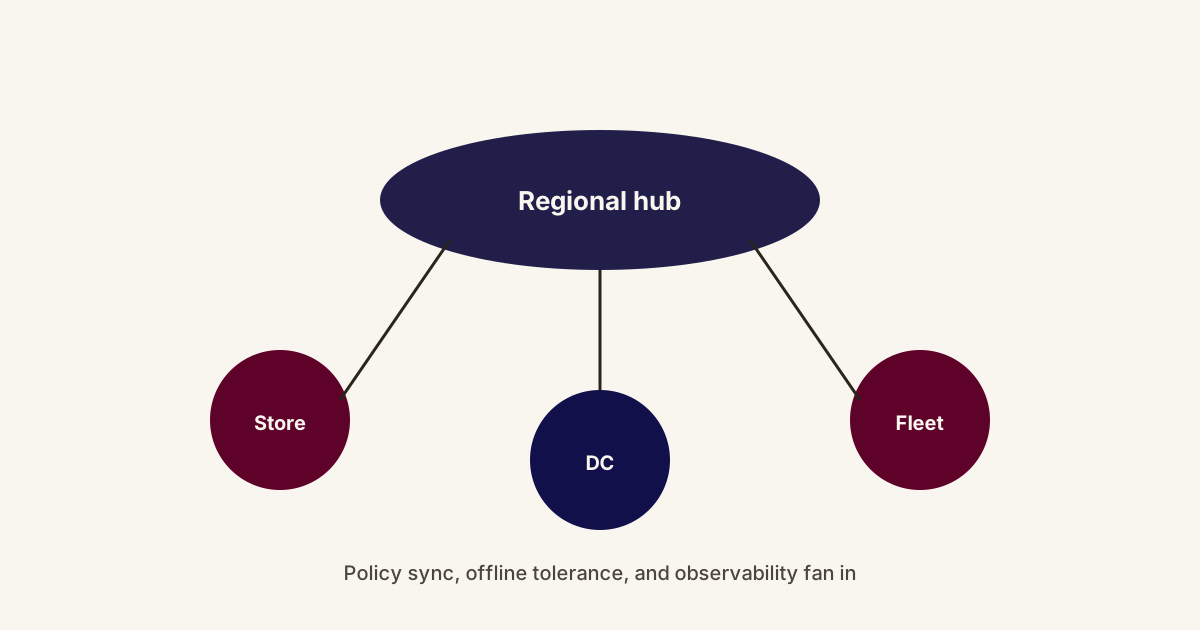
A policy fabric unifies these disparate trust decisions into a single control plane. Rather than maintaining separate firewall rules for the plant floor, VPN configurations for remote workers, and access control lists for cloud tenants, organizations codify intent in one place. That intent then propagates to enforcement points at each layer. Changes take effect in minutes, not weeks, and every decision is auditable from a central log.
Device posture assessment is the foundation of trust at the edge. Before granting access, the system checks whether the device runs a supported operating system, has current patches, uses disk encryption, and reports no signs of compromise. For unmanaged devices, browser isolation or virtual desktop sessions create a contained environment where sensitive data never touches the local file system. This layered approach balances usability with protection.
Legacy equipment that cannot run modern agents requires a different strategy. Gateway devices placed at the boundary of operational technology networks act as trust brokers, inspecting traffic and enforcing policies on behalf of the devices behind them. These gateways translate between proprietary industrial protocols and modern identity frameworks, ensuring that even a twenty-year-old programmable logic controller benefits from the same verification standards applied to a new cloud workload.
Micro-segmentation extends the zero trust model deeper into operational networks. Instead of flat network topologies where any compromised device can reach every other device, micro-segmentation creates granular zones that limit lateral movement. Each zone enforces its own access rules based on workload identity and data sensitivity. When a breach does occur, the blast radius is contained to a small segment rather than the entire infrastructure.
Just-in-time access provisioning is especially critical in operational technology environments where standing privileges create persistent risk. Technicians receive elevated permissions only for the duration of a specific maintenance window. The system automatically revokes access when the task ends or the window expires. This model reduces the attack surface dramatically because stolen credentials for an expired session hold no value to an adversary attempting lateral movement hours later.
Executive dashboards should highlight mean time to revoke access and the percentage of privileged sessions that use just-in-time elevation, not just green checkmarks on annual penetration tests.
Measuring zero trust maturity requires metrics that go beyond simple compliance checklists. Organizations should track the percentage of network traffic that flows through identity-aware proxies, the average time between a policy change and its enforcement across all endpoints, and the ratio of automated versus manual access reviews. These indicators reveal whether the architecture is truly adaptive or merely performing security theater with modern tooling.

Incident response improves substantially when zero trust telemetry is available. Every access decision generates a log entry that includes the identity, device posture, resource requested, and the policy that permitted or denied the action. During an investigation, security teams can reconstruct the exact path an attacker followed and identify the moment trust was misplaced. This forensic clarity accelerates containment and reduces the overall cost of a breach.
Regulatory frameworks increasingly mandate zero trust principles for critical infrastructure. Standards from NIST, IEC 62443, and sector-specific guidelines now reference continuous verification, least privilege access, and network segmentation as baseline expectations. Organizations that adopt zero trust proactively find compliance audits simpler because the architecture inherently produces the documentation and evidence that regulators require. Waiting for mandates only increases the cost and complexity of eventual adoption.
Vendor selection plays a significant role in zero trust success at the edge. No single product covers every use case, so organizations must evaluate how well solutions integrate with existing identity providers, endpoint management platforms, and industrial control systems. Open standards like SCIM, OIDC, and SAML reduce lock-in and ensure that trust signals flow freely between components. Interoperability should be a non-negotiable criterion during procurement.
Cultural change is as important as technical implementation. Security teams accustomed to perimeter defense must shift their mindset to assume breach and verify continuously. Operations staff need training on why access requests now require additional verification steps. Leadership must champion the initiative and communicate that zero trust is not about distrust of employees but about protecting the organization from compromised accounts and stolen credentials that target everyone equally.
A phased rollout reduces risk and builds organizational confidence. Start with the highest-value assets and most exposed identities, typically privileged accounts accessing production OT systems. Extend policies incrementally to field technicians, then to third-party SaaS integrations, and finally to the broader workforce. Each phase produces lessons that refine the next, and early wins generate the executive support needed to sustain funding through the full deployment lifecycle.
The convergence of IT and OT security is no longer optional. Threat actors routinely pivot between corporate networks and industrial systems, exploiting the gaps that exist when these domains are governed by separate teams with separate tools. A unified zero trust architecture closes those gaps by applying consistent identity verification, device posture checks, and access policies regardless of whether the resource is a cloud application or a factory floor controller.
Organizations that treat zero trust as a continuous journey rather than a one-time project will be best positioned to adapt as threats evolve. The edge of operations will keep expanding with new devices, new partners, and new regulatory requirements. A living policy fabric that learns from every access decision, adjusts to emerging risks, and scales with the business ensures that security remains an enabler of operational excellence rather than an obstacle to it.