Insights · Article · Operations · Mar 2026
A practical approach to fewer security and operations suppliers while preserving telemetry exports, forensic access, and crisis communications.

Vendor consolidation promises simpler invoices, fewer integration points, and reduced management overhead. Chief information security officers and operations leaders find the pitch compelling, especially when budgets tighten. Yet incident response teams often discover critical gaps too late. Archived logs that no longer export, APIs throttled under stress, or account managers who vanish during a crisis can transform a cost saving initiative into a serious liability.
The pressure to consolidate accelerates each year as organizations manage sprawling tool ecosystems. A typical enterprise security stack can include dozens of overlapping products acquired through years of tactical purchasing. Reducing that count makes intuitive sense, but the process demands careful orchestration. Consolidation decisions that ignore incident response workflows create blind spots that attackers are happy to exploit during the worst possible moments.
Treat consolidation as a resilience program, not only a sourcing program. Before you retire a tool, document which runbooks referenced it, which detections depended on its fields, and which regulators expected specific retention behavior. Build an inventory that maps every tool to the response capabilities it supports. Without this mapping, you cannot predict which capabilities degrade when a product disappears from the stack.
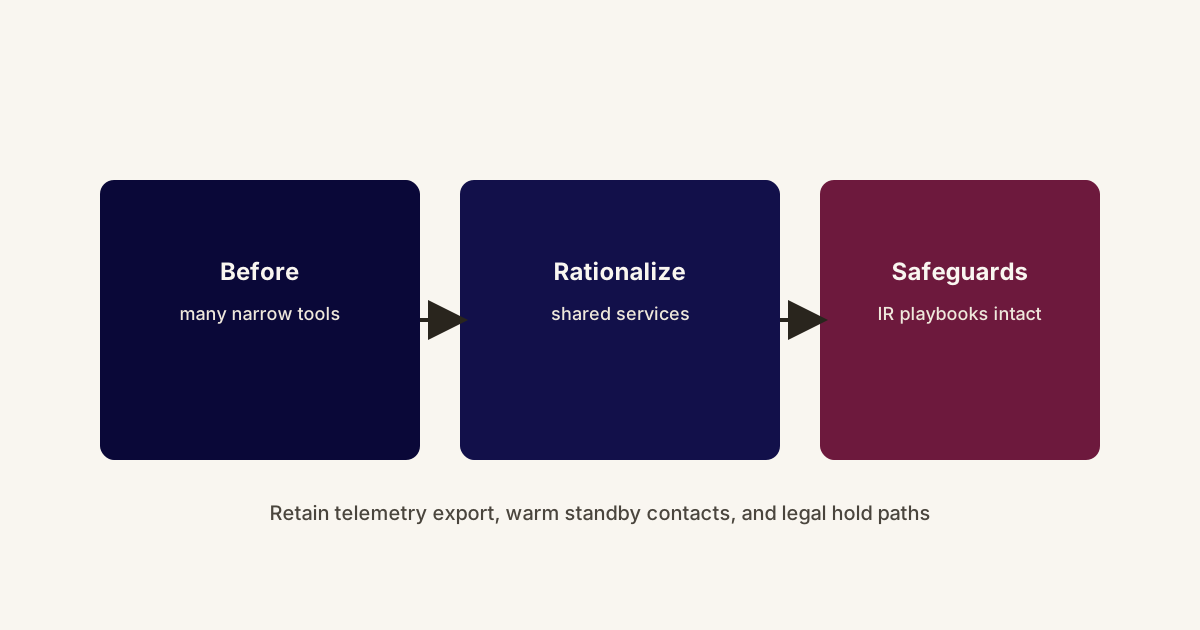
Safeguards should appear in the project plan alongside contract signatures, not as afterthoughts once migration is underway. Assign a dedicated incident response liaison to every consolidation workstream. That person reviews each decommission step through the lens of forensic readiness, detection continuity, and communication resilience. Their sign off should be a mandatory gate before any legacy tool loses access or data retention expires.
Require parity tests before any tool retirement reaches production. Run parallel ingestion for a defined window, typically thirty to sixty days, so blue teams can compare alert fidelity side by side. Accept consolidation only when critical alerts match or improve, and document every exception with clear business justification. Parity testing also exposes hidden dependencies like custom parsers or enrichment scripts that need migration.
We facilitate small-group sessions for customers and prospects without requiring a slide deck, focused on your stack, constraints, and the decisions you need to make next.
Detection engineering teams should maintain a formal registry of every rule, threshold, and correlation that references a data source tied to the outgoing vendor. During parity testing, validate each detection against the replacement platform. Track true positive rates, false positive rates, and mean time to alert. Any regression that exceeds an agreed tolerance should pause the consolidation until the team resolves the gap.
Negotiate forensic and legal hold clauses up front, before ink dries on master service agreements. Consolidated vendors become single points of failure for evidence preservation. Contracts should guarantee timely support for investigations, including named contacts across multiple time zones and committed response windows. Require explicit language that permits third party forensic examiners to access raw telemetry without vendor gatekeeping during active incidents.
Data retention terms deserve equal scrutiny. Many vendors default to short retention periods that conflict with regulatory or insurance requirements. Confirm that the consolidated platform can store logs, packet captures, and endpoint telemetry for the durations your compliance framework mandates. Where retention gaps exist, negotiate extended storage tiers or establish automated exports to your own long term archival infrastructure before decommissioning the legacy tool.
Preserve exit ramps even when you are satisfied with a platform. Maintain portable schemas for tickets, cases, alerts, and investigation artifacts. Migration fatigue is real, and teams often skip portability planning because it feels premature. Yet portability reduces lock in fear, strengthens your negotiation posture at renewal, and ensures you can pivot quickly if the vendor suffers a breach, acquisition, or unexpected service degradation.
Interoperability standards like OCSF and STIX provide a foundation for portable telemetry. Adopt these formats as canonical representations in your data lake so that switching a source vendor does not require rewriting downstream analytics. Investing in a normalization layer early pays dividends every time the stack changes, whether through consolidation, expansion, or emergency replacement after a vendor compromise.
Update tabletop exercises to feature the consolidated stack as soon as migration begins. Remove references to retired vendors from crisis communications templates, escalation trees, and war room procedures. Confusion during an actual breach costs far more than the savings you celebrated in procurement. Conduct at least one full scale exercise that simulates a major incident handled entirely on the new platform before you sunset legacy access.
Crisis communication plans often contain hard coded references to vendor specific dashboards, support portals, and escalation phone numbers. Audit every communication template, playbook, and contact card for stale references. Assign a communications owner who validates these artifacts after each consolidation milestone. A single outdated phone number in a ransomware playbook can delay critical response actions by hours when every minute matters.

Finance should model operational risk alongside license savings to produce an honest cost picture. A cheaper SIEM that increases dwell time is not cheaper when you factor in potential breach costs. Use simple scenario analyses borrowed from your cyber insurance discussions to quantify the risk delta. Present consolidation business cases with both optimistic and pessimistic incident outcomes so leadership can make informed trade off decisions.
Insurance carriers increasingly scrutinize the security tooling stack during underwriting reviews. A consolidation that removes a category of coverage, such as standalone email threat protection, may trigger premium increases or coverage exclusion clauses. Engage your insurance broker early in the planning process and share your consolidation roadmap. Their feedback can reveal hidden financial risks that offset the procurement savings driving the initiative.
Communicate changes to developers and SOC analysts with empathy and transparency. They lose familiar screens, keyboard shortcuts, and muscle memory during consolidation transitions. Pair every platform launch with dedicated office hours, concise cheat sheets, and fast feedback loops so frustration does not turn into shadow tool adoption. Shadow tools reintroduce the sprawl you set out to eliminate and create unmonitored blind spots across your environment.
Change management should extend beyond training sessions. Identify power users on each team and recruit them as consolidation champions who can answer peer questions in real time. Monitor adoption metrics such as login frequency, query volume, and case creation rates on the new platform. Low adoption signals that analysts have reverted to workarounds, and those workarounds deserve immediate attention before they become entrenched habits.
Revisit consolidation decisions on a regular annual cadence rather than waiting for contract renewals to force the conversation. Threat landscapes shift continuously, and a vendor that was excellent for email security last year may lag in API protection or cloud workload visibility today. Your architecture review board should schedule explicit revalidation sessions with documented criteria so that drift is caught early and corrective action stays proactive.
Vendor consolidation done well strengthens incident response by reducing tool switching overhead and creating clearer data flows. Done poorly, it strips teams of detection depth and forensic access precisely when those capabilities matter most. The difference between the two outcomes is disciplined planning that treats response readiness as a first class requirement from the earliest procurement conversation through every milestone of the transition.