Insights · Article · Operations · Apr 2026
When controlled probes beat RUM, when RUM is non-negotiable, and how to build SLOs that combine both without double counting outages.

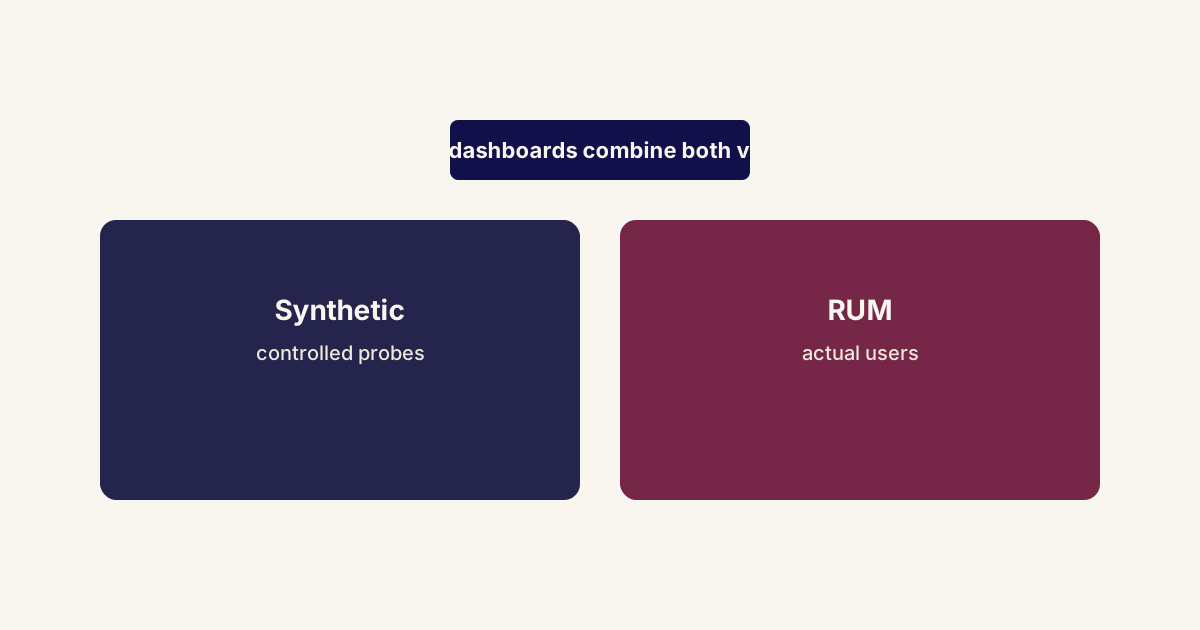
Site reliability teams need to know when customers suffer before customers tell them. Synthetic monitoring provides repeatable checks from known locations on fixed intervals. Real user monitoring captures actual device, network, and geography diversity across every session. Neither alone tells the full story, and organizations that rely on only one approach risk blind spots that quietly erode customer trust and revenue over time.
Modern applications span multiple cloud regions, rely on dozens of third party services, and serve users on devices ranging from flagship phones to budget hardware several years old. This complexity means a single monitoring strategy cannot cover every failure mode. Understanding the tradeoffs between synthetic and real user monitoring helps teams allocate budgets wisely, set meaningful service level objectives, and respond to incidents with accurate data rather than guesswork.
Synthetic monitoring shines for baseline availability checks, third party API dependency validation, and multi step transactions you can script with stable selectors. Because probes run on a schedule from consistent locations, they produce clean time series data that is easy to trend and baseline. However, synthetic checks can fail when scripts drift after UI refactors or when bot traffic gets rate limited differently than legitimate human sessions.
In practice, engineering teams maintain a library of synthetic scripts covering critical user journeys such as login, checkout, and account creation. Each script runs at intervals from geographically distributed probe nodes. When a check fails or breaches a latency threshold, the system pages on call engineers immediately. This proactive alerting catches outages during off peak hours when few real users are active, closing a gap that RUM alone cannot fill.
Synthetic monitoring has notable limitations in dynamic environments where personalization, A/B testing, or feature flags change page structure frequently. Scripts require regular maintenance as product teams ship new layouts and flows. Teams that treat synthetic tests as static artifacts quickly accumulate false positives, which erode on call confidence and delay genuine incident response. Investing in script lifecycle management and version controlled test definitions prevents this drift from becoming a reliability risk.
We facilitate small-group sessions for customers and prospects without requiring a slide deck, focused on your stack, constraints, and the decisions you need to make next.
Real user monitoring captures the long tail pain that synthetic probes miss entirely: budget smartphones with limited memory, congested mobile networks during commute hours, ad blockers that interfere with instrumentation libraries, and regional CDN variance caused by peering arrangements outside your control. RUM paints a picture of actual customer experience across the full spectrum of conditions, making it indispensable for understanding performance as users truly perceive it.
Implementing RUM requires embedding a lightweight JavaScript agent or native SDK into your application. The agent collects timing data, error counts, and interaction metrics from each user session before sampling and forwarding telemetry to your analytics backend. Choosing the right sampling rate balances data fidelity against ingestion costs. A one percent sample may suffice for high traffic sites, while lower volume applications may need higher rates to achieve statistical significance.
Privacy regulations such as GDPR and CCPA constrain what RUM data you collect, how long you retain it, and where you store it. Design your RUM pipeline with anonymization at the collection layer rather than as a post processing step. Strip or hash personal identifiers before data leaves the browser, configure retention policies that align with your legal obligations, and document your sampling methodology so auditors can verify compliance without accessing raw telemetry.
Service level objective design should avoid double counting the same outage across both monitoring channels. If synthetic probes already alert on API health and backend availability, then RUM should focus on front end vitals such as largest contentful paint, interaction to next paint, and conversion adjacent latency. Documenting which objectives belong to which data source prevents confusion during incident reviews and ensures that composite error budgets reflect genuine customer impact rather than measurement overlap.
Practical SLO boundaries emerge when teams map each objective to a specific user journey and data source. A checkout completion SLO might draw from synthetic probes that exercise the payment flow every five minutes, while a page load performance SLO relies on RUM percentiles collected from real sessions. This separation makes it clear which system is authoritative for each indicator and simplifies root cause analysis when error budgets deplete faster than expected.
Alerting thresholds need different baselines per channel and per platform. Mobile applications tolerate different latency patterns than desktop web experiences because users expect different interaction models on each surface. Seasonality matters as well; retail sites face load spikes during holiday sales, while B2B platforms see peaks on weekday mornings. Calibrating alert sensitivity to these rhythms reduces noise and keeps on call engineers focused on genuine anomalies rather than expected variance.
For mobile channels, consider separating alerts by operating system and connection type. Users on cellular networks in emerging markets experience fundamentally different conditions than users on fiber connections in urban centers. If your alerting treats both cohorts equally, you will either miss regressions in the slower cohort or generate excessive noise from the faster one. Segmented alerting tied to meaningful cohorts produces actionable signals that drive targeted performance improvements.
Dashboards for executives and product leaders should translate technical metrics into customer journey language: checkout success rate, login time to interactive, claims submission throughput, and search result relevance latency. This journey framing connects engineering performance work to business outcomes, which earns budget for remediation projects and headcount for reliability engineering. Without business context, even alarming percentile data struggles to compete for executive attention and investment.

Effective stakeholder communication goes beyond static dashboards. Monthly reliability reviews that overlay RUM trends with business metrics such as conversion rate, support ticket volume, and customer churn create a powerful feedback loop between engineering and leadership. When executives see a direct correlation between improved largest contentful paint scores and increased revenue per session, they become advocates for continued observability investment rather than skeptics questioning the value of infrastructure spending.
Pre production environments benefit from synthetic checks that gate release pipelines, blocking deploys when critical journeys fail or latency regresses beyond acceptable bounds. Production environments benefit from RUM regression detection after each deploy, comparing real user metrics before and after the change window. Pairing canary analysis with RUM cohort segmentation gives release engineers confidence that new code performs well across the full user population, not just in controlled lab conditions.
Progressive delivery strategies amplify this approach by routing a small percentage of traffic to new versions and monitoring RUM signals in real time. If the canary cohort shows degraded performance or elevated error rates, automated rollback triggers before the issue reaches the broader user base. Synthetic probes running against the canary endpoint provide an additional safety net, catching failures that may not yet appear in the limited RUM sample from early adopters.
Cost management requires attention to data volume on the RUM side and probe frequency on the synthetic side. Excessive granularity, such as collecting every resource timing entry or running probes every thirty seconds, increases bills without materially improving decision quality. Right sizing collection intervals and sampling rates to match your actual SLO resolution keeps observability spending proportional to the value it delivers, freeing budget for deeper investment where it matters most.
When evaluating vendors, look beyond sticker price to total cost of ownership. Factor in agent overhead on client devices, integration effort with existing alerting and incident management workflows, data export capabilities for long term retention, and the quality of out of the box dashboards and anomaly detection. A cheaper tool that requires weeks of custom configuration may cost more in engineering time than a pricier solution that delivers value on day one.
Review your monitoring tooling annually to ensure it still meets evolving requirements. Consolidating vendors can reduce agent overhead and simplify operations, but only if telemetry quality stays equal or improves. As your application architecture changes, whether through migration to edge computing, adoption of server side rendering frameworks, or expansion into new geographic markets, your monitoring strategy must evolve in lockstep to maintain the visibility your reliability practice depends on.
The most effective monitoring programs treat synthetic and real user monitoring as complementary layers rather than competing alternatives. Synthetic monitoring provides the controlled, repeatable baseline that catches outages early. Real user monitoring reveals the messy reality of diverse devices, networks, and behaviors. By combining both approaches under a unified SLO framework, teams gain comprehensive visibility that drives faster incident response, better release confidence, and stronger alignment between engineering effort and customer satisfaction.