Insights · Article · Strategy · Mar 2026
From PUE to workload carbon intensity: numbers that connect engineering choices to disclosure-ready narratives.

Sustainability reporting fails when IT hands facilities a spreadsheet of server counts and calls it done. Boards want to see how application architecture, region choice, and batching policy change the curve, not just whether the datacenter bought offsets.
Regulatory pressure from frameworks like CSRD, SEC climate rules, and ISSB standards has raised the bar for disclosure quality. General statements about green cloud migration no longer satisfy auditors or institutional investors. IT leaders must present metrics that survive scrutiny, connect to financial materiality, and show year over year progress in terms the audit committee can benchmark against peers.
The challenge is that most sustainability data in technology organizations lives in silos. Facilities teams track power usage, procurement tracks hardware lifecycle data, and platform engineering tracks utilization rates. Without a shared measurement framework, these numbers never combine into a coherent story. The first job of a sustainability metrics program is to build that connective tissue between operational data sources.
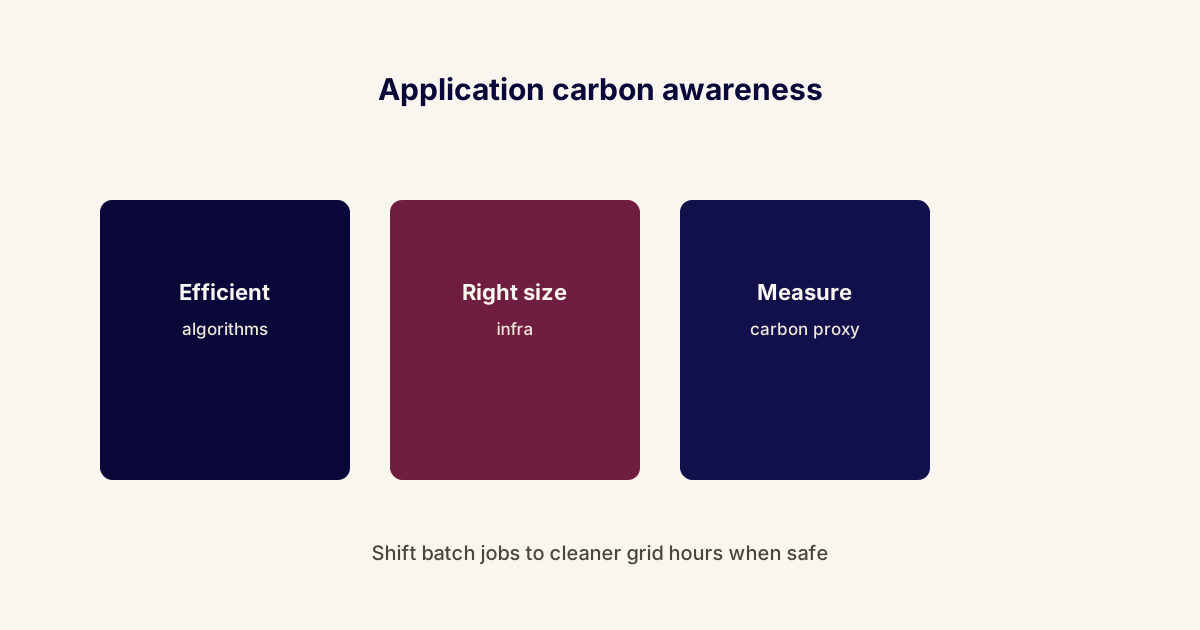
Start with a small set of ratios: carbon per useful transaction, energy per training run, and percentage of workloads on schedulable batch where time-shifting cuts grid intensity. These tie engineering decisions to numbers investors recognize.
Carbon per useful transaction is the single most defensible metric for application teams. It normalizes emissions against business output, which means growth does not automatically inflate your footprint on the slide deck. When a product team ships a feature that doubles throughput while holding energy flat, the ratio improves and the story writes itself for the quarterly review.
Energy per training run matters increasingly as organizations adopt large language models and machine learning pipelines. Tracking kilowatt hours consumed per model training cycle gives leadership visibility into one of the fastest growing cost and carbon line items. It also creates a natural incentive for engineers to pursue efficient architectures, smaller fine tuning runs, and distillation techniques that reduce total compute.
We facilitate small-group sessions for customers and prospects without requiring a slide deck, focused on your stack, constraints, and the decisions you need to make next.
Batch scheduling percentage captures how much of your workload portfolio can tolerate flexible timing. Jobs that run overnight or shift to regions with cleaner grid mixes at specific hours represent low hanging optimization. Reporting this number shows the board that engineering is actively seeking windows of lower carbon intensity rather than running everything at peak demand.
Power Usage Effectiveness, or PUE, remains the most recognized datacenter efficiency metric. It compares total facility energy to the energy consumed by IT equipment alone. A PUE of 1.2 means twenty percent of power goes to cooling and overhead. While useful as a baseline, PUE tells you nothing about whether the IT equipment itself is doing productive work or sitting idle.
That limitation is why forward looking organizations pair PUE with server utilization rate. A datacenter with a PUE of 1.1 but average CPU utilization of eight percent is still wasting enormous amounts of energy on idle silicon. Combining the two metrics gives a fuller picture and helps justify investments in workload consolidation, containerization, and right sizing that actually reduce total energy demand.
Water Usage Effectiveness, or WUE, is gaining attention as hyperscale operators expand into water stressed regions. Boards in sectors like agriculture, pharmaceuticals, and food production already understand water risk. Adding WUE to your sustainability deck signals that IT is thinking beyond electricity and carbon, addressing the full environmental footprint of digital infrastructure.
Embodied carbon in hardware is another metric that deserves a place in the board deck. Manufacturing a server generates significant emissions before it processes a single request. Extending hardware refresh cycles from three years to five years, where performance allows, can reduce embodied carbon by up to forty percent per unit of compute delivered over the asset lifecycle.
Scope 3 emissions from cloud providers present a reporting challenge because the data depends on vendor transparency. Major cloud platforms now publish carbon dashboards, but methodologies differ and granularity varies. IT leaders should document which vendor data they use, flag known gaps, and explain the estimation approach so the board understands both the number and its confidence interval.
Avoid vanity dashboards that only turn green when someone changes the baseline. Tie targets to product roadmaps so platform teams feel ownership, not blame.

Effective dashboards surface anomalies rather than averages. A weekly report that shows a sudden spike in energy consumption for a specific microservice is far more actionable than a quarterly average that smooths out every incident. Alert thresholds tied to sustainability budgets give engineering teams the same rapid feedback loop they already use for latency and error rates.
Embedding sustainability targets into sprint planning and architecture review processes ensures the metrics influence real decisions. When a design review checklist includes a question about expected carbon cost per request, teams begin to internalize efficiency as a quality attribute. Over time this cultural shift matters more than any single dashboard or executive presentation.
Governance structure determines whether sustainability metrics endure beyond the initial launch. Assign a data owner for each metric, define the collection cadence, and document the calculation methodology in a shared runbook. Treat these metrics with the same rigor you apply to financial reporting because regulators increasingly expect exactly that level of discipline.
Quarterly review cadence aligns well with earnings cycles and gives teams enough time to show meaningful progress. Monthly data collection feeds the quarterly narrative, while annual targets set the trajectory. Avoid reporting more frequently than the data can meaningfully change, as weekly board updates on carbon metrics invite noise and erode confidence in the numbers.
Benchmarking against industry peers adds context that raw numbers cannot provide. Organizations like the Green Software Foundation publish reference data, and several cloud providers offer comparison tools. Showing the board where your carbon per transaction sits relative to sector medians transforms an abstract number into a competitive positioning statement.
Materiality mapping connects sustainability metrics to financial risk and opportunity. A metric is material when its movement could influence investor decisions or regulatory outcomes. IT leaders who present a clear materiality matrix alongside their metric dashboard demonstrate strategic thinking, not just technical measurement, and that framing earns ongoing budget support for green engineering initiatives.
Looking ahead, carbon aware computing will move from experimental to expected. APIs that expose real time grid carbon intensity are maturing, and orchestration layers that route workloads accordingly are entering production. IT leaders who build measurement infrastructure today will be positioned to act on these signals tomorrow, turning sustainability reporting from a compliance exercise into a genuine operational advantage.