Insights · Article · Strategy · May 2026
Component design, subscriber notifications, incident versus maintenance language, and the difference between marketing green and operational truth.

Customers forgive outages they understand faster than outages buried under all-systems-operational banners. A useful status page is an operational product with owners, SLAs, and editorial standards. It sits at the intersection of engineering observability, customer communication, and brand reputation. When built with intention, it becomes one of the most powerful trust signals an organization can offer to paying customers and prospective buyers alike.
The cost of poor incident communication extends well beyond a single event. Research from multiple SaaS benchmarking firms shows that customers who experience an outage without clear updates are three to five times more likely to evaluate competitors in the following quarter. Conversely, transparent communication during downtime often increases net promoter scores. Honesty during failure is a stronger loyalty driver than perfection during normal operations.
Building an effective status page starts with defining its audience. Enterprise customers need structured data feeds and API access. Individual users want plain language and estimated resolution times. Internal stakeholders require deeper technical context. A single page can serve all three audiences if the information architecture separates summary views from detailed timelines and allows each group to self-select the depth they need.
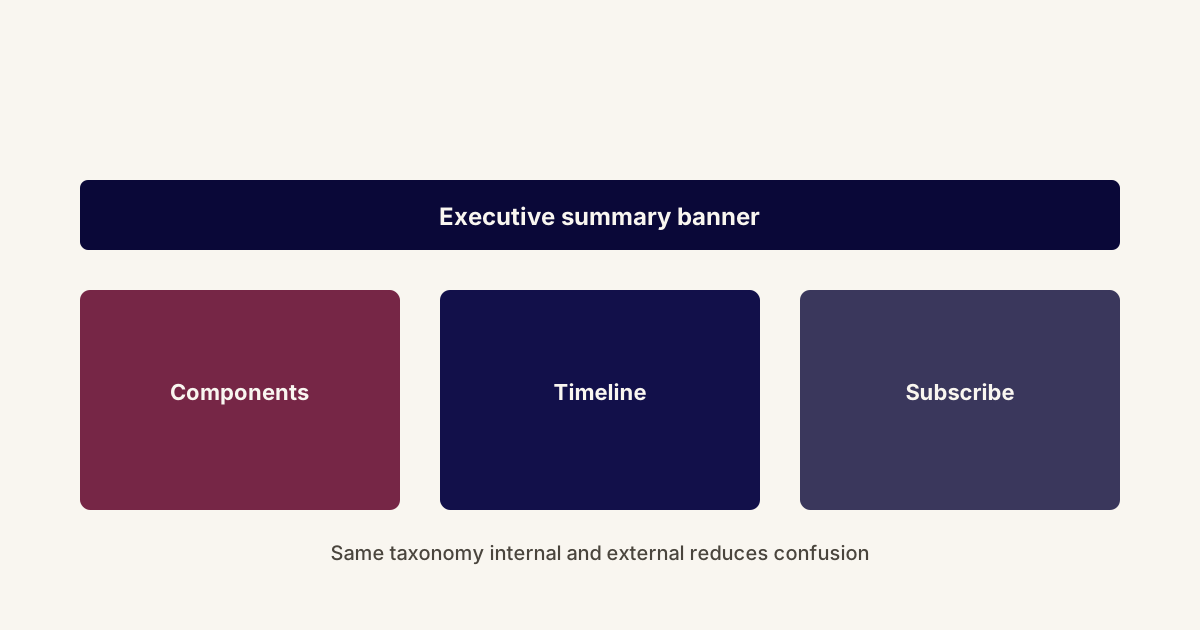
Group components by customer-visible capability, not by internal service name. Nobody outside your organization knows what service-mesh-east means, but they know login, checkout, and file upload. A well-structured taxonomy translates operational reality into language your customers already use, reducing confusion during high-stress moments and eliminating the need for support agents to decode internal jargon on every inbound call.
Naming conventions should be reviewed quarterly with customer-facing teams. Product launches, rebrands, and feature retirements all create drift between what the status page says and what customers experience. A quarterly alignment session between product, engineering, and support ensures that every listed component maps to something customers recognize and that retired components are archived cleanly rather than left as confusing orphans.
We facilitate small-group sessions for customers and prospects without requiring a slide deck, focused on your stack, constraints, and the decisions you need to make next.
Hierarchy matters as much as naming. Top-level groups should reflect broad functional areas such as authentication, data processing, and payments. Sub-components within each group provide granularity without cluttering the primary view. Collapsible sections let casual visitors scan quickly while giving power users and enterprise operations teams the detail they need to correlate your status with their own monitoring dashboards.
Distinguish degraded from down. Partial impairment with workarounds deserves amber states and concrete guidance, not binary failure declarations. A three-tier model of operational, degraded, and major outage covers most scenarios. Each tier should carry a predefined response template that includes current impact, affected components, expected next update time, and any interim workarounds customers can apply immediately.
Color coding reinforces severity at a glance, but accessibility demands more than color alone. Pair colors with icons, text labels, and ARIA attributes so that colorblind users and screen reader audiences receive identical urgency signals. Consistent visual language across your status page, email notifications, and embedded status widgets prevents customers from having to learn a second system of severity indicators when they move between channels.
Maintenance windows need start and end expectations, rollback plans, and post-event validation notes. Silent extensions erode trust more than a two-hour slip explained honestly. Publish the planned timeline at least 72 hours in advance for routine work and provide real-time updates if the window extends. Close each maintenance event with a brief summary confirming that validation checks passed and services returned to normal.
Distinguish scheduled maintenance from emergency maintenance in both labeling and notification routing. Scheduled work follows a predictable cadence and reaches subscribers through digest-style updates. Emergency maintenance triggers immediate alerts and higher-priority channels. Blurring the two categories desensitizes subscribers and creates ambiguity during genuine emergencies when rapid attention is critical and every minute of delayed awareness compounds operational risk for dependent systems.
Notification streams should respect frequency caps and severity filters. Paging subscribers for informational posts trains them to ignore real incidents. Let users choose between email, SMS, webhook, and RSS based on their own escalation needs. Offer granular subscriptions per component group so that a payments team is not buried in notifications about a documentation search outage that has zero relevance to their workflow.
Webhook integrations deserve special attention because they feed downstream automation. Publish a stable schema, version it explicitly, and document breaking changes with the same rigor you apply to your product API. Operations teams that build PagerDuty or Slack automations around your status webhooks will lose confidence quickly if a payload restructure breaks their alerting pipeline without warning or a published migration path.
Integrate with support tooling so agents see the same incident IDs customers see. Divergent narratives amplify frustration and erode credibility. When a customer opens a ticket referencing incident 4821, the support agent should see the same timeline, the same severity label, and the same resolution notes. Unified identifiers eliminate the back-and-forth that turns a minor inconvenience into a memorable negative experience.
Embed a lightweight status banner directly into your product interface so users do not have to navigate to a separate page. A contextual banner that appears only when relevant components are affected reduces support ticket volume and demonstrates proactive communication. This approach works especially well for SaaS platforms where users spend hours inside the application and may not think to check an external status URL.
Archive and search matter. Regulators, enterprise buyers, and your own postmortems need historical accuracy without PDF scavenger hunts. Maintain a searchable, publicly accessible incident history with consistent tagging by severity, affected component, and root cause category. A well-maintained archive becomes a selling point during procurement reviews and due diligence cycles where buyers evaluate operational maturity alongside feature checklists.
Retention policies for archived incidents should align with your contractual and regulatory obligations. Financial services and healthcare customers often require five or more years of incident history. Publishing a clear data retention statement on your status page reassures compliance teams and eliminates repetitive audit requests. Structured exports in JSON or CSV format allow enterprise customers to ingest your incident data into their own governance platforms.
Measure time to first public update, update cadence during long incidents, and subscriber satisfaction surveys after major events. Vanity uptime percentages without narrative context are obsolete. Track how quickly your team transitions from detection to public acknowledgment, how frequently updates flow during extended outages, and how customers rate the clarity and usefulness of your communication after each significant incident resolution.
Benchmark your incident communication metrics against industry peers and your own historical performance. Set quarterly targets for reducing time to first update and increasing post-incident satisfaction scores. Share these metrics internally with leadership so that status page quality receives the same executive attention as product uptime. When communication speed and clarity become organizational KPIs, the entire incident response culture shifts toward transparency.
Ownership of the status page should sit with a dedicated reliability or platform team, not rotate informally among on-call engineers. A named owner ensures consistent editorial voice, timely component updates, and accountability for subscriber experience. This owner partners with communications, legal, and customer success to define tone guidelines, approval workflows for sensitive incidents, and escalation paths when customer impact crosses predefined thresholds.
A status page that earns trust is never finished. Review its taxonomy when products evolve, audit notification channels when subscriber behavior shifts, and revisit severity definitions when customer expectations change. Treat the status page as a living product with its own roadmap, feedback loop, and continuous improvement cycle. Organizations that do this consistently turn operational transparency into a durable competitive advantage that outlasts any single feature release.