Insights · Article · Security · Apr 2026
Threat modeling moments, secure code review habits, vendor risk triage, and metrics that make security coaching part of line management, not only annual compliance videos.

Engineering managers influence architecture decisions, staffing priorities, and what ultimately ships under pressure far more than central security teams can review line by line. When security remains a staff function without management accountability, shift left becomes a slogan rather than a practice. Managers sit at the intersection of business goals and technical execution, making them uniquely positioned to embed security thinking into the daily workflow of every engineer on their teams.
The traditional approach to security training relies on annual compliance videos and checkbox exercises that developers quickly forget. This model fails because it treats security as an isolated obligation rather than a continuous discipline. Engineering managers who integrate security awareness into the rhythms of product delivery create lasting behavioral change. The goal is not to turn every manager into a penetration tester but to make secure thinking a reflexive habit across the organization.
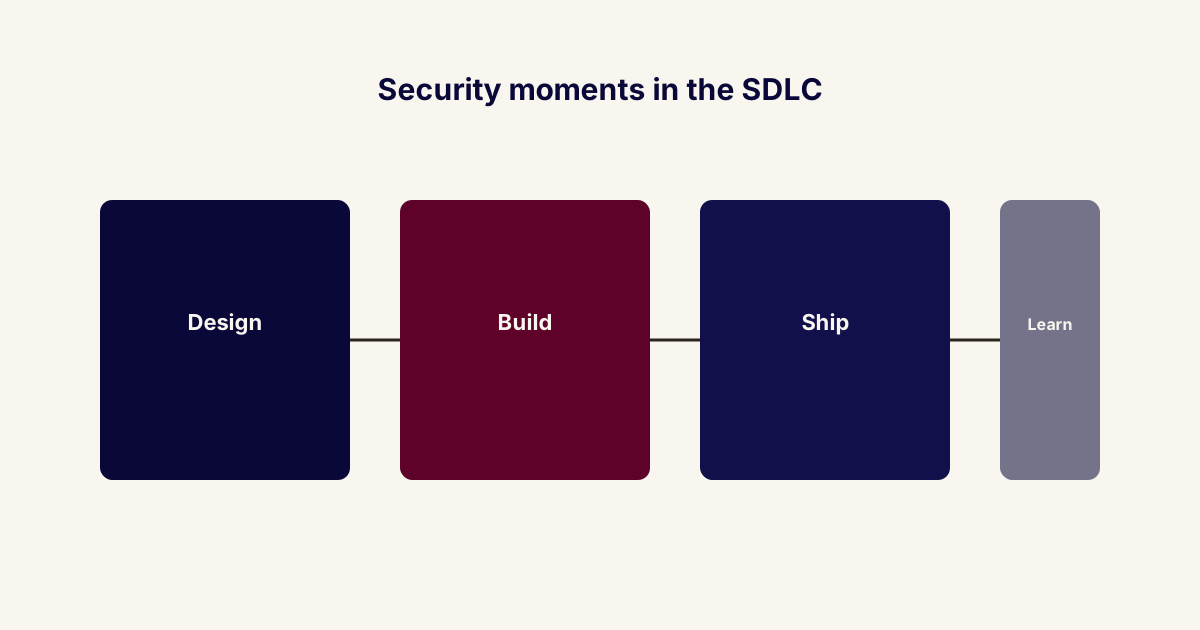
This article proposes lightweight security moments embedded in rituals managers already run. Sprint planning risk flags prompt teams to identify which stories touch sensitive data, authentication boundaries, or external integrations. Design review threat sketches ask engineers to diagram potential attack surfaces before committing to an approach. Retrospective entries for near misses capture security lessons alongside velocity and quality observations, giving security the same standing as other engineering concerns.
Sprint planning is an ideal moment to surface security considerations because the team is already evaluating scope and complexity. Managers can add a standing question to planning sessions: does this story change how we handle credentials, personally identifiable information, or trust boundaries? Even a two minute discussion raises awareness and creates a written record that security was considered before work began, not discovered after code hits production.
Design reviews benefit from a simple threat sketching exercise borrowed from formal threat modeling but stripped down for speed. Ask the presenting engineer to draw data flows on a whiteboard and mark points where untrusted input enters the system. The team then spends five minutes brainstorming what could go wrong at each boundary. This lightweight approach catches architectural risks without requiring a full day workshop or an external facilitator.
We facilitate small-group sessions for customers and prospects without requiring a slide deck, focused on your stack, constraints, and the decisions you need to make next.
Secure code review does not mean managers must find every bug themselves. It means they establish a culture where reviewers routinely ask whether changes touched authentication logic, input parsers, serialization layers, or secrets management. Managers can maintain a short checklist of high risk patterns and rotate responsibility for security focused review among team members. Over time, this practice sharpens the entire team rather than depending on a single specialist.
Building a lightweight security review checklist helps standardize expectations without slowing velocity. The checklist might cover questions about input validation, error handling that avoids leaking internal state, proper use of cryptographic libraries, and safe defaults for new configuration values. When the checklist lives alongside the pull request template, it becomes a natural part of the development workflow rather than an afterthought attached to release gates.
Vendor and dependency risk triage belongs in staffing decisions, not just vulnerability scanners. A team blocked on a vulnerable library needs dedicated time to upgrade, not only a ticket buried in a backlog graveyard. Engineering managers who treat dependency health as a first class planning concern allocate capacity for upgrades before critical vulnerabilities force emergency patches. This proactive stance reduces weekend fire drills and builds trust with security counterparts.
Open source supply chain governance is increasingly critical as modern applications pull in hundreds of transitive dependencies. Managers should ensure their teams maintain a current software bill of materials and subscribe to advisory feeds for their core libraries. When a new critical vulnerability surfaces, the team that already knows its dependency tree responds in hours rather than days. This preparedness is a leadership responsibility, not a tooling problem alone.
Metrics can include percentage of services with static analysis security testing in continuous integration, mean time to remediate critical findings, and recurring classes of defects quarter over quarter. Trend lines beat blame because they highlight systemic patterns rather than individual mistakes. Presenting these metrics in monthly engineering reviews alongside performance and reliability data normalizes security as a core dimension of engineering quality rather than an external audit concern.
Setting meaningful baselines requires collaboration between engineering managers and the security team. Start by measuring the current state honestly, even if the numbers look unflattering. Track improvement over two or three quarters before setting targets. Report metrics in dashboards that teams own rather than in security reports that arrive as surprises. When engineers see their own progress reflected in data they trust, intrinsic motivation replaces compliance pressure.
Psychological safety matters because teams hide incidents when punishment dominates the response. Model blameless analysis so lessons surface early and reach the widest possible audience. Managers who publicly share their own mistakes or knowledge gaps signal that learning is valued over perfection. This tone setting is among the most powerful security investments a manager can make, because unreported near misses are the precursors to breaches no dashboard will catch.
Post incident reviews should follow a structured format that separates timeline reconstruction from root cause analysis and action items. Invite participants from adjacent teams so lessons cross organizational boundaries. Publish redacted summaries internally to multiply the learning. When teams see that incident reports lead to funded improvements rather than blame, they report issues faster and more completely. Speed of detection often determines whether an event remains an incident or becomes a breach.
Partner with security champions per domain to reduce bottlenecks and translate policy into workable patterns for their technology stacks. Champions are senior engineers who volunteer or are nominated to serve as the local security conscience within a team. They attend security guild meetings, triage alerts relevant to their domain, and mentor junior developers on secure coding practices. This distributed model scales better than a centralized review gate that becomes a deployment chokepoint.
A successful champion program requires visible executive sponsorship, dedicated time allocation, and a clear career incentive. Champions should receive at least four hours per sprint for security related work, access to advanced training and conferences, and recognition in performance reviews. Without these investments, the champion role devolves into an unfunded mandate that burns out your most security minded engineers, exactly the people you can least afford to lose.
Budget for joint tabletop exercises with managers and security teams at least twice per year. Scenarios tied to your actual architecture, recent threat intelligence, and real runbooks beat generic ransomware theater that participants mentally dismiss. Include on call engineers, product managers, and communications leads so the exercise reveals coordination gaps. The goal is not to test knowledge but to practice decision making under ambiguity, which only improves through repetition.
After each exercise, document findings in a structured report that maps gaps to concrete action items with owners and deadlines. Track completion rates across exercises to demonstrate improvement over time. Share anonymized highlights with the broader engineering organization so teams that did not participate still benefit from the lessons. Exercises that produce visible change build credibility for the security program and increase willingness to participate in future rounds.
Recognize managers who invest in resilience by updating performance systems to reward fewer repeat incidents, healthier technical debt paydown, and measurable improvements in security posture. Feature velocity alone is an incomplete measure of engineering leadership. Organizations that promote managers partly on the strength of their security culture send a clear signal that protecting customers is as important as delighting them with new capabilities.
Shift left security training for engineering managers is not about adding work. It is about redirecting attention that already flows through planning, review, and retrospective rituals toward the threats that matter most. When managers own security outcomes alongside delivery outcomes, the entire engineering organization moves from reactive patching to proactive prevention. The result is fewer surprises, faster response when surprises do occur, and a culture where security is everyone's job.