Insights · Article · Cloud · May 2026
Certificate lifecycles, trust bundle rotation, sidecar resources, and when to simplify east-west policy before mesh operations become their own product team.

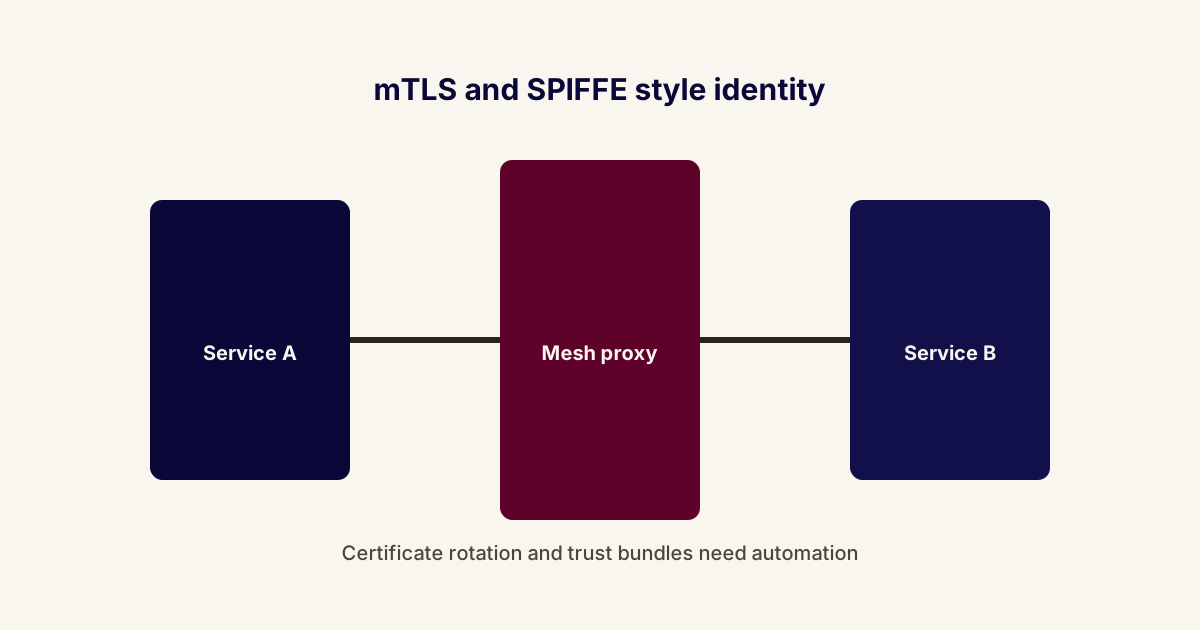
Mutual TLS between services raises the floor against spoofing and casual lateral movement. It also multiplies certificates, identities, and failure modes whenever rotation blips occur or trust bundles desync across clusters. Teams that adopt mTLS inside a service mesh often discover that the operational surface area grows faster than expected, turning a security improvement into a distributed systems challenge that demands dedicated tooling and continuous attention from platform engineers.
The initial appeal is straightforward. Encrypting east-west traffic eliminates a broad class of eavesdropping and impersonation attacks. Compliance frameworks increasingly expect encrypted internal communication, and service mesh mTLS satisfies auditors without requiring application developers to manage TLS configuration themselves. That abstraction works well until certificate volumes, identity sprawl, and proxy resource consumption reveal hidden costs that the marketing page never mentioned.
Start with identity standards. SPIFFE style identifiers give every workload a cryptographic identity rooted in a URI namespace that tools can parse and validate consistently. Centralized issuers paired with automated rotation shorter than your mean time to detect incorrect issuance keep the window of compromise small. Humans should never paste certificates into chat channels or manually copy key material between hosts. Automation must own the full lifecycle from provisioning to revocation without exception.
Certificate lifecycle management becomes a discipline of its own once you cross a few hundred services. Short-lived certificates reduce risk if compromised, but they increase the frequency of renewal events. Every renewal is a potential failure point where clock skew, network partitions, or issuer unavailability can cascade into service disruptions. Building retry logic and grace periods into the renewal pipeline prevents a single timeout from becoming a cluster-wide outage.
Issuance pipelines benefit from the same rigor you apply to deployment pipelines. Version the issuer configuration. Gate changes behind code review. Run integration tests that simulate expired certificates, revoked intermediates, and misconfigured SANs. Canary rollouts for certificate policy changes catch problems before they reach production traffic. Treating PKI infrastructure as code rather than as a set of manual procedures reduces the probability of human error during high-pressure rotations.
We facilitate small-group sessions for customers and prospects without requiring a slide deck, focused on your stack, constraints, and the decisions you need to make next.
Resource planning must account for sidecar overhead at peak concurrency, not just at steady state. Capacity models that ignore mesh proxies invite throttling surprises during marketing events, seasonal traffic spikes, or batch processing windows. Each sidecar consumes CPU cycles for TLS termination and connection management, and memory for connection pools and certificate caches. At scale these costs compound, sometimes adding fifteen to twenty percent to baseline compute requirements.
Benchmarking sidecar performance under realistic traffic patterns is essential before committing to production deployment. Synthetic load tests that only measure throughput miss the latency percentile regressions that matter to user-facing services. Measure P99 latency with and without the mesh under sustained load, and profile memory consumption during connection storms. Those numbers belong in your capacity planning spreadsheets alongside application resource requests and cluster autoscaling thresholds.
Policy authoring should stay approachable for the entire engineering organization. If only three people understand the authorization rules, on-call rotations will break glass constantly and approvals will bottleneck deployments. Prefer readable policy languages with clear deny-by-default semantics, and maintain reviewed templates that teams can adopt without writing rules from scratch. Version policies alongside service definitions so that changes are auditable and reversible through standard pull request workflows.
Testing authorization policies deserves the same investment as testing application logic. Build a policy test suite that validates allow and deny outcomes against representative request payloads. Run those tests in continuous integration so that a policy change never reaches production without automated verification. Dry-run modes, where available, let operators preview the impact of a new rule on live traffic before enforcement, reducing the risk of accidental lockouts during rollouts.
Multi-cluster and multi-cloud meshes need explicit trust federation stories written down and rehearsed. Rotating a root of trust without choreography drops traffic silently in some implementations, because remote clusters may cache the old root and reject certificates signed by the new one. Document the exact sequence of steps required to rotate trust anchors across every participating cluster, and automate the verification of bundle consistency before and after each rotation event.
Federation also introduces identity collision risks when workload names overlap across organizational boundaries. Namespace conventions, prefix policies, and admission controls must enforce uniqueness before two teams accidentally share a SPIFFE ID. Governance around trust domain boundaries deserves the same attention as network peering agreements. Treating identity federation casually leads to authorization confusion that is difficult to untangle once services depend on the existing identity hierarchy.
Observability should correlate mTLS handshake failures with client versions, sidecar builds, and rollout windows. Without that correlation, engineers blame the network generically and open tickets that bounce between teams. Structured logs that capture certificate serial numbers, expiration timestamps, and error codes at the proxy layer give responders the data they need to isolate whether a failure stems from an expired certificate, a misconfigured SAN, or a trust bundle propagation delay.

Dashboards that surface certificate expiration timelines, renewal success rates, and handshake error trends across the fleet provide early warning before incidents escalate. Alert on renewal failure rates rather than waiting for handshake errors to spike. A certificate that fails to renew today becomes a hard outage tomorrow. Proactive monitoring of the PKI pipeline, combined with runbooks that map common failure signatures to specific remediation steps, shortens mean time to resolution significantly.
Escape hatches for debugging encrypted traffic exist in most mesh implementations, so guard them carefully. Temporary plaintext taps belong in audited tools with configurable time limits, automatic expiration, and approval workflows. They should never rely on tcpdump folklore passed between engineers in ad hoc fashion. Every plaintext exception should generate an audit log entry that security teams review, ensuring that debugging convenience does not quietly erode the encryption guarantees the mesh provides.
Access controls around debugging tools should follow the principle of least privilege. Grant plaintext capture permissions to specific namespaces and services rather than offering cluster-wide visibility. Require a second approver for sensitive workloads that handle payment data or personally identifiable information. Time-bound access tokens that expire automatically after thirty minutes prevent forgotten sessions from lingering as permanent security holes in an otherwise encrypted environment.
Revisit mesh value periodically rather than treating the current architecture as permanent. Some organizations graduate to simpler network overlays once baseline mTLS moves into the platform runtime or the container orchestrator itself. Others discover that a lightweight library approach serves their scale better than a full sidecar mesh. Avoid dogma. The goal is encrypted, authenticated service communication, not loyalty to a particular implementation pattern or vendor ecosystem.
When evaluating whether to simplify, measure the operational cost of the mesh against the security and observability benefits it provides. If your team spends more time debugging mesh configuration than shipping product features, the abstraction is not paying for itself. Incremental migration strategies, where you remove the mesh from low-risk services first and measure the impact, reduce the risk of a disruptive wholesale architecture change.
Train platform on-call engineers on PKI basics before they need that knowledge at 3 a.m. Incidents resolve faster when responders understand certificate chains, intermediate authorities, subject alternative names, and the difference between trust anchor rotation and leaf certificate renewal. Invest in hands-on workshops that simulate common failure scenarios so that the team builds muscle memory rather than relying on runbook reading under pressure.
Building institutional knowledge around mesh operations prevents expertise from concentrating in a single engineer who becomes a bottleneck and a single point of failure. Document operational procedures in searchable, versioned runbooks. Record postmortem findings that include the specific certificate or identity misconfiguration that caused each incident. Over time, this knowledge base becomes the most valuable asset your platform team owns, outlasting any particular mesh product or version.