Insights · Article · Security · Apr 2026
Practical patterns for short-lived credentials, coordinated rollouts, and verification hooks so security gains do not become deployment phobia.

Secrets rotation sounds simple until you discover a batch job nobody owns still using a key from three years ago. The concept of regularly cycling credentials is universally accepted in security circles, yet the execution remains one of the most common sources of unplanned downtime. Programs that succeed treat secrets as products with owners, consumers, measurable expiry, and automated issuance wherever possible.
Outages tied to credential rotation tend to cluster on Fridays and at month boundaries because teams rush changes to meet compliance deadlines. The root cause is rarely a technical limitation. It is organizational: unclear ownership, missing runbooks, and no rehearsal windows. Shifting rotation from a quarterly compliance checkbox to a continuous engineering practice removes the deadline pressure that breeds mistakes, shadow workarounds, and finger pointing during postmortems.
Start by inventorying static credentials: long-lived API keys in configuration stores, embedded passwords in legacy services, and break-glass accounts that bypass normal identity and access management. Each category needs a concrete migration path, not only a policy statement. A spreadsheet of every credential, its owner, its consumers, and its last rotation date creates the baseline that makes improvement measurable and priorities visible.
Classification helps prioritization. Group credentials by blast radius: how many systems fail if the secret leaks or expires unexpectedly. A database connection string shared by twenty microservices ranks higher than an internal monitoring token used by one dashboard. Map dependencies visually so that rotation order reflects actual risk rather than alphabetical convenience or the preferences of whichever team responds first.
Ownership is the hardest part of any secrets program. Credentials often outlast the engineers who created them, and service accounts accumulate like sediment. Assign every secret an owning team, a backup contact, and a review cadence. Treat unowned secrets as critical findings in your risk register. If nobody claims a credential within thirty days, schedule deactivation in a staging environment to surface hidden consumers.
We facilitate small-group sessions for customers and prospects without requiring a slide deck, focused on your stack, constraints, and the decisions you need to make next.
Short-lived tokens reduce blast radius dramatically but they increase coordination demands. Service meshes, workload identity federation, and cloud provider IAM roles should serve as the default credential mechanism for every new system. When a token lives for only fifteen minutes, a leak becomes a brief exposure rather than a persistent backdoor. The tradeoff is that issuance infrastructure must be highly available and closely monitored.
Workload identity systems tie credentials to verified runtime attributes such as pod labels, service accounts, or instance metadata rather than to static secrets stored in environment variables. This approach eliminates an entire class of rotation problems because there is nothing static to rotate. Adoption requires investment in platform tooling and developer education, but the long term reduction in incident load justifies that upfront cost.
Migrating older systems from static keys to dynamic credentials often requires an intermediate step. Sidecar proxies can intercept outbound connections and inject fresh tokens without modifying application code. Scheduled credential pushes paired with health checks offer another bridge pattern. The goal is to shrink the population of long-lived secrets incrementally while avoiding a risky big bang migration that introduces exactly the outages you are trying to prevent.
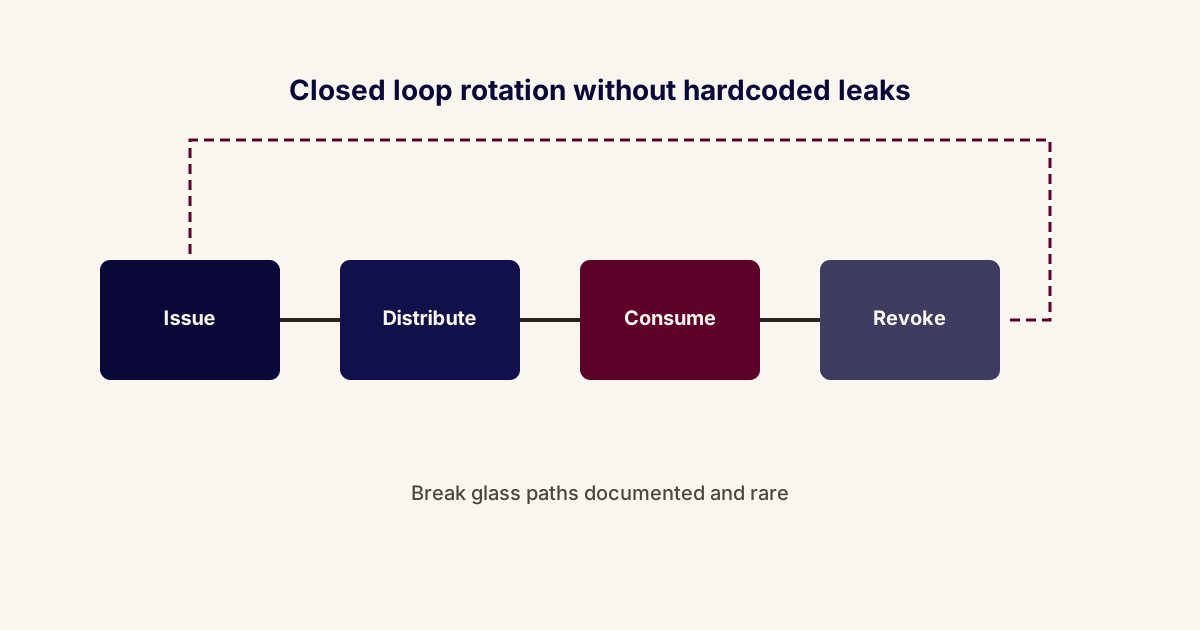
Rollout sequencing matters more than most teams realize. When both a consumer and an issuer must change, rotate the consumer side first so it can accept both old and new credentials during the transition window. Overlapping validity periods paired with dual acceptance tests ensure that no single moment of inconsistency causes a hard failure. Order of operations is the difference between a smooth rotation and a page.
Canary namespaces catch mistakes before they propagate fleet wide. Deploy the updated credential set to a small slice of traffic first and monitor error rates, latency, and authentication success ratios for a defined soak period. Only after the canary passes should the rotation proceed to the broader environment. This staged approach transforms rotation from a binary event into a gradual, observable, and reversible process.
Automate the rollback path before you automate the rotation itself. If a new credential causes failures, the system should revert to the previous credential within seconds, not minutes. Store the prior version alongside the current one in your secrets manager and wire health probes to trigger automatic fallback. Confidence in rollback is what allows teams to rotate frequently without fear of extended production impact.
Verification belongs in CI pipelines and in production probes equally. Unit tests should confirm that services retrieve credentials from the expected store rather than from hardcoded values. Integration tests in staging should validate that a freshly rotated credential grants the expected permissions. Synthetic transactions in production should fail loudly when authentication breaks, rather than letting customers discover silent partial failures in downstream systems.
Alerting on authentication error spikes is the safety net beneath every rotation. Configure your observability platform to trigger notifications when 401 or 403 response codes exceed baseline thresholds within a short window. Correlate those alerts with recent rotation events using deployment metadata so that on call engineers can pinpoint the cause quickly. Fast detection paired with automated rollback turns a potential outage into a brief anomaly.
Human break-glass paths remain necessary even in highly automated environments. Emergency credentials should be stored in a sealed vault with multi-party approval and full audit logging. Monitor every use of break-glass accounts and trigger an immediate review whenever one is accessed. Post-incident analysis should always include whether rotation delays or missing automation contributed to the need for manual intervention in the first place.

Practice revocation regularly in non-production environments. Game days that simulate a compromised credential force teams to exercise their runbooks under realistic conditions. Measure how long it takes to identify affected systems, rotate the exposed secret, and verify recovery. These drills reveal documentation gaps and tooling weaknesses that would otherwise surface only during a real incident when stress levels are highest and stakes are greatest.
Communicate with application teams using empathy and precision. A calendar invite titled mandatory rotation Friday invites shadow shortcuts and resentment. Instead, publish clear runbooks that explain what will change, when it will change, and what each team needs to do. Offer office hours where engineers can ask questions and test their services against rotated credentials in a sandbox before the production window opens.
Rollback steps should be documented at the same level of detail as the forward rotation procedure. Engineers are more willing to proceed with a change when they know exactly how to undo it. Include expected log patterns for both success and failure so that operators can distinguish a healthy rotation from a stalled one without guessing. Clarity in documentation directly reduces mean time to recovery.
Metrics that resonate with leadership include the percentage of services on fully automated rotation, mean credential age across the fleet, and the count of incidents tied to expired or leaked secrets year over year. Trend lines in these indicators justify continued platform investment and demonstrate that the security team is delivering measurable risk reduction rather than issuing policies that create friction without visible progress.
Build a dashboard that surfaces rotation health at a glance. Color code services by credential age: green for tokens under one hour, yellow for keys under thirty days, red for anything older. Make the dashboard visible to engineering leadership and include it in quarterly business reviews. Visibility creates social pressure toward compliance that no amount of policy email can replicate. What gets measured and displayed gets improved.
Align rotation practices with your compliance mapping early. Many regulatory frameworks ask for periodic password changes, but modern architectures can reinterpret that intent as proof of dynamic credential control rather than manual resets. Document the equivalency clearly so that auditors understand the design and accept automated short-lived tokens as meeting the spirit of the requirement. This avoids redundant manual processes that add risk without adding security.
Secrets rotation is a discipline, not a project with a finish line. Infrastructure evolves, new services launch, and vendors change authentication models. Embed rotation readiness into your architecture review process so that every new component ships with a credential lifecycle plan from day one. The teams that rotate calmly on any day of the week are the ones who invested in tooling, ownership, and rehearsal long before the audit arrived.