Insights · Article · Engineering · May 2026
Service workers, local persistence, optimistic UI, and merge rules when field workers and travelers edit records without continuous connectivity.

Progressive web apps promise near-native reach without app store friction, but building for the offline world adds meaningful complexity. Queued mutations, partial failures, and conflicts when two edits converge on stale record versions all demand thoughtful architectural decisions. Teams that treat offline support as an afterthought face cascading bugs once field workers, travelers, and remote employees rely on the application in areas with limited or unreliable connectivity.
The offline-first design pattern starts with the assumption that the network is unavailable by default and available only as an enhancement. This reversal from traditional web application thinking shapes how developers structure data flows, user interface feedback, and background synchronization. Progressive web apps that embrace this philosophy deliver consistent experiences whether the user stands in a subway tunnel or sits in a well-connected office.
Choose a consistency model deliberately before writing the first line of synchronization logic. Last-write-wins is simple to implement but quickly falls short in regulated domains that need full audit trails and deterministic merge outcomes. Operational transform and conflict-free replicated data types help specific collaborative domains such as shared documents and inventory counts, but they are not free magic and carry their own integration and debugging overhead.
Version vectors offer a practical middle ground for many business applications. Each record carries a vector clock or a monotonic revision number that lets the server detect divergence without scanning full payloads. When a conflict arises, the system can present both versions to the user for manual resolution or apply domain-specific merge rules such as preferring the record with the higher monetary total, the later appointment timestamp, or the most recent inventory count.
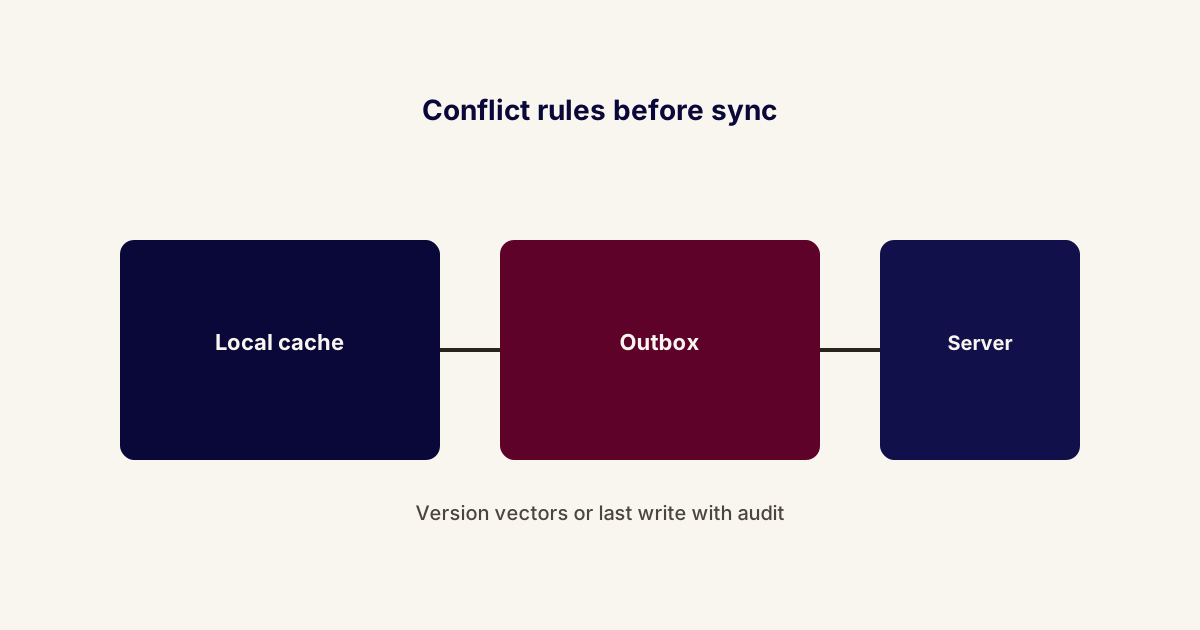
The outbox pattern is central to reliable offline synchronization in progressive web apps. Every user action that modifies data writes first to a local database and simultaneously enqueues a pending operation in an outbox table. A background sync manager processes the queue in order when connectivity returns, retrying failed operations with exponential backoff. This separation ensures that the user interface never blocks on network availability.
We facilitate small-group sessions for customers and prospects without requiring a slide deck, focused on your stack, constraints, and the decisions you need to make next.
Optimistic user interface rendering improves perceived performance by immediately reflecting changes in the local view before the server confirms them. A pending badge or subtle indicator tells the user that the change is queued but not yet synchronized. If the server rejects the mutation, the application rolls back the local state and notifies the user with a clear explanation and a path to retry or correct the input.
Service worker update strategy directly affects how fast security patches and feature releases reach client devices. Teams must document whether the application prompts users to refresh for a new version or silently installs updates in the background during the next navigation. A skip-waiting approach delivers fixes faster but can interrupt in-progress form submissions. Stale-while-revalidate balances speed and safety for most content-driven progressive web apps.
Caching strategies deserve careful layering beyond the default service worker precache. API responses, images, and static assets each benefit from distinct cache lifetimes and invalidation rules. A runtime cache that stores recent API payloads allows the application to render meaningful content even when the network is absent. Teams should version cache keys alongside deployment hashes so that stale entries do not persist after a release.
Storage quotas and eviction policies require testing on low-end Android devices and older iPhones where available space is severely constrained. IndexedDB and the Cache API share a storage budget that the browser can revoke under memory pressure without warning. Silent data loss from eviction is far worse than displaying an honest offline error to the user. Applications should monitor storage estimates through the navigator API and warn users before the quota threshold approaches.
IndexedDB serves as the primary local persistence layer for most progressive web apps that handle structured data offline. Wrapping IndexedDB with a lightweight abstraction such as idb or Dexie simplifies transaction management and cursor iteration. Schema migrations must be versioned carefully because a failed upgrade can leave the database in a broken state that only a full wipe resolves. Plan rollback paths for every schema change before shipping.
Authentication tokens inevitably expire while users work offline, and poorly designed reauth flows risk discarding an entire queue of unsynchronized changes. The application should decouple token validity from the outbox processor so that pending mutations persist across login sessions. When the user reauthenticates, the sync manager should resume from where it stopped rather than forcing the user to re-enter data. Short-lived tokens combined with refresh token rotation offer the best balance of security and continuity.
The Background Sync API provides a browser-native mechanism for deferring network requests until connectivity is restored. Registering a sync event in the service worker allows the operating system to wake the worker even after the user closes the tab, provided the browser supports the specification. Teams should implement a fallback polling mechanism for browsers that lack Background Sync support, ensuring that queued mutations eventually reach the server regardless of the client environment.

Testing offline behavior should simulate flaky networks with variable latency, packet loss, and captive portal redirects rather than relying solely on airplane mode toggles. Chromium DevTools throttling profiles and tools like Toxiproxy allow teams to reproduce conditions that field workers encounter in rural areas and underground facilities. Automated integration tests should cover the complete lifecycle of creating a record offline, synchronizing it, handling a server rejection, and verifying that the local state recovers gracefully.
End-to-end test suites benefit from dedicated service worker mocking libraries that intercept fetch events without touching production caching logic. Playwright and Cypress both support service worker interception, but the setup requires careful coordination between the test runner and the browser context. Teams should maintain a matrix of test scenarios covering first install, returning visits with stale caches, and mid-session connectivity drops to ensure that every user path behaves predictably.
Privacy considerations for offline progressive web apps extend beyond standard web security practices. Local caches may contain sensitive records such as patient information, financial details, or personal identifiers that persist on shared or public devices long after a session ends. Timeout locks that clear the local database after a period of inactivity and remote wipe commands triggered by an administrator belong in the threat model from the earliest design phase.
Encrypting data at rest in IndexedDB adds a meaningful layer of defense for applications that store regulated or personally identifiable information offline. The Web Crypto API provides native primitives for AES encryption without requiring third-party libraries. Deriving encryption keys from user credentials ensures that cached records remain unreadable if the device is lost or stolen, though teams must manage key rotation and recovery flows to avoid permanent data lockout.
Monitoring and observability for offline-capable progressive web apps require instrumentation that works without continuous network access. The application should buffer telemetry events locally and flush them during the next successful sync window. Key metrics include average time spent offline per session, outbox queue depth at reconnection, conflict frequency by entity type, and the percentage of mutations that succeed on the first server round trip.
Measure conflict rates and resolution time segmented by feature area and user cohort. Sudden spikes in conflicts often indicate unclear data ownership boundaries, missing server-side constraints, or workflows that encourage simultaneous edits to the same record. Dashboards that surface these trends help product teams prioritize schema changes, locking mechanisms, or user interface guardrails that prevent conflicts at the source rather than resolving them after the fact.
Progressive web apps with robust offline sync and conflict resolution give organizations a durable competitive advantage in industries where connectivity cannot be guaranteed. The upfront investment in local persistence, deterministic merge logic, and thorough network simulation testing pays dividends through higher user satisfaction, fewer support tickets, and reliable data integrity. Teams that treat offline capability as a first-class architectural concern rather than a bolt-on feature will build applications that earn trust in the field.