Insights · Article · Strategy · Apr 2026
Design reviews, consent UX, and metric guardrails that keep growth experiments respectful so regulators and customers trust your digital channels.

Growth teams live by funnels. Left unchecked, funnel optimization nudges toward manipulative defaults, confusing cancellations, and intrusive tracking. Ethics in product analytics is not abstract philosophy; it is operational discipline that reduces regulatory and reputational tail risk. Companies that ignore ethical guardrails face enforcement actions under laws like the Digital Services Act, FTC guidelines, and emerging state privacy statutes that specifically target deceptive design patterns in digital products.
Regulators worldwide have sharpened their focus on dark patterns. The European Data Protection Board issued guidelines that classify misleading interface choices as violations of consent requirements. California's CPRA includes provisions against deceptive data collection interfaces. Organizations that treat ethical analytics as a compliance checkbox rather than a design philosophy will find themselves perpetually reacting to enforcement trends instead of building durable customer relationships grounded in transparency and mutual respect.
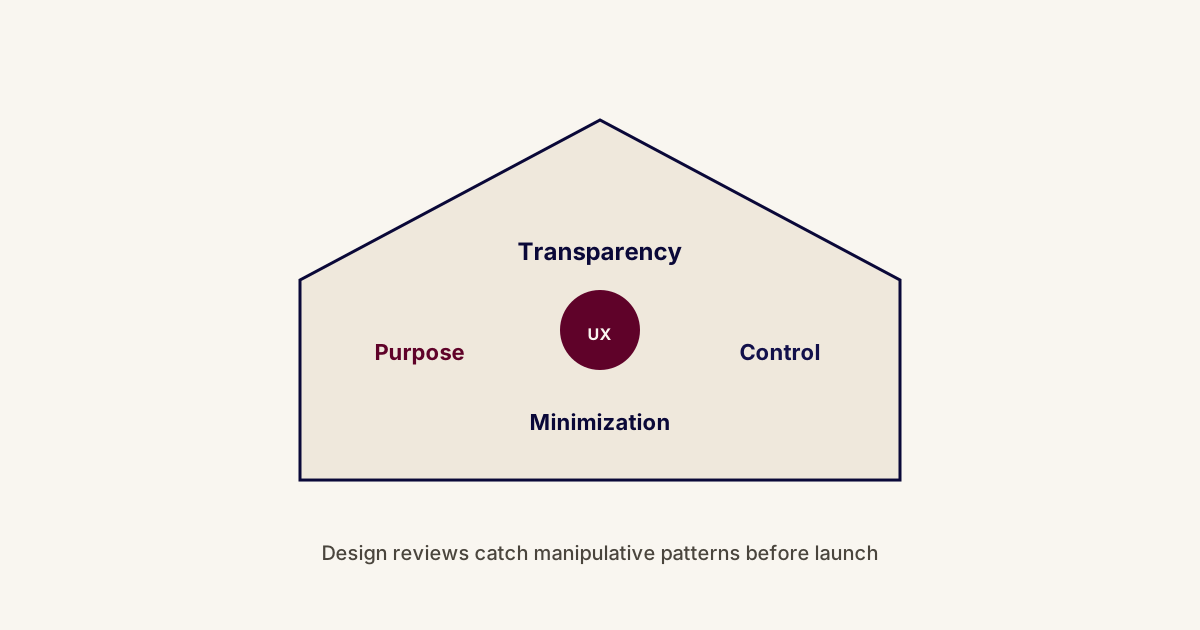
Start with a short ethical design checklist embedded in feature kickoffs: purpose limitation, proportionality, transparency, and easy exit. The checklist should be owned by product management, not delegated entirely to legal after the build is finished. Product managers who internalize these principles make better tradeoff decisions during sprint planning. When ethical review happens upstream, teams avoid costly late stage redesigns that delay releases and frustrate engineers who built features in good faith.
Each checklist item should translate into concrete acceptance criteria. Purpose limitation means every data collection point has a documented business justification that the team can articulate without referencing revenue alone. Proportionality requires that the amount of data gathered matches the stated need. Teams that collect behavioral signals beyond what the feature requires create liability without corresponding value. Audit these criteria quarterly to catch scope creep before it compounds into systemic overreach.
We facilitate small-group sessions for customers and prospects without requiring a slide deck, focused on your stack, constraints, and the decisions you need to make next.
Analytics instrumentation should map every tracked event to a documented purpose. Random event sprawl makes later deletion and subject access requests expensive and error prone. Name events consistently using a shared taxonomy, retire unused ones on a regular cadence, and version your tracking plan alongside product releases. A well maintained event catalog functions as both a compliance artifact and a productivity tool that helps analysts find signals faster.
Assign ownership of the tracking plan to a specific role, whether that is a data governance lead or a rotating product analyst. Without clear ownership, instrumentation grows unchecked as each team adds events without coordinating with others. Periodic instrumentation audits reveal orphaned events, duplicate trackers, and collection points that no longer serve any active dashboard or model. Cleaning up dead instrumentation reduces storage costs and simplifies privacy compliance workflows significantly.
Experiment review boards are useful even outside regulated industries. Include a customer support representative who sees confusion in tickets before dashboards look green. Include a security engineer for experiments that touch authentication state or payment flows. Reviews need not be heavyweight; a thirty minute weekly sync with a lightweight template covering hypothesis, risk surface, affected populations, and rollback criteria keeps velocity high while adding meaningful ethical oversight to growth experimentation.
Document every experiment with a pre registration brief that states the hypothesis, success metric, and potential harm vectors. Pre registration discourages teams from cherry picking favorable results after the fact, a practice that corrodes analytical integrity over time. When an experiment produces unexpected negative effects on user satisfaction or support volume, the review board should have authority to pause the test immediately and require a revised design before relaunch.
Dark patterns often hide in microcopy and timing. Pre checked marketing consent boxes, obscured fees revealed only at checkout, and forced navigation loops that prevent users from completing simple tasks all erode trust. A straightforward heuristic applies: if you would not explain the UX choice proudly to a journalist or regulator, redesign it. This test works because it forces product teams to confront the gap between intent and perceived user experience.
Common dark pattern categories include confirmshaming, where decline options use guilt laden language, roach motels that make account deletion unreasonably difficult, and misdirection that draws attention away from important choices. Mapping your product surfaces against established taxonomies like those maintained by the FTC or the Deceptive Design Hall of Shame helps teams identify violations they might otherwise overlook. Conduct these mapping exercises at least twice per year as interfaces evolve.
Consent interfaces deserve particular scrutiny because they form the legal and ethical foundation for all downstream data use. Cookie banners that require five clicks to decline while offering a single click to accept fail both the spirit and increasingly the letter of consent law. Design consent flows with equal prominence for acceptance and refusal. Use plain language that avoids jargon, and never bundle unrelated consent categories into a single toggle.
Children, vulnerable populations, and users experiencing financial distress deserve higher ethical bars than general audiences. Model features that infer hardship from behavioral signals need human oversight and conservative defaults. Age gating should rely on meaningful verification rather than trivial self declaration that provides no real protection. Teams building products in healthcare, lending, or education verticals should adopt sector specific ethical frameworks that supplement general product analytics guidelines with domain appropriate safeguards.
Ethical analytics extends to accessibility. Screen reader users, people with cognitive disabilities, and those on low bandwidth connections may experience analytics heavy pages differently. Excessive client side event tracking can degrade performance on older devices, disproportionately affecting lower income users. Test instrumentation impact across device tiers and connection speeds. Ethical product teams ensure that measurement infrastructure does not create a two tier experience that penalizes users with fewer resources.

Metrics dashboards should include harm indicators alongside growth figures: complaint rates, chargebacks, support contacts per thousand activations, and unsubscribe spikes all serve as early warning signals. A north star revenue metric without guardrails invites shortcuts that sacrifice long term customer lifetime value for short term conversion bumps. Pair every growth metric with at least one counterbalancing health metric so that optimization pressure cannot push the product toward extractive patterns.
Design executive dashboards that surface ethical health metrics with the same visibility as revenue and activation numbers. When leadership only sees growth charts, incentive structures naturally tilt toward aggressive optimization. Including trust scores, opt out rates, and regulatory inquiry counts in board level reporting signals that the organization values sustainable growth. This visibility also helps data teams secure budget for compliance tooling that might otherwise lose priority against feature development.
When privacy and consumer protection laws differ by region, implement policy engines in your data planes rather than maintaining forked application code indefinitely. Central governance with localized rules scales better than copy paste code paths that diverge over time and become impossible to audit. Invest in configuration driven consent and collection logic that a compliance team can update without requiring engineering sprints for every regulatory change across jurisdictions.
Automated compliance tooling should handle data residency requirements, retention schedules, and deletion workflows without manual intervention for routine requests. Subject access requests under GDPR and similar statutes must be fulfilled within tight deadlines, and manual processes break down at scale. Build deletion pipelines that propagate across analytics warehouses, backup systems, and third party integrations. Testing these pipelines regularly prevents the embarrassment of discovering gaps only when a regulator asks.
Culture reinforcement matters as much as process controls. Run quarterly ethics workshops where product, engineering, and design teams review real world enforcement cases and discuss how similar issues could arise internally. Celebrate teams that identify and remove manipulative patterns voluntarily rather than only rewarding conversion improvements. When ethical behavior is recognized alongside business performance, organizations create feedback loops that make dark pattern avoidance a natural part of product development.
Publish plain language summaries of your analytics practices in help centers and onboarding flows where users can find them without searching. Transparency reduces suspicion and supports marketing claims about respectful data use. Go beyond the minimum legal privacy notice by explaining in conversational terms what you track, why you track it, and how users can control their data. Companies that embrace radical transparency often discover it becomes a competitive differentiator in trust sensitive markets.
The intersection of product analytics and ethics will only grow more consequential as AI driven personalization increases the power and subtlety of digital influence. Organizations that build ethical infrastructure today position themselves to adopt emerging technologies responsibly rather than retrofitting safeguards under regulatory pressure. Treating users as partners in a transparent value exchange, rather than targets for extraction, creates products that grow sustainably and earn loyalty that no dark pattern can replicate.