Insights · Article · Risk · Apr 2026
Translate data subject rights, retention schedules, and purpose limitation into automated checks that developers cannot accidentally bypass.

Privacy engineering succeeds when policies become executable constraints rather than PDFs attached to tickets. Organizations that treat privacy as a compliance afterthought routinely discover that their engineering teams have already built around the rules. Bridging that gap requires product managers, legal counsel, and platform engineers to agree on canonical definitions for personal data categories and processing purposes before a single line of automation code is written.
Cross-functional alignment is the first obstacle most teams underestimate. Legal teams often write policies using regulatory language that developers cannot map to database schemas. Product managers focus on feature velocity and view privacy reviews as blockers. Building a shared vocabulary early prevents miscommunication later. Schedule a working session where all three groups walk through one real data flow and annotate each field with its category, purpose, and retention period.
Begin with a lightweight data dictionary that links business terms to technical columns and tables. Without that bridge, automation guesses wrong and auditors lose confidence. A good dictionary captures field sensitivity levels, lawful bases for processing, owning teams, and expected retention horizons. Invest in curation before you invest in more tools. One well-maintained and regularly reviewed dictionary outperforms an expensive catalog platform that nobody keeps current.
Treat the data dictionary as a living artifact, not a one-time compliance deliverable. Assign ownership to a data steward or rotating privacy champion within each product area. Every schema migration should trigger a review that confirms new columns are classified. When classifications fall behind, downstream automation silently loses coverage. Quarterly reconciliation between the dictionary and production schemas keeps definitions honest and auditable over time.
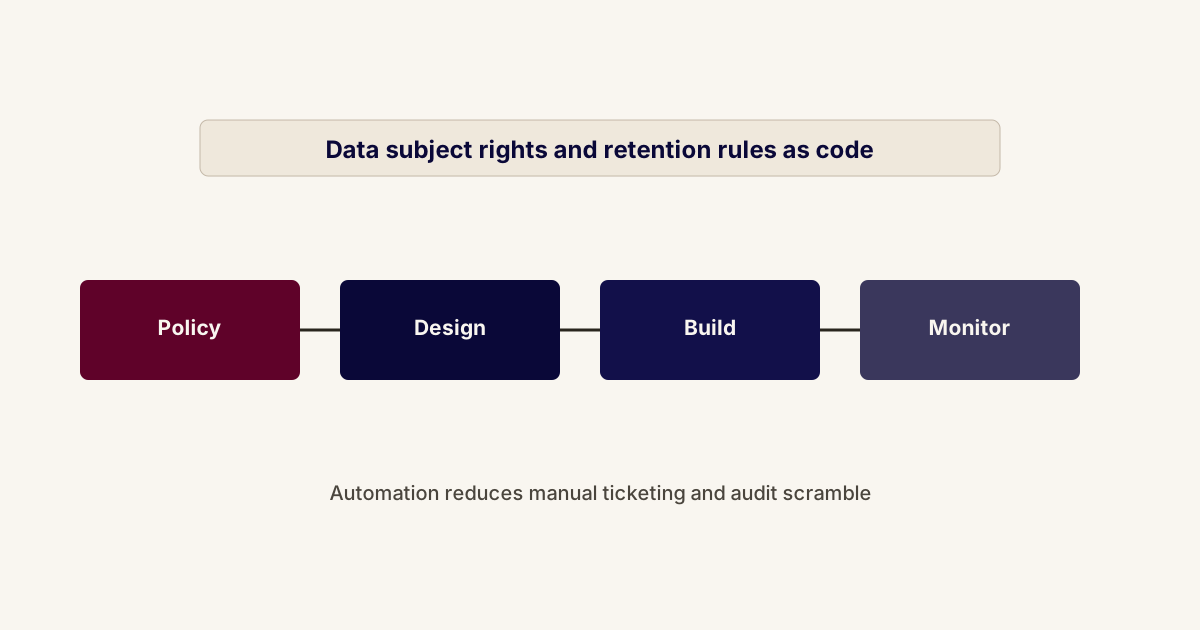
Once canonical definitions are established, automation can reference them with confidence. Tagging systems should pull purpose and sensitivity metadata from the dictionary rather than relying on developer annotations at commit time. Centralized metadata services reduce duplication and prevent drift across repositories. When every pipeline reads from the same source of truth, consistency becomes a property of the system rather than a function of individual discipline.
We facilitate small-group sessions for customers and prospects without requiring a slide deck, focused on your stack, constraints, and the decisions you need to make next.
Design reviews should include privacy threat modeling for new data flows. Ask what happens when a downstream consumer adds a field to an export, when a model trainer copies a snapshot to a sandbox, or when retention clocks differ across regions. These questions surface risks that functional testing alone cannot catch, and they force teams to document assumptions that would otherwise remain implicit in code.
Privacy threat modeling does not require heavyweight frameworks or week-long workshops. A thirty-minute session during sprint planning can cover the most critical flows. Focus on data ingestion points, storage boundaries, and any interface where personal data crosses team or system boundaries. Record each finding in the same backlog that holds feature work so that mitigations receive prioritization alongside business requirements rather than languishing in a separate tracker.
Build-time checks validate schema changes against retention metadata, encrypt sensitive columns by default using approved patterns, and block merges when purpose tags are missing. The goal is fast feedback in continuous integration, not a monthly committee convened to approve diffs. Developers who receive immediate, actionable signals fix issues while the context is fresh. Delayed reviews create backlogs that erode both velocity and compliance posture.
Schema governance becomes practical when policy-as-code libraries provide reusable validations. A shared linting rule that rejects untagged columns costs minutes to integrate and saves hours of retroactive classification. Pair these rules with clear error messages that point developers to documentation. Friction that educates is acceptable; friction that confuses drives workarounds. The difference between the two often comes down to the quality of error output and linked guidance.
Developer experience matters more than most privacy programs acknowledge. If tagging a column requires navigating three internal portals and filing a ticket, engineers will defer the task until someone escalates. Build tagging into the tools developers already use. IDE plugins, pull request templates with required fields, and CLI commands that generate compliant boilerplate reduce resistance. When the secure path is the easiest path, adoption follows naturally.
Runtime monitoring closes the loop between design intent and operational reality. Log access patterns, flag bulk exports, and correlate API activity with consent records where applicable. Alerts should route to named owners with runbooks, not to a shared mailbox that becomes a graveyard. Effective monitoring distinguishes between expected batch processing and anomalous access that could indicate misuse, misconfiguration, or a genuine breach scenario.
Consent correlation at runtime demands integration between your consent management platform and your data access layer. When a user withdraws consent for marketing analytics, downstream queries should respect that withdrawal within the timeframe your privacy notice promises. Building this linkage incrementally is acceptable. Start with the highest-risk processing activities and expand coverage each quarter. Partial automation with clear boundaries beats a stalled project that attempts full coverage on day one.
Data subject rights workflows benefit from orchestration engines that coordinate across services. When a deletion request arrives, systems should know which replicas, caches, analytics projections, and backup archives require action. Manual spreadsheets do not scale past the first supervisory authority question. A well-designed orchestration layer confirms completion from each downstream system and produces an auditable receipt that regulators can inspect without engineering intervention.

Portability and access requests introduce their own complexity. Gathering records from multiple microservices, normalizing formats, and redacting third-party information within statutory deadlines requires pre-built connectors and tested export templates. Run periodic dry runs against synthetic identities to verify that the entire chain works end to end. Discovering a broken connector during a real request from a regulator is a failure mode that rehearsal eliminates entirely.
Train customer support and operations teams on what engineered privacy controls can and cannot do. Overpromising instant erasure across every legacy archive destroys trust faster than a known limitation disclosed honestly. Provide clear SLAs for each request type and pair them with transparent status pages that requesters can check. Honest communication about processing timelines outperforms heroic manual intervention that cannot be sustained at scale.
Collaboration between privacy engineering and security operations strengthens both functions. Shared telemetry pipelines reduce duplicate instrumentation. Incident response playbooks that address both breach notification and data subject communication prevent gaps during high-pressure events. Joint tabletop exercises reveal blind spots that siloed teams never encounter. When privacy and security operate from the same data and the same alert infrastructure, the organization responds faster and with greater accuracy.
Measure outcomes with metrics that leadership understands and cares about. Track time to fulfill access and deletion requests, the percentage of production systems with automated retention enforcement, and the count of audit findings related to privacy controls year over year. Quantitative evidence keeps the program funded when leadership changes. Without numbers, privacy engineering becomes the first budget line cut during cost reduction exercises.
Build a reporting cadence that surfaces these metrics to stakeholders monthly. Dashboards visible to engineering leads, legal counsel, and executive sponsors create shared accountability. Highlight trends rather than snapshots so that leadership sees directional progress. A declining backlog of unclassified fields or a shrinking median response time for deletion requests tells a more compelling story than a single compliance score. Transparency in reporting builds organizational trust in the program.
Partner with internal audit early in the program lifecycle. Show auditors the test evidence generated by pipelines, the sampled access logs, and the reconciliation reports from your data dictionary reviews. When audit sees repeatable, automated controls with clear ownership, external examinations become less disruptive for engineering roadmaps. A collaborative relationship with audit transforms them from adversaries into advocates who reinforce funding requests.
Privacy engineering is not a project with a finish line. Regulations evolve, data architectures shift, and new processing activities emerge with every product launch. Sustainable programs embed privacy into the software development lifecycle so deeply that removing it would be harder than maintaining it. Start with definitions, automate incrementally, measure relentlessly, and treat every audit cycle as an opportunity to strengthen the pipeline from policy to production.