Insights · Article · Engineering · May 2026
Publication design, slot monitoring, cutover rehearsal, and fallback paths when major versions require low-downtime migration beyond in-place pg_upgrade alone.

Major PostgreSQL version upgrades present a significant challenge for teams that have accumulated years of schema conventions, extension dependencies, and application assumptions tied to a specific release. Logical replication offers a path to rolling migrations with controlled cutover windows, but it demands far more preparation than a simple pg_upgrade command. Publication definitions, replication slot monitoring, and rehearsed cutover procedures become essential components of any serious upgrade plan.
Traditional upgrade methods such as pg_upgrade work well for smaller databases with brief maintenance windows. However, organizations running multi-terabyte clusters or providing service level agreements that require near-zero downtime often find in-place upgrades insufficient. Logical replication allows the old and new clusters to run simultaneously, giving teams the ability to validate the target environment under real workloads before committing to a final switchover that affects production traffic.
Upgrade planning begins months before execution. Teams should document the current PostgreSQL version, all installed extensions, custom operator classes, and any compile-time options that deviate from standard distributions. Compatibility matrices between the source and target versions help surface breaking changes in authentication, query planner behavior, or configuration defaults. A shared project tracker ensures that infrastructure, application, and security teams stay aligned on milestones and dependencies.
Inventorying tables that lack primary keys is a critical first step because logical replication requires a unique row identifier for change tracking. Large bytea columns and exotic data types such as composite arrays or range types can introduce unexpected replication failures or performance bottlenecks. Running a pre-flight audit script that flags unsupported column types and missing constraints saves hours of debugging once replication channels are active and data is flowing between clusters.
Publication design determines exactly which tables and operations the source cluster streams to the target. Selective publications that include only INSERT, UPDATE, and DELETE for specific schemas reduce bandwidth and simplify conflict resolution. Teams should avoid publishing temporary staging tables or high-churn audit logs that inflate WAL volume without contributing meaningful state. Testing publication filters in a staging environment confirms that no critical table is accidentally excluded from the replication set.
We facilitate small-group sessions for customers and prospects without requiring a slide deck, focused on your stack, constraints, and the decisions you need to make next.
On the target cluster, subscription configuration controls how replicated data arrives and applies. Setting the synchronous_commit parameter appropriately and tuning max_logical_replication_workers prevents apply lag from compounding during peak traffic. It is also wise to disable triggers and foreign key checks on the target during initial synchronization so that bulk data loading does not trigger cascading constraint validations. Re-enabling these safeguards before cutover ensures data integrity without sacrificing synchronization speed.
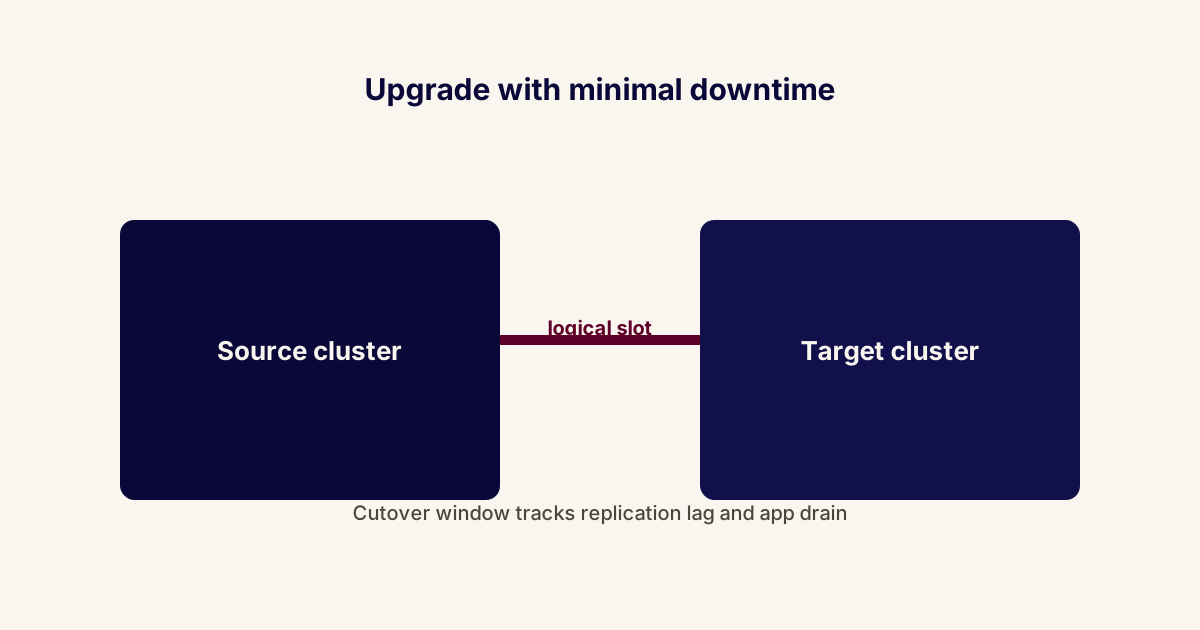
The initial table copy phase can dominate total migration time for large datasets. Catch-up replication then processes every change that occurred on the source during the copy window. Teams must run these phases under production-representative load because quiet test databases produce misleadingly optimistic timing estimates. If the catch-up phase cannot converge within the planned maintenance window, the entire cutover schedule may need revision, additional worker threads, or a phased table migration approach.
Monitoring replication lag is the single most important operational concern during the migration window. Querying pg_stat_replication on the source and pg_stat_subscription on the target provides real-time visibility into bytes sent versus bytes applied. Alerting thresholds should trigger well before lag reaches a level that would extend the cutover window beyond acceptable limits. Dashboards displaying lag trends over time help the team decide whether to proceed with the switchover or postpone until conditions stabilize.
Application cutover patterns vary based on risk tolerance and architecture. A read-only maintenance window is the simplest approach, pausing writes while replication drains to zero lag. Dual-write strategies send mutations to both clusters simultaneously, with a reconciliation process that detects and resolves conflicts after the fact. Blue-green connection string flips redirect traffic instantly through DNS or connection pooler changes. Each pattern carries distinct tradeoffs in complexity, data consistency, and rollback ease, so teams must choose deliberately and document the selected procedure.
Dual-write reconciliation deserves special attention because it introduces the possibility of divergent state between source and target. Hash-based row comparison tools such as pg_comparator or custom checksum queries can validate that both clusters hold identical data after the write period ends. Any discrepancies must be resolved before the old cluster is decommissioned. Logging every write to both clusters in an append-only journal simplifies forensic analysis if inconsistencies surface during post-migration validation.
Extensions and search indexes frequently do not replicate through logical channels. Full-text search indexes built on GiST or GIN structures must be rebuilt on the target cluster before it can serve production queries at acceptable latency. Extensions such as PostGIS, pg_trgm, or hstore may require matching library versions on the target host. Teams should script these rebuild steps, measure their execution time under load, and include them in the cutover checklist so nothing is forgotten during a high-pressure migration window.
Sequence values and identity columns present another replication gap that teams often overlook until cutover. Logical replication does not stream sequence advances, so the target cluster's sequences may start at values far below the source's current positions. Before switching application traffic, teams must manually set each sequence to a value safely ahead of the source's last known position. Automating this step with a script that queries pg_sequences on the source and applies setval on the target eliminates a common source of primary key collisions.
Replication slot retention on the source cluster protects against data loss if the target experiences an outage or falls behind. However, retained WAL segments consume disk space continuously, and an unmonitored slot can fill the source's storage volume within hours during high-write workloads. Aggressive alerting on both replication lag and disk usage is non-negotiable. Teams should define a maximum tolerable WAL retention threshold and configure automated slot deactivation if that threshold is breached, accepting a controlled replication restart over an unplanned source outage.
WAL management extends beyond slot retention into archive and backup considerations. If the source cluster uses continuous archiving for point-in-time recovery, the additional WAL generated by replication activity increases archive storage costs and may affect backup completion times. Coordinating with backup schedules ensures that neither process starves the other of disk bandwidth. Some teams choose to temporarily increase wal_keep_size during the migration window as an additional safety net, reverting the setting once the target cluster has fully caught up.
Security posture during replication requires careful attention because data flows between two clusters over a network path that may traverse untrusted segments. Encrypting the replication channel with TLS prevents eavesdropping on sensitive row data in transit. Replication roles should follow least-privilege principles, granting only the REPLICATION attribute and SELECT on published tables. Network segmentation ensures that a compromised analytics replica or development environment cannot become a lateral movement path into production infrastructure through an open replication channel.
Connection pooler and DNS configuration play a pivotal role in seamless cutover. Tools such as PgBouncer or Pgpool allow teams to redirect application connections by updating a single upstream target rather than redeploying every service. DNS-based approaches using low TTL records achieve similar results but depend on clients honoring TTL values, which some connection libraries cache aggressively. Testing the chosen redirection method under realistic connection counts and failover scenarios prevents surprises when the actual cutover window opens.
Post-cutover validation should begin immediately once application traffic reaches the new cluster. Comparing query execution plans between the old and new versions reveals optimizer behavior changes that could degrade performance for critical workloads. Statistics health matters because freshly loaded tables may lack the histogram data that the planner needs for efficient joins. Running ANALYZE on all tables and reviewing autovacuum schedules ensures that the new cluster reaches steady-state performance quickly rather than suffering through a slow warm-up period.
Establishing a performance baseline on the new cluster within the first 48 hours provides an early warning system for regressions. Capture metrics including query latency percentiles, transaction throughput, index hit ratios, and checkpoint frequency. Comparing these figures against the old cluster's historical data confirms that the upgrade delivered expected improvements or, at minimum, maintained parity. Any anomalies detected during this window are far easier to investigate while the old cluster is still available as a reference point for plan and configuration comparison.
A documented rollback strategy is essential even when confidence in the migration is high. If the new cluster exhibits critical issues after cutover, teams need a tested path back to the old version. Keeping the source cluster's replication slot active for a defined grace period allows reverse synchronization if needed. Alternatively, maintaining the source cluster in a read-only standby mode preserves the option of a rapid failback without requiring a full data restore from backup.
Archiving detailed runbooks and timing data from each migration turns institutional knowledge into a durable asset. Record every step's duration, any deviations from the plan, and the resolution for each unexpected issue. Future upgrade cycles benefit enormously from this documentation because PostgreSQL major versions arrive on a predictable annual cadence. Teams that treat each migration as a learning opportunity build compounding expertise, reducing both risk and effort with every subsequent upgrade rather than rediscovering the same pain points repeatedly.