Insights · Article · Cloud · Jan 2026
From DORA to unit economics: dashboards that align engineering outcomes with capital plans.

Platform engineering has matured from an internal convenience into a strategic investment. As organizations scale their internal developer platforms, the conversation inevitably shifts from technical capability to financial accountability. CFOs and finance leaders want to understand what every dollar spent on platform tooling actually delivers. Bridging this gap requires metrics that speak the language of business outcomes, not just engineering velocity.
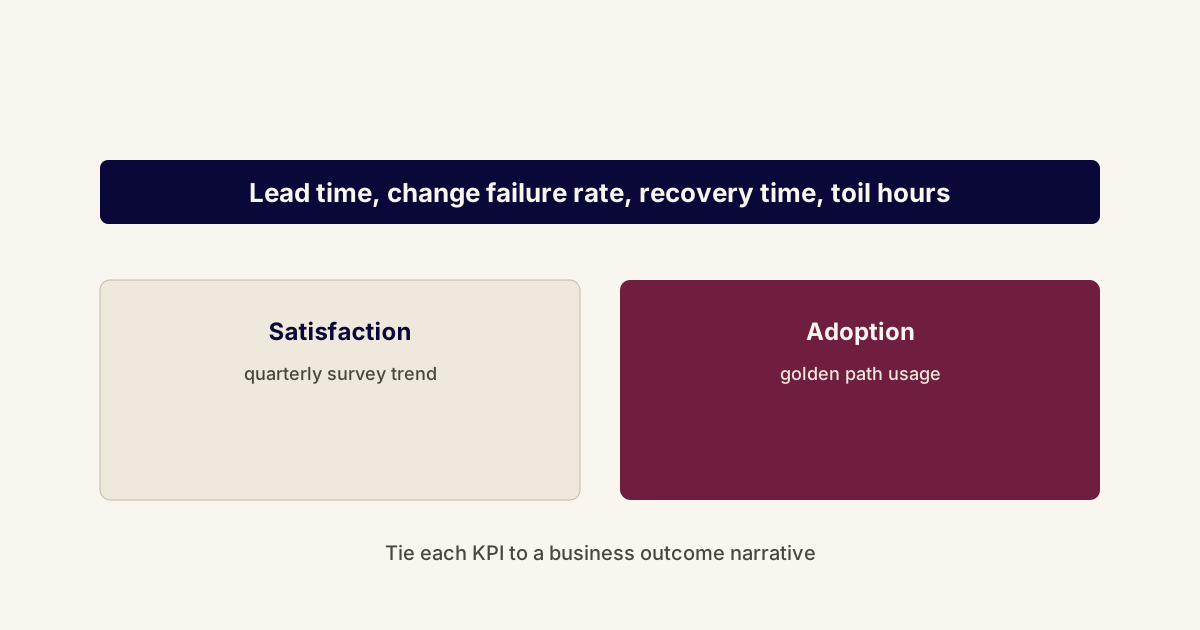
Most engineering teams default to reporting deployment frequency, lead time for changes, mean time to recovery, and change failure rate. These DORA metrics are valuable for gauging software delivery performance, but they rarely appear on a CFO's quarterly review slide. The disconnect is not about relevance. It is about translation. Engineering leaders must reframe platform investments in terms that map directly to revenue, cost, and risk.
DORA metrics explain flow; they do not, by themselves, explain whether the platform budget should grow or shrink. Finance teams need to see developer hours reclaimed, incident cost avoided, and time-to-compliance for new regions.
Developer hours reclaimed is one of the most compelling metrics for finance stakeholders. When a platform team automates environment provisioning that previously took two days of manual effort, the savings compound across hundreds of engineers. Multiply the hours saved per developer by the fully loaded cost per hour, and the ROI becomes tangible in a way that deployment frequency alone cannot achieve.
Incident cost avoidance tells a similarly powerful story. Every production outage carries direct costs in lost revenue, customer churn, and engineering time spent firefighting. Platform investments that reduce mean time to recovery or prevent incidents entirely translate to measurable savings. Tracking the cost per incident before and after platform adoption gives finance teams a clear before and after comparison for budget justification.
We facilitate small-group sessions for customers and prospects without requiring a slide deck, focused on your stack, constraints, and the decisions you need to make next.
Time to compliance is another metric that resonates with the CFO's office. Expanding into new markets or regulatory jurisdictions requires meeting specific data residency, encryption, and audit requirements. When the internal platform provides guardrails and automated policy enforcement, the timeline from zero to compliant shrinks dramatically. This acceleration has direct financial value because it determines how quickly new revenue streams can open.
We tie internal platform SKUs to consumption and showback where appropriate. When product lines can compare the fully loaded cost of self-managing Kubernetes against the internal platform, prioritization debates become data-driven.
Showback models work best when they expose consumption at a granularity that product teams can act on. Rather than presenting a single monthly cloud bill, the platform team should break costs into compute, storage, networking, and observability per service. This transparency empowers teams to make informed tradeoffs without waiting for a central optimization initiative to identify waste on their behalf.
Unit economics at the platform layer reveal whether the organization is achieving economies of scale. Track the cost per deployment, cost per environment, and cost per onboarded service over time. If these unit costs decline as adoption grows, the platform is delivering leverage. If they remain flat or increase, it signals architectural inefficiency or scope creep that warrants investigation before the next budget cycle.
Comparing internal platform costs against the alternative of each team self-managing infrastructure is a powerful framing device. Many organizations discover that the fully loaded expense of individual teams maintaining their own CI pipelines, secret management, and observability stacks far exceeds the centralized platform investment. Presenting this counterfactual analysis during planning season helps justify headcount and tooling spend for the platform group.
Avoid vanity adoption scores. Prefer measures linked to revenue protection, such as faster recovery from outages in customer-facing paths, or measurable reduction in audit findings tied to deployment hygiene.
Adoption metrics tempt platform teams because they are easy to collect and always trend upward in the early phases. But a high adoption number paired with low satisfaction or high workaround usage signals that teams feel compelled to use the platform rather than genuinely choosing it. CFOs should ask whether adoption correlates with improved delivery outcomes, not simply whether the number is growing.
Revenue protection metrics deserve a dedicated section on every platform dashboard. Faster recovery from customer-facing outages preserves revenue that would otherwise be lost during downtime windows. If the platform reduces mean time to recovery by forty percent and the average outage costs the business fifty thousand dollars per hour, the financial case writes itself. Quantifying these scenarios turns abstract resilience into concrete savings.

Audit and compliance findings tied to deployment hygiene offer another lens into platform value. Organizations that automate change management, enforce separation of duties through pipeline configuration, and maintain immutable deployment records tend to see fewer audit exceptions. Each avoided finding reduces remediation cost and lowers the risk of regulatory penalties, both of which are outcomes that finance teams track carefully.
Security posture improvements driven by the platform also carry financial weight. Centralized secret rotation, automated vulnerability scanning in build pipelines, and enforced network policies reduce the probability and blast radius of breaches. Cyber insurance underwriters increasingly request evidence of these controls, and organizations with mature platform practices may qualify for lower premiums. This is a metric worth surfacing during renewal negotiations.
Building the right dashboard is only half the challenge. The reporting cadence and audience must be deliberately designed. Monthly operational reviews can use granular metrics like cost per deployment and developer satisfaction scores. Quarterly business reviews should elevate the conversation to total cost of ownership trends, incident cost avoidance, and compliance acceleration. Annual planning should present the multi-year trajectory alongside industry benchmarks.
Stakeholder alignment depends on consistent storytelling across these review cycles. The platform team should partner with finance business partners to agree on definitions, data sources, and calculation methods before the first report is published. Disputes over methodology undermine credibility. Once the framework is established, automate the data collection so that reporting becomes a byproduct of platform operations rather than a manual quarterly exercise.
Benchmarking against industry peers adds context that internal metrics alone cannot provide. Organizations like DORA, the FinOps Foundation, and analyst firms publish annual surveys on platform maturity and cloud cost efficiency. Positioning your platform's performance relative to these benchmarks helps the CFO understand whether the investment is competitive. It also highlights areas where targeted spending could yield disproportionate improvement.
The most effective platform engineering organizations treat metrics as a product in their own right. They invest in self-service dashboards that let product teams explore their own cost and performance data without filing a ticket. This democratization of insight reduces the reporting burden on the platform team while fostering a culture of shared ownership over efficiency. When everyone can see the numbers, accountability follows naturally.
Ultimately, the metrics that matter to the CFO are the ones that connect engineering activity to financial outcomes. Deployment frequency is interesting. Deployment cost trending downward while feature throughput increases is compelling. Platform engineering teams that learn to tell this dual story, performance improving and cost declining, will find it far easier to secure sustained investment through economic cycles and budget pressures.