Insights · Article · Engineering · May 2026
Designing safe retries across acquirers, double charge prevention, timeout ambiguity, and observability that finance reconcilers actually trust.

Payments fail in messy ways. Gateways time out but capture charges minutes later. Mobile clients retry blindly when network signals drop. Webhooks arrive out of order, duplicated, or not at all. Every one of these failure modes can result in a customer being charged twice or a merchant losing revenue silently. Idempotency keys are the contract between product engineering and the unpredictable reality of money movement across distributed systems.
The business case for investing in retry safety is straightforward. Double charges erode customer trust faster than almost any other product defect. Support tickets multiply, chargeback rates climb, and payment processor relationships deteriorate when duplicates go unchecked. For subscription businesses processing thousands of recurring transactions daily, even a fraction of a percent in duplicate charges translates into significant revenue leakage and operational overhead that compounds month over month.
Standardize idempotency key generation at the business operation level, not at the individual HTTP call level. When a user clicks the pay button twice, both requests should map to a single payment intent with deterministic server behavior. Combine a user identifier, cart hash, and a timestamp window to produce keys that are unique to the operation but stable across retries. This approach prevents accidental duplication while allowing legitimate new attempts.
Idempotency key storage requires careful lifecycle management. Store each key alongside its response payload in a durable datastore with a defined expiration window. When a duplicate request arrives, return the stored response without re-executing the operation. Time to live values should balance storage costs against the realistic window in which retries occur. For most payment flows, retaining keys for 24 to 48 hours covers the vast majority of retry scenarios.
Race conditions in key lookups are a subtle but dangerous problem. Two concurrent requests bearing the same idempotency key can both pass the deduplication check if the lookup and insert are not atomic. Use database level uniqueness constraints or compare and swap operations to ensure that only one request proceeds to execution. Failing to handle this correctly undermines the entire safety guarantee that idempotency keys are meant to provide.
We facilitate small-group sessions for customers and prospects without requiring a slide deck, focused on your stack, constraints, and the decisions you need to make next.
Storing outcomes with sufficient detail is critical for downstream reconciliation. Each idempotency record should capture the acquirer response code, the authorization identifier, the settlement status, and a timestamp accurate to milliseconds. When finance teams investigate discrepancies weeks after a transaction, they need a single source of truth that connects the original intent to every external call made on its behalf. Sparse records create costly manual investigations.
Retry policies must distinguish between idempotent read operations and non-idempotent write operations. A GET request to check payment status can be retried freely, but a POST request to capture funds demands strict deduplication before any repeat attempt. Exponential backoff with jitter helps absorb network congestion without overwhelming acquirer endpoints. Blind replays at fixed intervals, by contrast, compound the very failures they attempt to resolve and risk corrupting ledger state.
Timeout ambiguity is the most treacherous failure mode in payment orchestration. When a capture request times out, the orchestrator cannot know whether the acquirer processed the charge or dropped it. Treating the timeout as a failure and retrying may produce a double charge. Treating it as a success may leave the merchant unpaid. The correct response is to query the acquirer for the transaction status before deciding on any subsequent action.
Circuit breakers add another layer of resilience to retry logic. When an acquirer begins returning errors at an elevated rate, the orchestrator should temporarily route transactions to an alternate processor rather than queuing retries that will likely fail. Configuring circuit breaker thresholds requires historical data on each acquirer's baseline error rates and recovery patterns. Overly sensitive thresholds cause unnecessary failovers while overly permissive ones delay recovery during genuine outages.
Webhook verification and replay protection matter as much as client side retries. Attackers can forge callback payloads to manipulate transaction states. Every incoming webhook should be verified against a cryptographic signature using a shared secret that rotates on a regular schedule. Nonce validation prevents replay attacks where a legitimate but outdated callback is resubmitted. These protections belong in a shared baseline library rather than being re-implemented by each consuming service.
Webhook ordering introduces additional complexity. A settlement notification may arrive before the corresponding authorization confirmation, especially when acquirers process events through separate pipelines. Event handlers should be designed to tolerate out of order delivery by treating each callback as a state transition proposal rather than an absolute truth. If the proposed transition is not valid given the current state, the handler should park the event and reprocess it after a brief delay.
Partial failure modes are among the most difficult to manage in payment orchestration. A charge may be authorized by the card network but never settled by the acquirer, leaving funds held on the customer's account indefinitely. State machines governing the payment lifecycle should model every possible intermediate state explicitly, including authorization hold, capture pending, settlement failed, and void requested. Making these states visible in customer support tools empowers agents to resolve disputes quickly.
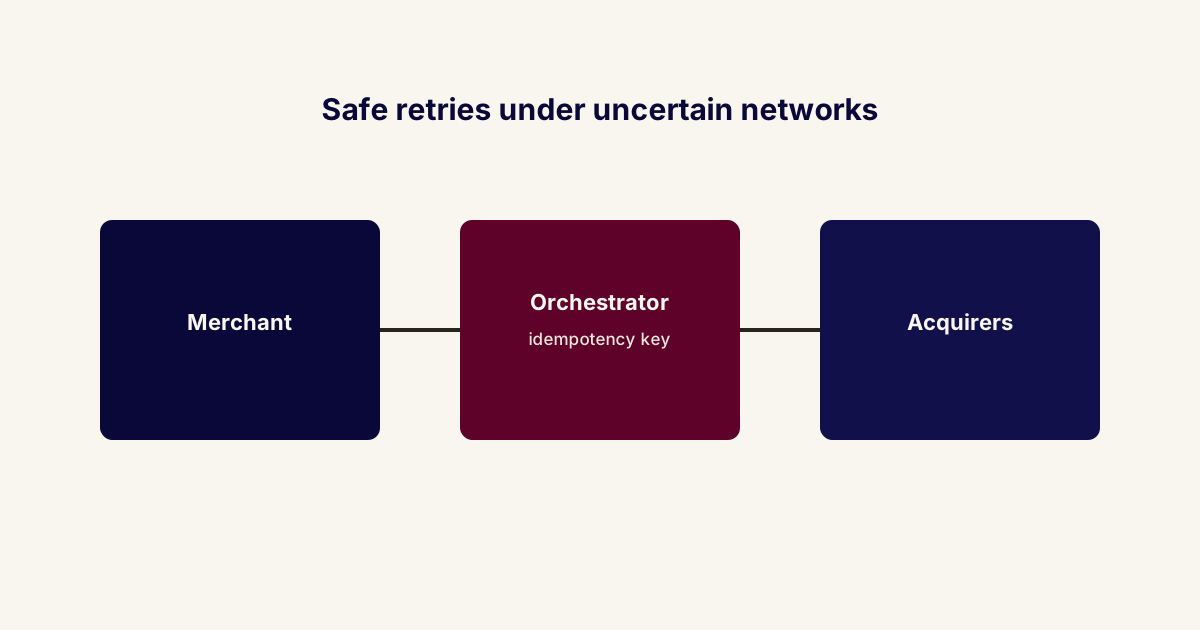
Multi-acquirer routing adds another dimension to retry strategy. When the primary acquirer rejects or times out on a transaction, the orchestrator may route the retry to a secondary acquirer. This failover must carry the same idempotency key to prevent double charges across processors. Routing logic should also account for acquirer specific rules around card brand support, currency handling, and geographic restrictions to avoid sending transactions to processors that will decline them.

Observability should correlate a payment intent across every service it touches using a single trace identifier that finance teams can search. Distributed tracing tools should propagate this identifier from the initial checkout request through the orchestrator, acquirer gateway, fraud engine, and ledger service. When traces are fragmented or identifiers change between services, investigating a single disputed transaction can require hours of manual log correlation that frustrates both engineering and finance teams.
Beyond tracing, payment orchestration systems benefit from dedicated metrics dashboards. Track authorization rates, capture latency percentiles, retry counts per acquirer, and idempotency key collision rates as first class indicators. Alert thresholds should reflect business impact rather than arbitrary technical limits. A two percent drop in authorization rate at a major acquirer during peak hours warrants an immediate page, while a minor latency increase during off peak traffic may only need a ticket.
Load tests for payment orchestration should include gateway latency injection and acquirer error simulation. Orchestrators that perform well under ideal conditions but collapse under slow or unresponsive acquirers cause incident weekends and revenue loss. Simulate scenarios where one acquirer responds in five seconds while others respond in milliseconds. Test what happens when retry queues fill up and backpressure propagates upstream. These realistic failure scenarios reveal architectural weaknesses that synthetic benchmarks miss entirely.
Chaos engineering practices adapted for payment systems take load testing further. Introduce random acquirer failures in staging environments during regular intervals to build team muscle memory for incident response. Verify that circuit breakers trip correctly, that failover routing activates within acceptable latency bounds, and that no duplicate charges result from the disruption. Teams that practice these scenarios routinely handle production incidents with significantly less confusion and faster resolution times.
Document edge cases for refunds and voids with the same rigor applied to captures. Refund operations carry their own idempotency requirements because a duplicate refund is just as damaging as a duplicate charge. Void requests face race conditions when a settlement batch has already been submitted to the card network. The window between authorization and settlement varies by acquirer, and orchestrators must check the current transaction state before attempting any reversal operation.
Reconciliation is the ultimate test of an orchestration system's integrity. Daily automated reconciliation jobs should compare internal ledger records against acquirer settlement files and flag discrepancies within hours rather than days. Common mismatches include transactions that were authorized internally but never appeared in the acquirer's settlement report, or refunds that the acquirer processed but the internal system failed to record. Catching these gaps early limits financial exposure and simplifies month end accounting.
Building a reliable payment orchestration layer is an investment that pays compounding returns. Every retry policy, idempotency safeguard, and observability improvement reduces the surface area for duplicate charges, lost transactions, and prolonged incidents. The systems that handle money well are not the ones that never fail but the ones that fail predictably and recover gracefully. Start with idempotency keys, build outward to retries and observability, and iterate as transaction volume grows.