Insights · Article · Engineering · Apr 2026
Inventory, license policy, contribution rules, and security review hooks that let engineering move fast without courting legal surprise.

Every large enterprise consumes open source, whether or not a formal open source program office exists. Informal adoption creates inconsistent license risk, duplicate forks scattered across business units, and security patches that never propagate to every copy. A lightweight OSPO pays for itself within a single fiscal year by reducing the chaos that unmanaged dependencies introduce into release pipelines and legal reviews.
The cost of operating without an OSPO grows quietly. Engineering teams unknowingly pull in copyleft libraries that conflict with proprietary licensing terms. Separate divisions maintain independent forks of the same project, doubling maintenance labor. Vulnerability disclosures surface in the press before internal teams learn about them. These recurring incidents erode executive confidence in engineering governance and often trigger reactive, expensive remediation efforts that a small dedicated team could have prevented.
Building an OSPO does not require a large headcount. Many successful programs begin with a single coordinator who partners with engineering, legal, and security stakeholders. The coordinator defines initial policies, selects tooling, and establishes communication channels. Scaling happens naturally as the program demonstrates value through faster approvals, fewer compliance surprises, and better visibility into the software supply chain that supports every product the enterprise ships.
Start with an automated inventory tied to builds, not only to spreadsheets that go stale after a single sprint. Link every component to software bill of materials outputs so vulnerability response and license questions share one source of truth. Build tooling should generate SBOM artifacts as part of continuous integration, ensuring that the inventory reflects reality rather than relying on manual audits that fall behind within weeks of completion.
Choose an SBOM format that aligns with your regulatory landscape. SPDX and CycloneDX both enjoy broad tooling support, but the best choice depends on your downstream consumers. Government contractors often need SPDX to satisfy federal procurement mandates, while security teams may prefer CycloneDX for its richer vulnerability correlation features. Standardizing on one format early avoids painful migrations and ensures consistent reporting across your entire portfolio of applications and services.
We facilitate small-group sessions for customers and prospects without requiring a slide deck, focused on your stack, constraints, and the decisions you need to make next.
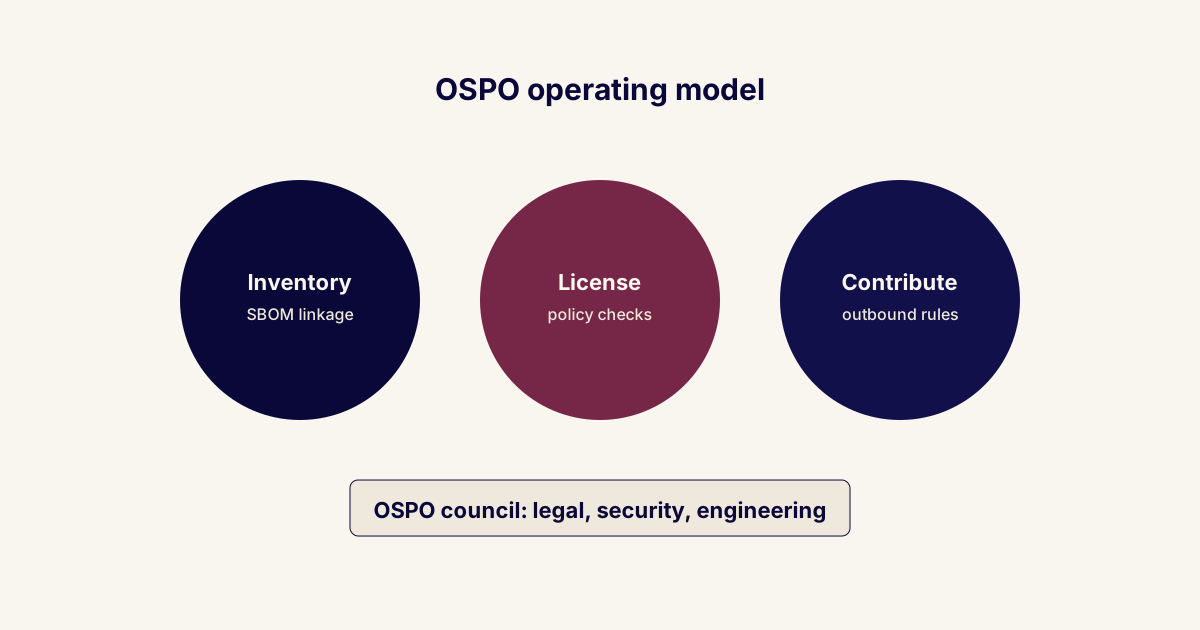
License policy should be short, opinionated, and actively maintained. A green list accelerates approvals for permissive licenses like MIT and Apache 2.0. A yellow list triggers legal review for reciprocal licenses such as LGPL. A red list blocks copyleft or ambiguously licensed packages by default. Ambiguous middle categories destroy trust if reviewers never reach a decision, so commit to clearing the yellow backlog on a regular cadence.
Encoding license policy into tooling multiplies its effectiveness. Package manager plugins can reject red list dependencies before code reaches a pull request. CI pipelines can flag yellow list additions and automatically open a legal review ticket. When policy lives in configuration files rather than wiki pages, enforcement is consistent and developers receive feedback at the moment they introduce a problematic dependency instead of weeks later during a quarterly audit.
Inbound contributions need disciplined hygiene at every step of the workflow. Contributor license agreement processes protect intellectual property rights. Copyright headers in source files clarify ownership when code crosses organizational boundaries. Secrets scanning must run before any public push to prevent credential leaks. Embarrassment is not the only risk that follows a careless commit. Contractual breach, regulatory penalties, and lost customer trust can compound quickly once sensitive material reaches a public repository.
Establish a clear inbound review checklist that every contributor follows before proposing changes to external projects. The checklist should verify that the contribution does not include proprietary algorithms, customer data references, or internal infrastructure details. Pair the checklist with automated scanning tools that detect common patterns such as internal domain names, API keys, and database connection strings. Automation catches what human reviewers overlook during busy release cycles.
Outbound contributions benefit from clear rules about what can be shared, what requires manager approval, and what touches competitive advantage. Engineers appreciate predictability more than freedom without guardrails. A concise contribution policy that defines these boundaries helps developers participate in upstream communities with confidence, knowing they will not accidentally violate company expectations or trigger post hoc legal scrutiny that discourages future participation.
Consider creating a tiered approval framework for outbound contributions. Bug fixes and documentation improvements to projects already on the green list can proceed with minimal oversight. Feature contributions that introduce new functionality may require a lightweight review from the OSPO coordinator. Contributions to projects outside the existing inventory or those involving novel intellectual property should route through legal counsel. Tiered governance balances speed with appropriate risk management for each scenario.
Security patching workflows should treat popular open source libraries as critical suppliers in your software supply chain. Monitor advisories from sources like the National Vulnerability Database and project specific mailing lists. Test upgrades in sandboxed environments that mirror production configurations. Document exceptions with clear expiration dates when upgrades cannot land immediately, and assign owners who are accountable for resolving each exception before its deadline passes.
Integrate vulnerability scanning into every stage of the development lifecycle, from local development environments through staging and production. Scanners that only run during weekly builds leave a window where new vulnerabilities go undetected. Real time scanning in CI pipelines catches issues at the pull request level, while runtime monitoring tools detect exploits against known vulnerabilities in deployed containers. Layered scanning provides defense in depth without placing the entire burden on a single checkpoint.

Funding open source maintainers strategically reduces long term risk for the enterprise. Sponsor the projects your stack depends on most heavily and track health signals like maintainer churn, release cadence, and responsiveness to security reports. Philanthropy narratives help justify budget lines, but the primary argument is operational resilience. A well funded upstream project is more likely to deliver timely patches, maintain backward compatibility, and invest in the documentation that your developers rely on daily.
Beyond direct financial sponsorship, consider contributing dedicated engineering time to upstream projects. Assigning developers to fix bugs, review pull requests, or improve test coverage builds relationships with maintainer communities and gives your organization influence over project direction. This approach also develops internal talent. Engineers who contribute to widely used open source projects sharpen their skills, gain visibility in the broader community, and bring back practices that elevate the quality of internal codebases.
Training accelerates adoption of OSPO policy across the entire engineering organization. Lunch sessions that cover common license types, patent implications, and export control requirements prevent recurring mistakes that slow down product launches. Refresh training whenever policies change and tailor content for different audiences. Developers need practical guidance on license compatibility, while product managers benefit from understanding how open source obligations affect go to market timelines and partnership agreements.
Supplement scheduled training with self service resources that developers can consult on demand. An internal knowledge base with searchable FAQs, decision trees for license selection, and templates for contribution proposals removes friction from daily workflows. Gamification elements such as badges for completing compliance modules or recognition for upstream contributions encourage voluntary engagement. The goal is to embed open source literacy into engineering culture rather than treating compliance as an occasional burden.
Mature OSPOs publish annual transparency reports summarizing contributions, incidents, and policy updates. Public accountability improves internal discipline and strengthens external reputation among developer communities, potential hires, and enterprise customers who evaluate supply chain governance. Include metrics such as the number of upstream contributions, average time to patch critical vulnerabilities, and the percentage of projects covered by automated SBOM generation. Concrete numbers turn the OSPO narrative from aspirational to evidence based.
Define key performance indicators that connect OSPO activities to business outcomes. Track the reduction in license compliance incidents quarter over quarter, measure the time savings from automated approvals compared to manual review cycles, and monitor developer satisfaction with contribution workflows. When OSPO metrics align with objectives that executive leadership already cares about, budget conversations shift from justifying existence to discussing where to invest next for maximum return.
An open source program office is not a bureaucratic layer added on top of engineering. It is a coordination function that makes responsible open source consumption and contribution the path of least resistance. Start small, automate early, and expand the program as demonstrated value earns organizational trust. The enterprises that build this capability now position themselves to move faster, attract stronger talent, and manage supply chain risk with confidence as open source continues to underpin modern software delivery.