Insights · Article · Engineering · Apr 2026
Shared database isolation, session context, migration hazards, and escape hatches when a few tenants need dedicated infrastructure without forking your codebase.

Row level security promises cheaper operations than siloed databases per tenant. It demands relentless tenant_id discipline, secure session context binding, and tests that prove cross-tenant reads cannot occur.
Multi-tenant SaaS platforms face a fundamental architectural decision early in their lifecycle. Dedicated databases per tenant simplify isolation but multiply operational overhead as the customer count grows into the hundreds or thousands. Shared databases with row level security consolidate infrastructure costs and streamline deployments. The tradeoff is clear: every layer of the application stack must enforce tenant boundaries consistently, from the ORM through background jobs to analytics pipelines.
The single database approach also simplifies cross-tenant reporting, schema migrations, and connection management. One connection pool serves all tenants rather than routing traffic across dozens or hundreds of isolated instances. These benefits compound at scale, but they introduce a class of bugs that siloed architectures simply never encounter. A missing WHERE clause or an unscoped background worker can expose one customer's data to another in milliseconds, creating both legal liability and reputational damage.
Standardize tenant resolution at authentication: JWT claims, session variables, or connection pool hooks. Every query path must set context before hitting pooled connections.
PostgreSQL provides native support for row level security through CREATE POLICY statements tied to session variables. Setting a session variable like app.current_tenant at the start of every transaction ensures that all subsequent queries filter by that value automatically. This approach centralizes tenant scoping in the database layer rather than relying solely on every application query to include the correct filter. Other databases offer comparable mechanisms, though the implementation details and performance characteristics vary significantly.
Connection pooling introduces additional complexity for session-based tenant context. Tools like PgBouncer operating in transaction mode reset session state between transactions, so tenant context must be set within each transaction block rather than once per connection. Teams that overlook this distinction often discover it in production when pooled connections carry stale tenant identifiers from previous requests, silently serving data to the wrong customer. Always validate your pooler configuration against your RLS strategy before launch.
We facilitate small-group sessions for customers and prospects without requiring a slide deck, focused on your stack, constraints, and the decisions you need to make next.
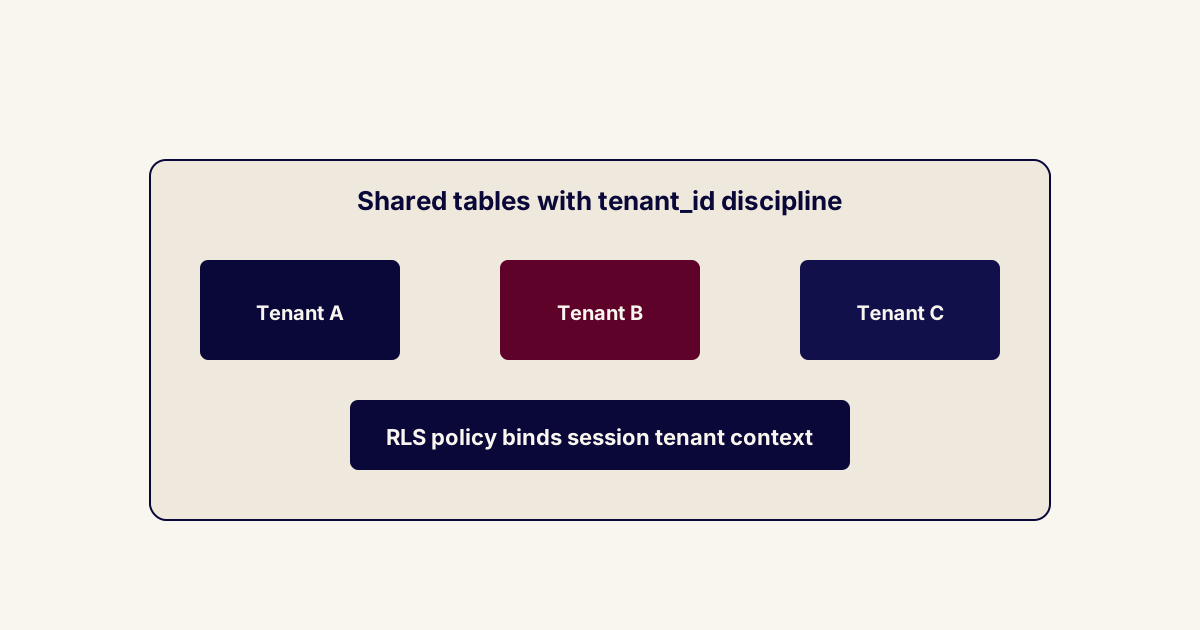
Writing effective row level security policies requires careful consideration of both read and write paths. SELECT policies prevent unauthorized reads, but INSERT, UPDATE, and DELETE policies are equally critical. A tenant that can read only its own rows but accidentally insert into another tenant's partition creates a subtle data corruption vector that standard read-only tests will never catch. Treat each operation type as an independent security boundary requiring its own policy definition and dedicated test coverage.
Default-deny is the safest starting posture for any multi-tenant row level security configuration. Enable RLS on every table that stores tenant-scoped data and write explicit USING clauses for each allowed access pattern. Tables without policies silently permit full access, which means a forgotten table is a potential data leak. Maintaining a registry of all tenant-aware tables helps catch gaps during code review and automated policy audits.
Administrative and support tools are high risk. Impersonation features need logging, approvals, and time limits. One forgotten impersonation session is a headline.
Audit logging for every elevated access event should capture the operator identity, the target tenant, the timestamp, and the specific records accessed. Storing these logs in an immutable, append-only system ensures that post-incident investigations have reliable evidence. Customers subject to compliance audits will request access logs, and the ability to produce them on demand builds trust and accelerates deal cycles with security-conscious buyers.
Migrations must backfill tenant columns and verify constraints before enabling policies. Partial migrations create silent holes.
Schema migrations in a multi-tenant row level security environment demand extra caution around default values and NOT NULL constraints on tenant identifier columns. Adding a tenant_id column to an existing table without a default value will fail if existing rows lack that identifier. Backfill scripts must run before constraint enforcement, and the window between backfill and policy activation must be as short as possible to minimize exposure.
Feature flags help stage rollouts of new RLS policies across tenant cohorts. Activating a policy for a small group of internal or beta tenants first surfaces edge cases before they affect the entire customer base. Rolling back a database policy is more disruptive than toggling a feature flag, so combining both mechanisms gives teams a faster and safer recovery path during migration incidents.
Performance tuning changes with RLS. Indexes should align with tenant-scoped queries. Explain plans under tenant context differ from superuser previews.
Composite indexes that lead with the tenant_id column dramatically improve query performance under row level security. Without a leading tenant identifier, the database engine may scan large portions of an index before filtering results down to a single tenant, negating the benefits of indexing entirely. Always review execution plans under a tenant-scoped session rather than a superuser session to see realistic query costs that accurately reflect actual production behavior for your customers.
Query planners may not always push row level security predicates into subqueries or common table expressions in the way developers expect. Complex queries involving joins across multiple tenant-scoped tables can produce plans where the RLS filter applies later than intended, resulting in unnecessary data scanning. Profiling slow queries with EXPLAIN ANALYZE under tenant context reveals these bottlenecks and guides targeted optimization efforts.
Large tenants may eventually need dedicated shards. Design portability layers so code paths do not multiply uncontrollably when you graduate whales.
A tenant routing layer at the application boundary abstracts the physical location of tenant data from the rest of the codebase. Whether a tenant lives in the shared database or on a dedicated shard, the application code issues the same queries through the same interfaces. This abstraction prevents feature divergence between shared and dedicated tenants, which is one of the most common sources of long-term technical debt in multi-tenant SaaS platforms.
Backup and restore drills should include tenant-scoped restore tests. Regulatory customers will ask whether another tenant's restore can leak into their environment.
Point-in-time recovery in a shared database restores every tenant simultaneously, which means a restore triggered by one customer's data issue affects all customers in that database. Logical backups scoped to individual tenants provide surgical recovery options without broad impact. Tools like pg_dump with schema and table filtering can produce tenant-specific snapshots, though they require careful scripting to capture all related tables and foreign key dependencies.
Regulatory frameworks like SOC 2, GDPR, and HIPAA impose specific requirements on data isolation, access logging, and breach notification timelines. Row level security supports compliance by enforcing tenant boundaries at the database layer, but it does not automatically satisfy all regulatory obligations. Teams should map each compliance requirement to a specific technical control and verify coverage through periodic internal audits rather than assuming that RLS alone is sufficient.
Document escape hatches for break-glass support with legal sign-off. Absolute rules without documented exceptions invite shadow databases.
Shadow databases and unauthorized data exports emerge when engineers feel blocked by overly rigid access controls and create unofficial copies of production data to debug customer issues. Preventing this behavior requires providing legitimate, audited pathways for accessing tenant data in emergencies. A well-designed break-glass procedure that balances speed with accountability removes the incentive to circumvent security controls entirely, keeping sensitive customer information within governed systems at all times.
Finally, automate integration tests that attempt cross-tenant access with malicious session swaps. Passing once at launch is insufficient; run in CI continuously.
Beyond integration tests, chaos engineering exercises that simulate tenant context failures reveal weaknesses in error handling paths. Deliberately injecting null or invalid tenant identifiers into request pipelines exposes code paths that silently bypass row level security rather than failing safely. These exercises build confidence that the system degrades gracefully under adversarial conditions rather than leaking data across tenant boundaries. Schedule them quarterly and rotate the team members who design the failure scenarios for fresh perspectives.
A healthy multi-tenant SaaS platform treats row level security as one layer in a defense-in-depth strategy rather than a standalone solution. Application-level checks, network segmentation, encrypted storage, and continuous monitoring all contribute to a robust isolation posture. When these layers work together, the platform earns customer trust, satisfies auditors, and scales efficiently without sacrificing the data privacy guarantees that enterprise buyers demand.