Insights · Article · Security · May 2026
Play Integrity and DeviceCheck style signals, server-side verification, privacy tradeoffs, and fallback UX when attestation fails on legitimate devices.

High-value mobile flows such as payments, crypto wallets, and enterprise single sign-on are frequent targets for modified binaries, emulators, and cloned devices. Attestation APIs let servers verify that the app and the underlying device meet baseline integrity requirements before granting access to sensitive operations. These checks raise the cost of abuse significantly, yet they also introduce false positives and privacy questions that teams must address deliberately from the outset.
Mobile app attestation works by asking a platform service to produce a signed token that vouches for the device and application state. On Android, Google Play Integrity returns a verdict covering device integrity, app licensing status, and account details. On iOS, Apple App Attest generates hardware backed assertions tied to a unique key pair stored in the Secure Enclave. Both approaches rely on server side verification to close the trust loop.
Treat attestation as one signal in a broader risk engine rather than a sole gate. Farmed devices and patched ROMs exist at scale, so a single binary pass or fail verdict cannot capture the full threat landscape. Customer support teams need compassionate escalation paths for legitimate users who trip integrity checks because of unusual device configurations, beta operating systems, or accessibility tooling that modifies the runtime environment.
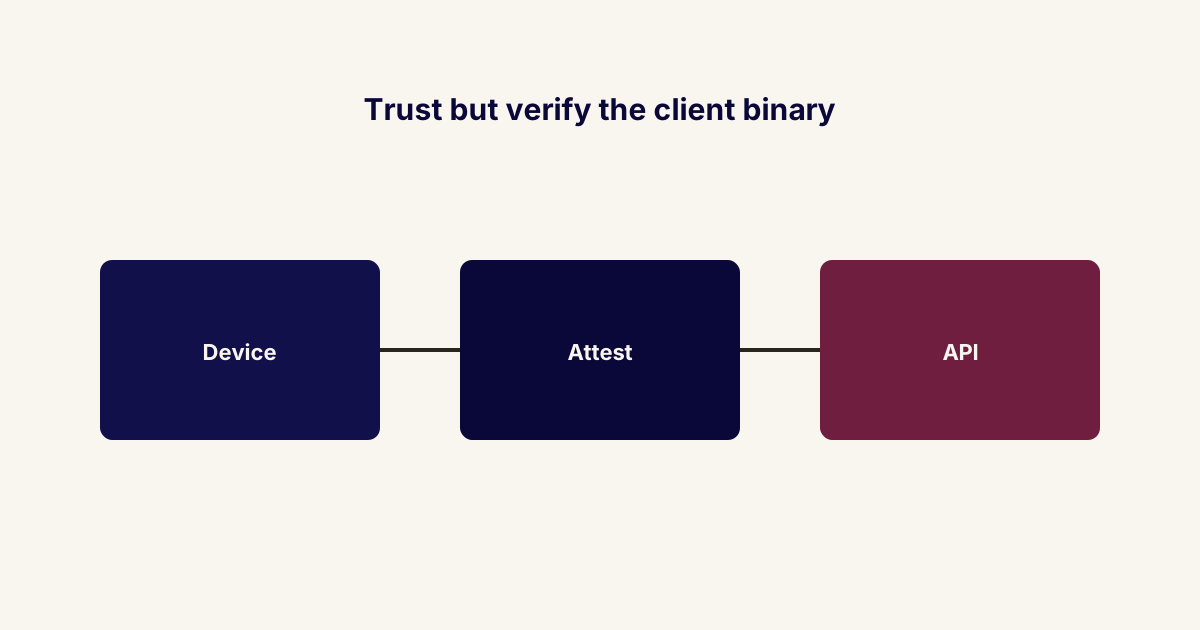
Server side token verification is the foundation of a trustworthy attestation architecture. The mobile client sends the signed attestation token to your backend, which then calls the platform provider to decode and validate the payload. Performing this step on the server prevents attackers from patching client code to skip the check entirely. Keep your verification keys rotated and store provider credentials in a secrets manager rather than in application configuration files.
Nonce and timestamp validation prevents replay of captured attestation tokens. Each request should carry a server generated nonce that is bound to the specific action the user is performing. Clock skew handling belongs in your verification library, with a reasonable tolerance window that accounts for network latency without opening a wide replay window. Log any requests where the timestamp falls outside the expected range for post incident analysis.
We facilitate small-group sessions for customers and prospects without requiring a slide deck, focused on your stack, constraints, and the decisions you need to make next.
Google Play Integrity classifies device verdicts into tiers that indicate whether the device passes basic integrity, meets CTS profile criteria, or carries a strong hardware backed guarantee. Each tier maps to different risk levels in your decision matrix. Low tier verdicts may still represent genuine users on older phones, so pair the device signal with behavioral analytics, session history, and transaction value before deciding whether to allow, challenge, or deny the request.
Apple App Attest generates a unique key pair during initial setup and uses the Secure Enclave to sign assertions on subsequent requests. The attestation object includes a receipt that Apple can refresh periodically, allowing your server to detect if the app environment changes between sessions. Implementing receipt validation adds complexity but provides a continuous integrity signal rather than a one time check at install, which substantially reduces the window for runtime tampering.
Token caching strategies deserve careful design. Fetching a fresh attestation token on every API call introduces latency and can trigger platform rate limits. A common pattern caches the token for a short duration and reuses it across requests that share the same risk tier. However, high assurance operations like wire transfers or account recovery should always demand a fresh token bound to a single use nonce to prevent token reuse attacks.
Privacy policies should disclose integrity checks in plain language, especially when the attestation payload is combined with device identifiers or advertising signals. Under GDPR and similar frameworks, integrity data may qualify as personal data if it can be linked back to an individual. Data protection impact assessments should cover what is collected, how long it is retained, and whether any third party receives the raw attestation payload. Transparent communication builds user trust and reduces regulatory risk.
Fallback journeys for failed attestation should preserve accessibility and avoid punishing legitimate users. Blind blocks harm people on older hardware, corporate MDM profiles, or devices running custom ROMs for accessibility needs. A layered approach might present a CAPTCHA challenge, request an additional authentication factor, or route the user to a reduced privilege flow that still allows core functionality. Each degradation step should be instrumented so product teams can measure the real world impact on conversion rates.
Enterprise deployments add another dimension because managed device policies can alter the integrity profile of otherwise healthy hardware. Mobile device management agents often modify system certificates, install custom profiles, and restrict Google Play Services updates. Coordinate with enterprise mobility teams to whitelist known MDM configurations in your attestation policy. Failing to account for managed environments can lock out entire corporate fleets and escalate support ticket volume rapidly.

Web views inside native apps complicate trust boundaries because attestation tokens cover the native host but not the embedded browser context. Decide early whether web view based flows participate in high assurance operations or whether those flows require a transition back to native code. If you must run sensitive logic inside a web view, consider injecting the attestation token through a JavaScript bridge and validating it on each critical request to maintain a consistent security posture.
Hybrid frameworks such as React Native, Flutter, and Capacitor each interact with attestation APIs through platform channels that abstract the underlying native calls. Verify that your chosen plugin or module handles error codes correctly, surfaces the full verdict payload, and does not silently swallow transient failures. Custom native modules offer more control but increase maintenance burden across platform releases. Automated integration tests that mock attestation responses help catch regressions when the framework or plugin updates.
Telemetry from attestation failures should segment by OS version, device model, region, and app release to spot rollout regressions quickly. Dashboards that track failure rate trends over time reveal whether a new app version inadvertently changed the attestation flow or whether a platform update shifted verdict distributions. Alert thresholds should account for seasonal variation and major OS release cycles, which historically cause temporary spikes in integrity check failures across the user base.
Testing attestation in continuous integration pipelines requires emulator and device farm strategies that simulate both passing and failing integrity verdicts. Google provides testing tools that return configurable Play Integrity responses in debug builds, while Apple offers sandbox environments for App Attest. Encode expected verdicts in your test fixtures and assert that your backend correctly routes each scenario through allow, challenge, or deny paths. This discipline prevents silent failures when provider APIs change.
Plan proactively for vendor API changes because attestation providers regularly evolve their signal definitions, deprecation timelines, and payload schemas. Pin your SDK dependencies to known stable versions, subscribe to platform developer newsletters, and monitor release notes as part of your dependency update workflow. Budget engineering time each quarter for attestation SDK upgrades so that deprecations do not become emergencies that force hurried patches under time pressure.
Looking ahead, device attestation is converging with broader zero trust architectures where every request must prove device health, user identity, and context before gaining access. Standards like the IETF Remote Attestation Procedures working group aim to bring interoperability across vendors. Teams that build flexible policy engines today will adapt more easily as attestation signals become richer, more standardized, and more tightly integrated with identity and access management platforms across the mobile ecosystem.