Insights · Article · Strategy · Apr 2026
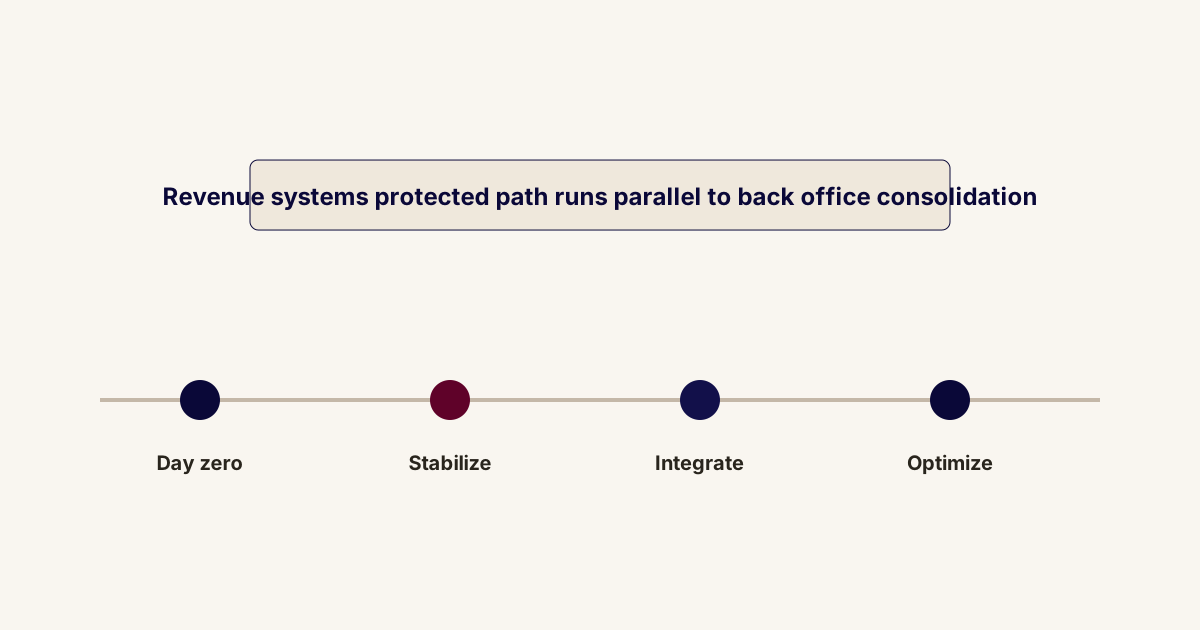
Day zero stability, identity consolidation waves, and cutover rehearsals that keep sales and fulfillment running while back offices eventually converge.

Mergers fail in technology when integration teams optimize for ERP diagrams while sales teams cannot quote and factories cannot ship. Revenue protection should serve as the spine of every merger IT program, with back-office convergence scheduled deliberately behind customer-impacting stability. Organizations that treat integration as a purely technical exercise risk losing the very value the deal was designed to capture. The first principle is simple: protect the revenue engine before rationalizing anything else.
Most acquisition business cases assume uninterrupted revenue during integration. Yet customer churn frequently accelerates in the first twelve months after close because order management, billing, or support systems degrade during migration. Establishing formal revenue guardrails before any technical work begins forces the integration management office to sequence projects by commercial risk rather than engineering convenience. A revenue impact assessment for every planned system change provides the necessary discipline to keep the program honest.
Day zero runbooks focus on identity, DNS, email, and security baselines. Parallel authentication domains, emergency break-glass access, and clear executive communication reduce panic-driven misconfigurations. These runbooks should be rehearsed at least twice before legal close, with each rehearsal surfacing assumptions about network connectivity, firewall rules, and certificate authorities that look obvious on paper but collapse under time pressure. Document every decision and every workaround in a shared war room log.
Identity consolidation deserves its own workstream rather than being buried inside infrastructure tasks. Determining which directory service becomes authoritative, how conflicting usernames resolve, and when federated trust replaces parallel domains are decisions that affect every application in both organizations. Rushing single sign-on before applications are tested against the new identity provider creates outages that directly interrupt customer-facing transactions and erode confidence in the integration program.
We facilitate small-group sessions for customers and prospects without requiring a slide deck, focused on your stack, constraints, and the decisions you need to make next.
Data integration waves should follow legal closing milestones and privacy assessments. Copying entire customer databases early creates liability and confusion about lawful basis for processing. Instead, define clear data domains and assign stewards from both legacy organizations who approve each migration tranche. Customer master data, pricing tables, and contractual terms deserve the highest scrutiny because errors in these records translate directly into billing disputes and lost revenue.
Privacy and compliance reviews must run in parallel with technical data migration planning. Different jurisdictions impose distinct requirements on cross-border data transfers, consent records, and retention schedules. A merged entity that violates data protection regulations during integration faces fines and reputational damage that dwarf the projected synergies. Engaging legal and compliance teams as full participants in the data workstream, rather than reviewers at the end, prevents costly rework and regulatory exposure.
Application rationalization benefits from structured decision records. For each duplicate system, document the retained owner, the sunset date, and the customer migration path. Ambiguity prolongs duplicate licensing costs and confuses support teams who do not know which system is authoritative. A simple scorecard covering business criticality, integration complexity, and contract exit terms helps leadership compare options objectively rather than defaulting to the acquiring company's platform out of institutional habit.
License management often becomes an overlooked source of cost leakage during mergers. Enterprise software agreements typically contain change-of-control clauses that allow vendors to renegotiate terms or terminate contracts. Proactively auditing license inventories from both organizations and engaging vendor management teams before close prevents surprise true-up invoices that can reach millions of dollars. Consolidating agreements under a single procurement function also strengthens negotiating leverage for renewals.
Network and security integration must respect regulatory boundaries. Air-gapped subsidiaries and national operators may require phased trust models rather than instant single sign-on everywhere. Segmenting the network integration into zones of trust allows teams to open connectivity incrementally while monitoring for anomalous traffic that could indicate compromise. Security operations centers from both organizations should operate jointly from day one, sharing threat intelligence and incident response procedures even before full network convergence.
Zero trust principles provide a practical framework for merger network architecture. Rather than attempting to flatten two perimeter-based networks into one, teams can publish applications through identity-aware proxies that authenticate and authorize every request. This approach allows employees from both organizations to access shared services without requiring full network convergence. It also limits the blast radius if a compromised credential from either legacy environment is exploited during the transition period.
Cutover rehearsals deserve the same rigor as production launches. Rollback steps, customer-facing status pages, and war room roles should be practiced well in advance rather than invented at two in the morning. Each rehearsal should include realistic failure injection so that teams experience the pressure of a degraded state and learn to follow the documented recovery procedures. Recording time to detect, time to communicate, and time to recover builds a dataset that improves each subsequent cutover.
Communication during cutovers extends beyond internal war rooms. Customers, channel partners, and key vendors need timely updates when services are migrating. Establishing a dedicated integration status page, pre-drafted notification templates, and a single accountable communications lead prevents conflicting messages from reaching the market. Sales teams in particular need clear talking points that acknowledge the transition without undermining confidence in the combined organization's ability to deliver on existing commitments.

Culture and retention intersect technology more deeply than most integration plans acknowledge. Integration fatigue drives attrition among engineers who maintain legacy glue code and middleware that holds revenue systems together. Staffing plans should include explicit sustainment budgets for these unglamorous but critical systems. Retention bonuses tied to specific integration milestones, paired with visible career paths in the combined organization, help keep institutional knowledge intact during the period of greatest disruption.
Knowledge transfer and documentation practices protect the program against single points of failure. When key engineers leave, they take configuration context, vendor relationships, and incident history with them. Mandatory knowledge capture sessions, recorded walkthroughs of critical systems, and shared runbooks in a central repository reduce this risk. Treating documentation as a deliverable with the same status as code deployments ensures that institutional knowledge survives personnel transitions throughout the integration timeline.
Synergy targets should connect directly to measurable decommissioning milestones. Retiring datacenters, terminating redundant licenses, and exiting duplicate contracts proves progress with auditable financial evidence rather than slide-deck estimates. Finance and IT leaders should co-own a synergy tracker that maps each technology initiative to a specific cost reduction or revenue protection outcome. Weekly reviews against this tracker keep the integration office honest and surface delays before they compound into missed quarterly targets.
Vendor consolidation represents one of the most tangible synergy opportunities but requires careful sequencing. Terminating contracts before replacement services are stable creates operational gaps that endanger revenue. A phased approach that first inventories overlapping vendor relationships, then negotiates enterprise-level agreements, and finally migrates workloads allows the organization to capture savings without assuming unnecessary risk. Procurement teams should track realized savings separately from projected savings to maintain credibility with stakeholders.
Post-integration, run a blameless review of every surprise encountered during the program. Feed these lessons into a structured deal playbook that future acquisition teams can reference from day one. Serial acquirers compound competitive advantage when each deal improves the integration methodology. Document what the pre-close due diligence missed, which runbook steps failed under real conditions, and where communication gaps caused unnecessary friction between the two organizations.
Building a repeatable integration capability transforms mergers from existential risk into a strategic growth lever. Organizations that invest in standing integration teams, reusable technology templates, and standardized governance frameworks execute faster and preserve more value with each successive deal. The companies that win through acquisition are not simply the ones that identify attractive targets. They are the ones that protect revenue while absorbing complexity, turning operational discipline into lasting competitive advantage.