Insights · Article · Cloud · Apr 2026
Shared node overhead, idle capacity, chargeback fairness, and dashboards that connect pod usage to product lines finance already recognizes.

Kubernetes bills explode quietly through oversized resource requests, idle clusters kept warm out of fear, and shared infrastructure that nobody attributes to a specific team. FinOps for Kubernetes requires cluster level truth combined with fair, repeatable rules for splitting costs that lack perfect boundaries. Without deliberate allocation practices, organizations discover their container spend only after budget reviews surface uncomfortable surprises.
The fundamental challenge is that Kubernetes abstracts away individual machines. Pods share nodes, nodes share underlying reservations, and control plane overhead belongs to everyone and no one simultaneously. Traditional per server cost models break down in a world of bin packed workloads. Organizations need a new mental model that treats cluster infrastructure as a shared utility and allocates costs based on consumption signals rather than static assignments.
Standardize labels early and apply them consistently across every namespace: team, product, cost center, and environment at minimum. Enforce these labels through admission controllers such as OPA Gatekeeper or Kyverno so that analytics remain trustworthy from day one. Retrofitting labels across hundreds of existing namespaces is painful and error prone, making early governance the single highest leverage investment in Kubernetes cost visibility.
Label governance extends beyond initial deployment. Teams rename products, organizations restructure, and new cost centers appear quarterly. Build automation that validates label values against a central registry and flags drift before it corrupts reporting. Periodic audits that reconcile cluster labels with the corporate chart of accounts prevent the slow erosion of data quality that undermines confidence in FinOps dashboards over time.
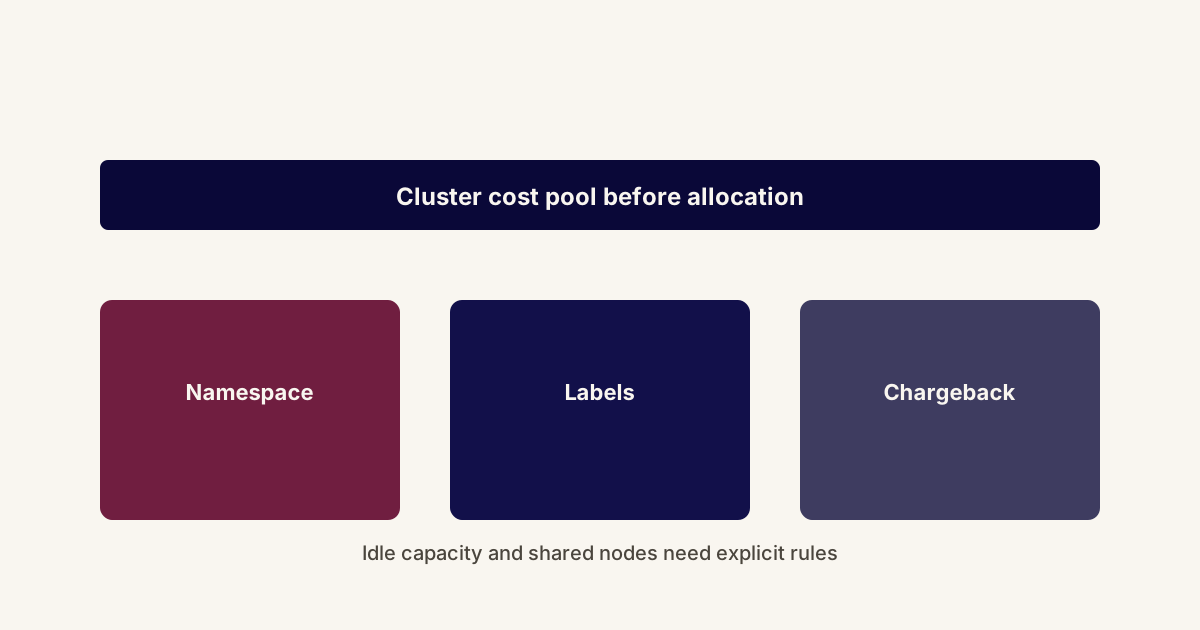
Namespace quotas express intent, but utilization metrics prove reality. Track requested versus actually consumed CPU and memory at the pod level to identify overprovisioning patterns. Right sizing requests unlocks bin packing gains that reduce the total number of nodes required. Even modest improvements in request accuracy across a large fleet compound into meaningful savings because each freed node removes an entire unit of compute cost.
We facilitate small-group sessions for customers and prospects without requiring a slide deck, focused on your stack, constraints, and the decisions you need to make next.
Vertical and horizontal pod autoscalers help close the gap between requests and actual usage, but they require careful tuning. Aggressive vertical scaling can trigger frequent pod restarts, while conservative settings leave waste on the table. Treat autoscaler configuration as a continuous optimization loop informed by historical utilization data rather than a one time setup. Review scaling behavior monthly alongside cost reports to balance efficiency with application stability.
Node pools and committed use reservations change the marginal cost of each workload significantly. Finance teams should see blended rates that reflect the weighted effect of on demand pricing, savings plans, and reserved instances together. Engineers benefit from seeing effective cost per pod hour for each service, which transforms abstract prioritization debates into concrete trade off discussions grounded in dollars rather than opinions about resource importance.
Spot instances and preemptible nodes offer dramatic discounts but introduce termination risk. Allocating fault tolerant batch workloads to spot capacity while reserving standard nodes for latency sensitive services creates a tiered cost structure. The allocation model must reflect these tiers accurately so that teams running on spot capacity receive credit for accepting interruption risk rather than being charged the same blended rate as teams on guaranteed nodes.
Persistent volumes, load balancers, and network egress often dominate service bills yet receive far less scrutiny than compute. Include storage IOPS, provisioned throughput, and cross zone data transfer in your showback or chargeback model alongside CPU and memory. Teams that optimize only compute while ignoring a growing pool of unattributed storage and networking costs will find their total Kubernetes spend stubbornly resistant to reduction efforts.
Network cost visibility deserves special attention in multi region and hybrid deployments. Cross region traffic charges accumulate silently when services communicate across availability zones or cluster boundaries. Instrumenting service mesh telemetry with cost annotations lets platform teams surface these charges to the responsible application owners. Awareness alone often motivates architectural changes such as deploying read replicas locally or caching responses to reduce repeated cross zone calls.
Idling non production environments on predictable schedules saves money and simultaneously reduces attack surface. Development and staging clusters that run continuously through nights and weekends represent pure waste in most organizations. Policy tags that distinguish production from non production workloads enable automated scale down rules. Guardrails built into the scheduling system prevent accidental production shutdowns while still capturing the full savings potential of lower environments.

Cluster autoscaling complements workload scheduling by removing empty nodes during low demand periods. Configure scale down delays and pod disruption budgets thoughtfully so that the autoscaler does not thrash during normal traffic fluctuations. The interaction between workload idling, horizontal pod autoscaling, and cluster autoscaling creates a layered efficiency strategy that addresses waste at every level of the Kubernetes resource hierarchy from individual containers up to entire node groups.
Chargeback can wait, but showback should not. Transparency changes engineering behavior faster than internal invoices when the organizational culture around cloud cost accountability is still maturing. Publish weekly or biweekly cost reports per team in channels they already use, whether that is Slack, email digests, or embedded dashboards in developer portals. Visibility creates ownership, and ownership creates the motivation to optimize without requiring heavy handed enforcement from a central platform team.
Building a FinOps culture around Kubernetes requires collaboration between platform engineering, application teams, and finance. Establish a regular cadence of cost review meetings where anomalies are discussed and optimization opportunities are prioritized collectively. Celebrate teams that reduce waste without degrading reliability. When cost awareness becomes part of engineering identity rather than an external mandate, optimization efforts sustain themselves and scale naturally across the organization.
Executive summaries should link savings initiatives directly to reliability metrics so that leadership understands the full picture. Reckless rightsizing that increases out of memory kills or causes latency regressions is not genuine savings. Present cost reduction alongside error rates, p99 latency, and deployment frequency to demonstrate that efficiency gains are real and sustainable. This framing builds executive trust in FinOps recommendations and secures ongoing investment in tooling and process improvements.
The tooling landscape for Kubernetes cost allocation continues to mature rapidly. Open source projects like OpenCost provide real time cost monitoring at the pod level, while commercial platforms such as Kubecost, CAST AI, and cloud provider native tools offer deeper analytics and automation. Evaluate tools based on their ability to integrate with your existing observability stack, support custom allocation logic, and export data into formats that finance systems can consume without manual transformation.
Integrate Kubernetes cost views with corporate general ledger mapping as the final step in a mature allocation pipeline. Finance recognizes product codes, business units, and project identifiers, not CSI driver names or Helm release labels. Build a translation layer that maps cluster metadata to financial taxonomy automatically. When engineering dashboards and finance reports tell the same story using the same numbers, cost governance becomes a shared discipline rather than a source of cross departmental friction.