Insights · Article · Cloud · Apr 2026
Documentation quality, golden paths, scorecards, and product management discipline that turn a portal from a link farm into a platform customers actually use.

Many enterprises launch an internal developer portal as a static catalog of microservices and APIs. Adoption stalls within months because engineers wanted answers, not inventory. They need to know how to provision a database, which team owns a failing dependency, or where the canonical deployment guide lives. Effective portals bundle discovery, documentation, templates, and health signals into workflows that match how teams actually ship software every day.
The most successful portals treat developer experience as a product discipline. That means interviewing internal customers, mapping their most common journeys, and measuring task success rates for activities like creating a new service, rotating credentials, or onboarding a new hire. Product managers should own the portal backlog and iterate quarterly based on usage analytics and direct feedback from engineering teams across the organization.
Platform engineering has matured rapidly as organizations recognize that scaling developer productivity requires more than provisioning cloud resources. Tools like Backstage, Port, and Cortex have raised expectations for what a portal should deliver. Engineering leaders who still rely on wikis and spreadsheets to track service ownership find themselves losing ground to competitors whose developers can self-serve infrastructure, documentation, and compliance checks from a single pane of glass.
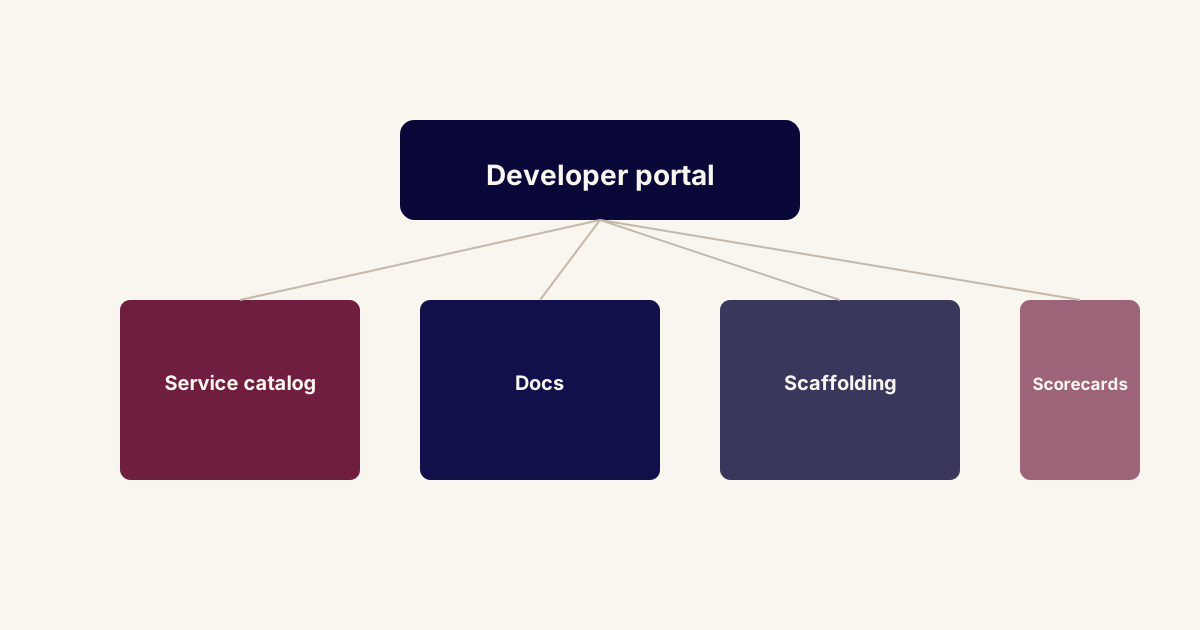
Documentation must stay close to the code it describes. Generated OpenAPI specifications, architecture decision records linked directly to repositories, and ownership metadata that updates automatically from the source of truth all reduce the drift that plagues static wikis. When documentation lives alongside the codebase, pull requests can enforce freshness, and engineers trust what they read because they can verify it in the same commit history.
Adopting a docs-as-code workflow means treating documentation with the same rigor as production software. Linting tools can catch broken links and outdated references during continuous integration. Technical writers should collaborate directly in version control rather than maintaining a parallel knowledge base. This approach transforms documentation from a chore completed after launch into a living artifact that evolves alongside the services it describes.
We facilitate small-group sessions for customers and prospects without requiring a slide deck, focused on your stack, constraints, and the decisions you need to make next.
Golden paths beat infinite choice every time. Publishing blessed templates for the languages and frameworks your organization supports, with security scanning, observability instrumentation, and compliance checks pre-wired, dramatically reduces the cognitive load on developers. Allow escape hatches for teams with legitimate edge cases, but make the default path so convenient that most engineers never need to deviate from the paved road your platform team maintains.
Organizations that invest in golden paths report measurably faster time to first deployment for new services. Instead of spending days assembling boilerplate, copying configuration from a colleague's repository, and debugging pipeline errors, developers can scaffold a production-ready service in minutes. The consistency this creates also simplifies auditing, because every service that follows the template inherits the same logging format, secret management strategy, and deployment topology.
Scorecards surface operational maturity by tracking metrics such as test coverage trends, vulnerability aging, SLO adherence, and on-call health across every service in the catalog. When presented transparently, scorecards encourage teams to close gaps voluntarily. However, gamification requires careful design. Shame dashboards that rank teams publicly create perverse incentives, encouraging engineers to chase metrics rather than solve the underlying reliability or security problems those metrics reveal.
Effective scorecard programs define clear, achievable tiers of maturity rather than a single pass-fail threshold. A bronze tier might require basic CI pipelines and an on-call rotation, while gold demands automated canary deployments and sub-second alerting. This tiered approach gives teams a roadmap for incremental improvement and lets leadership allocate investment toward the services that carry the most business risk rather than spreading effort evenly across the portfolio.
Search quality determines whether the portal becomes a daily habit or a forgotten bookmark. Investing in full-text indexing, synonym mapping, and relevance tuning transforms the portal into the first place engineers look for answers. Without strong search, developers revert to Slack threads and email chains, fragmenting institutional knowledge. Tracking zero-result queries and low-click searches reveals content gaps and guides the editorial roadmap for portal maintainers.
Integrating the portal with ticketing systems and chat platforms ensures that engineers can escalate to human help without leaving their workflow. More importantly, tracking why humans were needed creates a feedback loop. Repeated questions about the same topic signal documentation gaps or confusing user interfaces. Portal teams that instrument this feedback loop can prioritize fixes that eliminate entire categories of support requests over time.
Self-service workflows represent the portal's highest-value capability. Allowing developers to provision infrastructure, request access, or create environments through portal actions reduces the bottleneck that operations teams often become. Each self-service action should include guardrails such as cost estimation, policy checks, and approval routing so that speed does not come at the expense of governance. The goal is to make the safe path and the fast path identical.

Executive sponsors need adoption metrics tied to business outcomes rather than vanity indicators. Faster onboarding times, fewer misconfigured pipelines, reduced duplicate services, and shorter incident resolution windows all demonstrate concrete return on investment. Page views and login counts hide emptiness. Presenting portal value in terms that finance and operations leaders already care about secures the ongoing budget and executive attention that sustain the platform over multiple fiscal years.
Portal governance extends beyond content freshness into compliance and regulatory territory. Organizations in regulated industries can embed policy checks directly into portal workflows, ensuring that every new service meets data residency requirements, encryption standards, and access control baselines before it reaches production. This shift-left approach to compliance reduces the friction of audit cycles and lets security teams focus on novel threats rather than chasing configuration drift.
A healthy portal ecosystem supports plugins and extensions that let individual teams customize their experience without forking the core platform. API-first design enables integrations with internal tools, proprietary data sources, and specialized workflow engines. When the portal acts as a composable platform rather than a monolithic application, it can evolve at the pace of the organization without requiring a central team to build every feature from scratch.
Federation becomes essential when business units maintain separate technology stacks or operate under different regulatory regimes. A single pane of glass can aggregate service catalogs, documentation, and scorecards from multiple underlying systems without forcing premature consolidation. Federated portals require clear contracts for data freshness, schema compatibility, and access control, but the payoff is a unified developer experience that respects organizational boundaries rather than ignoring them.
Technology alone cannot drive portal adoption. Culture and change management play equally important roles. Champions within engineering teams who advocate for the portal, contribute templates, and file constructive feedback create the grassroots momentum that top-down mandates rarely achieve. Celebrating teams that publish high-quality documentation or achieve scorecard milestones reinforces the behaviors that make the portal valuable and signals that leadership takes developer experience seriously.
Looking ahead, the convergence of AI-assisted coding, platform engineering, and developer portals will reshape how organizations deliver software. Portals that surface contextual suggestions, auto-generate boilerplate documentation, and predict service dependencies based on historical patterns will move from passive catalogs to active copilots for engineering teams. Organizations that invest in portal infrastructure today position themselves to integrate these capabilities as they mature, compounding their advantage over less prepared competitors.