Insights · Article · Operations · Nov 2025
Moving from PDF graveyards to executable checklists tied to telemetry and on-call rotations.

Every engineering organization eventually encounters a production incident severe enough to test whether its response procedures actually work. The difference between a controlled recovery and a chaotic scramble often comes down to one artifact: the runbook. Yet most teams treat runbooks as a compliance checkbox rather than a living operational tool. Static documents decay rapidly in dynamic environments, and the gap between what the runbook describes and what the system requires widens with every deployment.
Traditional runbooks suffer from a fundamental distribution problem. They live in wikis, shared drives, or PDF repositories that responders rarely visit outside of onboarding. When an alert fires at two in the morning, an engineer under pressure will rely on muscle memory, Slack history, or a senior colleague before searching a knowledge base. If the runbook is not surfaced automatically within the paging workflow, it effectively does not exist during the moments that matter most.
The content itself compounds the accessibility challenge. Many runbooks read like narrative essays describing architectural context and historical decisions rather than providing actionable steps a responder can execute under stress. Verbose documentation has its place in design records, but incident response demands concise, sequenced checklists that minimize cognitive load. Each step should be unambiguous, testable, and completable without requiring the responder to interpret intent or make judgment calls about procedure.
Runbooks fail when they live outside the tools responders already use. Embedding links to dashboards, log queries, and rollback scripts inside the paging workflow cuts mean time to remediate more than prose ever will. Modern incident management platforms allow teams to attach runbook steps directly to alert definitions so that when an alert triggers, the relevant checklist appears alongside the notification. This tight coupling eliminates the context switching that slows initial triage.
Executable runbook steps take this integration further. Rather than instructing a responder to open a specific Grafana dashboard and visually inspect a metric, the runbook can include a direct deep link that opens the dashboard pre-filtered to the affected service and time window. Log query templates populated with the alerting context, rollback commands pre-staged with the correct deployment identifier, and escalation paths linked to the current on-call roster transform passive documentation into active tooling.
We facilitate small-group sessions for customers and prospects without requiring a slide deck, focused on your stack, constraints, and the decisions you need to make next.
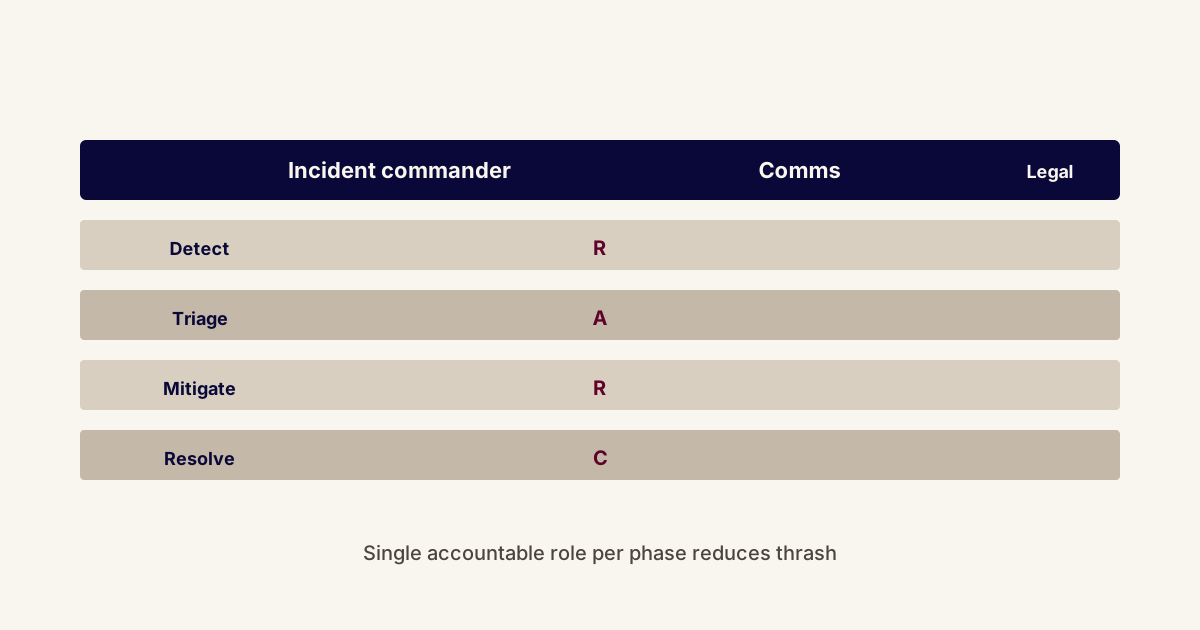
Ownership is the single most important factor in keeping runbooks current. Without a named individual accountable for each runbook, updates depend on goodwill and available bandwidth, both of which evaporate under delivery pressure. Assign runbook ownership to the team that operates the corresponding service, and make the on-call lead responsible for verifying accuracy during each rotation handoff. This distributed ownership model scales far better than centralizing documentation responsibility in a single platform team.
After every significant incident, require a single owner to update the runbook before the retrospective closes. Treat stale documentation as technical debt with the same visibility as open vulnerabilities. Track runbook freshness metrics alongside traditional reliability indicators. If a runbook has not been reviewed in ninety days, flag it in the same tooling that surfaces overdue dependency patches. Aging documentation deserves the same operational attention as aging infrastructure, because both create hidden risk.
Retrospectives provide a natural forcing function for runbook improvement, but only when the review process is structured. Dedicate a specific section of every post-incident review to documentation accuracy. Ask whether the runbook existed, whether the responder found it, whether the steps were correct, and whether anything was missing. Capture the answers as action items with deadlines, and track completion in your project management system rather than leaving them buried in meeting notes.
A runbook-as-code approach brings the same rigor to operational documentation that engineering teams already apply to application source. Storing runbooks in version-controlled repositories alongside the services they describe ensures that documentation changes flow through the same pull request review process as code changes. Reviewers can verify that a new deployment modifies the corresponding runbook when service behavior changes, catching documentation drift at the point where it originates rather than discovering it during an incident.
Version control also provides an audit trail that compliance teams value. Regulated industries often require evidence that operational procedures were reviewed and approved before they were active. Git history, pull request approvals, and CI validation checks create a tamper-evident record that satisfies auditors without imposing a separate documentation governance workflow. Teams that already practice infrastructure as code will find runbook-as-code a natural and low-friction extension of their existing discipline.
Tabletop exercises should rotate scenarios across business units so executives rehearse communications, not only engineers rehearse kubectl. A tabletop that only involves the on-call team validates technical procedures but ignores the coordination challenges that define real-world major incidents. Customer communication timelines, legal notification requirements, partner escalation protocols, and executive briefing cadences all need rehearsal. Discovering gaps in these workflows during an actual outage is far more expensive than discovering them during a simulation.
Effective tabletop exercises also serve as a runbook validation mechanism. When participants follow documented steps and encounter ambiguity, outdated information, or missing procedures, those findings translate directly into runbook improvements. Schedule tabletops on a quarterly cadence and vary the scenario severity, from minor degradation events to full region failures. This variety ensures that teams exercise different runbook sections and prevents the complacency that comes from rehearsing the same familiar scenario repeatedly.

Automation should augment runbooks rather than replace them entirely. Fully automated remediation works well for known failure modes with deterministic fixes, such as restarting a crashed process or scaling a resource pool. However, novel incidents require human judgment, and the runbook serves as a scaffold for that judgment. Design your automation to handle the predictable first steps, then hand off to a human responder with clear context about what has already been attempted and what remains.
Telemetry integration transforms runbooks from static instructions into context-aware guidance. When a runbook step says verify that error rates have returned to baseline, the system should automatically query the relevant metric and display the current value alongside the historical baseline. This eliminates the toil of manual metric lookups and reduces the chance that a responder misreads a dashboard under stress. Context-aware runbooks compress diagnosis time and improve decision quality simultaneously.
On-call rotation alignment ensures that the engineers executing runbooks are familiar with their content. Include a runbook review task in every rotation handoff checklist. The incoming on-call engineer should spend fifteen minutes scanning the runbooks for their assigned services, noting any steps that seem unclear or outdated. This brief investment pays dividends when an incident occurs because the responder has recently refreshed their mental model of the expected response procedure.
Measuring runbook effectiveness requires more than tracking whether runbooks exist. Instrument your incident management platform to record which runbook steps were executed during each incident, how long each step took, and whether any steps were skipped or modified. Over time, this data reveals which runbooks are well-calibrated and which consistently require improvisation. Steps that responders routinely skip indicate unnecessary procedures, and steps that responders frequently modify indicate documentation that does not match operational reality.
Cultural adoption ultimately determines whether runbook discipline persists beyond the initial implementation enthusiasm. Leaders must model the behavior they expect by referencing runbooks during incident calls, praising teams that keep documentation current, and treating runbook coverage gaps as risks worth discussing in operational reviews. When runbook maintenance is visible, valued, and rewarded, it becomes an embedded practice rather than an afterthought that teams abandon once the next priority demands attention.
Organizations that commit to living runbooks gain compounding returns. Each incident improves the documentation, each improvement reduces the next recovery time, and each faster recovery builds confidence that the investment in documentation hygiene is worthwhile. The goal is not perfection on the first draft but a relentless improvement cycle that narrows the gap between documented procedure and operational reality. Teams that embrace this cycle build resilience that compounds with every incident they resolve.