Insights · Article · Strategy · Apr 2026
Algorithmic choices, infrastructure right-sizing, and carbon-aware scheduling that engineers can implement without waiting for a perfect emissions data lake.

Sustainability discussions often stall waiting for perfect carbon accounting. Meanwhile, application teams can make meaningful progress today by targeting redundant queries, oversized payloads, and workloads mismatched to actual CPU and memory requirements. These are not moonshot initiatives requiring executive sponsorship and year-long roadmaps. They are practical engineering habits that compound over months. Organizations that start with what they can measure now gain momentum far faster than those chasing pristine emissions data before writing a single optimization.
The business case for green software engineering is surprisingly straightforward. Every wasted CPU cycle translates into electricity consumed and dollars spent. Reducing compute waste simultaneously lowers cloud invoices and carbon emissions, aligning financial incentives with environmental outcomes. When engineering leaders frame efficiency work in terms of cost avoidance and capacity reclamation, sustainability initiatives earn budget approval far more readily than when they rely on environmental arguments alone.
Start with profiling before purchasing carbon offsets. Identify hot paths, N+1 database patterns, and caches that never achieve meaningful hit rates. Efficiency gains at the code level often improve customer-facing latency at the same time, turning sustainability work into a performance story that product owners already care about. This dual benefit makes green engineering one of the rare initiatives that sells itself across both technical and business audiences without requiring translation.
Algorithmic complexity deserves renewed attention in efficiency reviews. A sorting routine or search query running at quadratic time might seem harmless during prototyping, but at production scale it translates directly into wasted CPU cycles and higher energy draw. Reviewing algorithmic choices during code review is a low-cost habit that prevents efficiency debt from accumulating silently over successive releases and deployment cycles that compound the original oversight.
Database interactions are among the largest efficiency levers available to application teams. Unindexed queries, excessive joins, and full table scans on growing datasets consume disproportionate compute resources. Connection pooling, query plan analysis, and read replica routing reduce both energy consumption and response times. Engineers who treat the database as a shared natural resource rather than an infinite utility tend to build systems that scale gracefully and sustainably over the long term.
We facilitate small-group sessions for customers and prospects without requiring a slide deck, focused on your stack, constraints, and the decisions you need to make next.
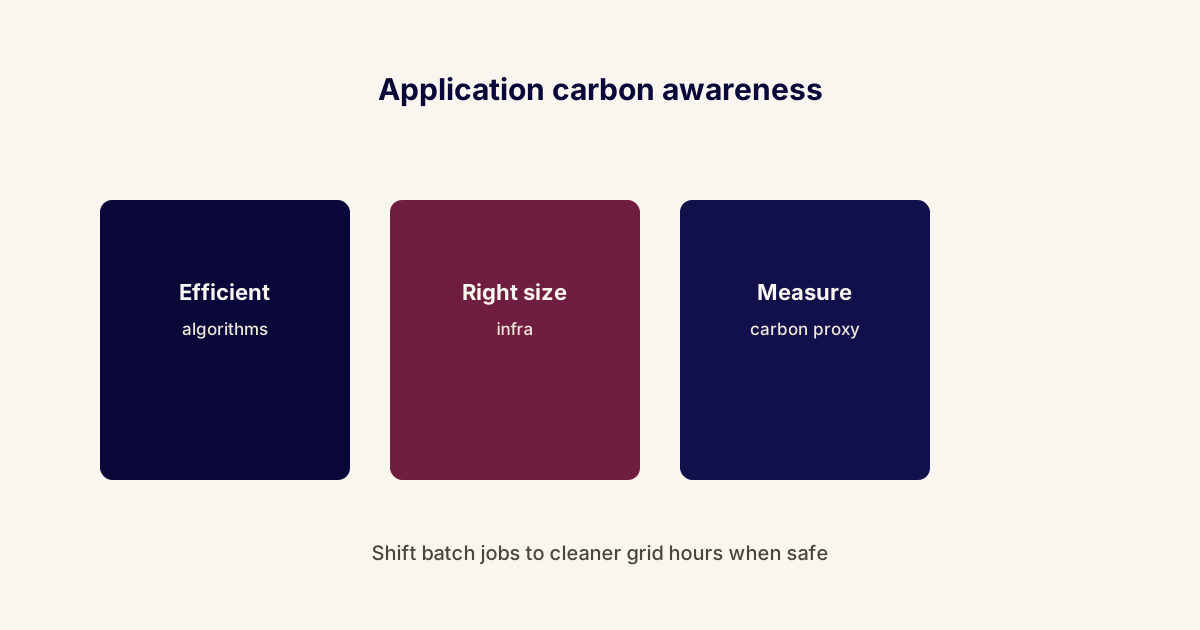
Batch and training jobs can shift to cleaner grid hours when deadlines allow. Carbon-aware scheduling tools now integrate with major cloud providers, enabling workloads to queue during periods of higher renewable energy availability. Policy engines should enforce safety windows so that shifting does not break SLAs or compliance cutoffs. The key is defining which workloads are time-flexible and which are not, then automating the distinction so teams do not have to remember manually.
Data pipelines deserve special scrutiny because they often run on schedules established years ago. Daily full refreshes may have been necessary once, but incremental processing frequently achieves the same analytical outcomes at a fraction of the compute cost. Auditing pipeline frequency, deduplicating transformation steps, and archiving stale datasets frees significant infrastructure capacity while simultaneously reducing cloud spend and the associated carbon footprint that accompanies always-on processing.
Autoscaling discipline prevents idle clusters from masquerading as resilience. Minimum instance counts should reflect real traffic patterns, not fears inherited from incidents three years ago. Right-sizing exercises that compare provisioned capacity against actual utilization often reveal startling overprovisioning. Cloud providers offer recommendation engines, but teams should validate suggestions against their own peak and trough patterns before committing to changes that might affect availability during genuine demand spikes.
Microservices architectures can inadvertently multiply energy consumption through excessive inter-service communication, redundant serialization, and duplicated data stores. Before splitting a monolith, teams should weigh the operational overhead against the organizational benefits. Where services already exist, consolidating chatty interfaces into coarser APIs or adopting event-driven communication patterns reduces network hops. Fewer round trips mean less CPU time spent marshalling data and less energy dissipated across load balancers and service meshes.
Frontend engineering matters more than many backend teams acknowledge. Image optimization, lazy loading, and reduced client-side JavaScript cut device energy consumption and data transfer costs significantly. Mobile users on constrained devices feel the difference immediately through faster load times and longer battery life. Progressive enhancement strategies that serve lightweight experiences by default, upgrading only when the client demonstrates capability, align performance goals with sustainability goals in a single design decision.
Caching strategies should be revisited with an efficiency lens. A cache that stores everything but evicts too aggressively wastes write cycles without delivering read benefits. Conversely, an overly generous time-to-live can serve stale data that triggers downstream recomputation. Effective caching requires understanding actual access patterns and tuning eviction policies accordingly. When done well, caching eliminates redundant computation at every layer of the stack and reduces the total energy cost of serving each request.
Continuous integration and delivery pipelines represent a hidden energy cost that scales with team size. Running full test suites on every commit, building artifacts that are never deployed, and maintaining overly broad integration environments all contribute to unnecessary compute consumption. Selective test execution based on change impact, ephemeral build environments, and artifact caching across pipeline runs can reduce CI energy usage by half or more without sacrificing confidence in release quality.
Cloud region selection is an underused lever for carbon reduction. Not all availability zones carry the same energy mix, and placing latency-tolerant workloads in regions powered by higher proportions of renewable energy can lower overall emissions considerably. Major cloud providers now publish sustainability data by region. Teams that incorporate this information into their deployment strategies make greener choices without sacrificing the reliability guarantees their customers expect from globally distributed services.

Measurement frameworks turn intuition into action. Proxy metrics like watt-hours per transaction, carbon intensity per deployment, and energy cost per active user provide tangible benchmarks that engineering teams can track sprint over sprint. The Green Software Foundation offers open tools and standards that organizations can adopt incrementally. Starting with a single application and expanding measurement coverage over time avoids the paralysis that comes from demanding comprehensive observability before taking any first step.
Finance and sustainability teams should see engineering KPIs they recognize: cost per transaction, infrastructure utilization ratios, and trend lines after efficiency sprints. Translation beats purity when building cross-functional support. When engineers present energy savings in terms of dollars reclaimed and capacity freed, budget holders pay attention. Aligning green metrics with financial reporting cycles ensures that sustainability progress appears in quarterly reviews rather than languishing in engineering dashboards that only developers read.
Vendor selection can include efficiency claims, but those claims require verification through benchmarks on your actual workloads. Marketing watts are not engineering watts. Request transparent methodology behind published sustainability figures and run comparative tests using representative data volumes and traffic patterns. Vendors that welcome scrutiny tend to deliver genuine efficiency, while those that deflect with glossy reports often hide inefficiencies behind favorable measurement conditions and carefully selected scenarios.
API design influences downstream energy consumption in ways that outlast any single release. Overfetching through bloated response payloads, missing pagination, and synchronous calls where asynchronous patterns would suffice all force clients and servers to perform unnecessary work. Thoughtful API contracts that return only what consumers need, support partial responses, and leverage compression reduce cumulative compute across every integration partner consuming the service over its operational lifetime.
Open source and shared libraries should be maintained to avoid abandoned dependencies that force oversized runtimes and unnecessary memory allocation. Dependency hygiene is green hygiene. Auditing dependency trees for unused packages, pinning versions to avoid unexpected bloat from upstream changes, and replacing heavyweight libraries with purpose-built alternatives keeps application footprints lean. Smaller containers start faster, consume fewer resources at rest, and require less network bandwidth during deployment rollouts across distributed environments.
Building a culture of efficiency requires visible leadership commitment and consistent reinforcement. Designating green engineering champions within each team, incorporating efficiency metrics into sprint retrospectives, and recognizing contributions through internal forums all normalize the practice. When sustainability becomes part of how teams define quality rather than an external mandate imposed by compliance, engineers internalize efficiency as a professional standard rather than an additional burden layered onto already crowded sprint backlogs.
Finally, celebrate incremental wins publicly and often. Engineers adopt efficient habits when leaders notice kilowatt-hours saved and dollars reclaimed, not only abstract environmental talking points. Share before-and-after metrics in team channels, present efficiency case studies at engineering all-hands meetings, and connect individual contributions to organizational sustainability targets. Green software engineering is not a destination with a finish line. It is a continuous practice that improves systems, budgets, and environmental outcomes simultaneously.